
By Opeyemi Adelakun
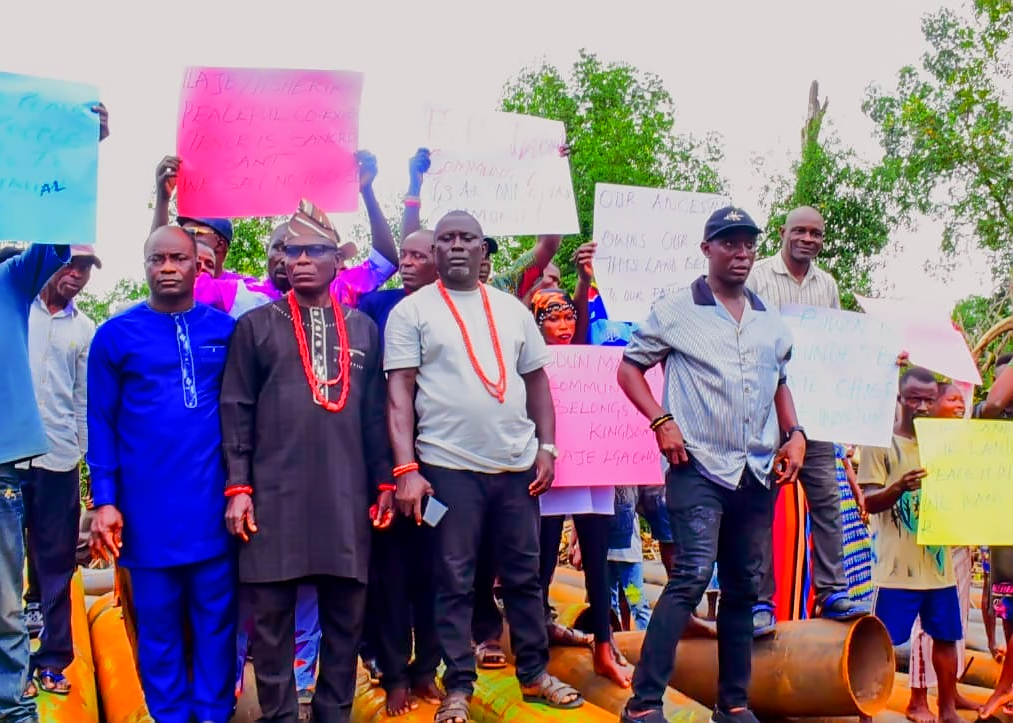
Residents of Odun Ebiwonjumi Community in Ilaje Local Government Area of Ondo State have protested what they described as an alleged attempt by some Itsekiri people to lay claim to their ancestral community.
The residents staged a peaceful protest on Thursday, carrying placards and calling on the Ondo and Delta State governments, traditional rulers and other relevant authorities to intervene in the dispute and prevent it from degenerating into violence.
The protest followed reported moves by the Ondo State Oil Producing Areas Development Commission to construct a concrete jetty in the community, which the residents said had heightened tensions over ownership and territorial claims.
Speaking on behalf of the community, one of its indigenes, Busayo Ebiniyi, said the Ilaje and Itsekiri had maintained longstanding relationships through trade, friendship and intermarriage despite the current disagreement.
He said the community was an ancestral settlement inherited from their forefathers and maintained that its residents recognised the Ondo State Government as the authority responsible for the area.
Ebiniyi argued that the dispute extended beyond Odun Ebiwonjumi, alleging that several other coastal settlements were also being affected by the disagreement.
He identified the communities as Odun Makin, Ilu Titun, Odun Odunjo, Odun Maha, Eke Nla, Eke Kekere, Ubajakere, Eke Itiola, Odun Okoro, Odun Yonren, Odun Beku, Odun Ogungbeje, Odun Oyinbo, Odun Oriretan, Ubale Kekere, Ubale Nla, Ikuyinminu and Odun Igo.
According to him, the affected settlements had historically operated as separate Ilaje oil-producing communities.
He appealed to the governments of Ondo and Delta states to initiate discussions involving elders and traditional institutions from both sides.
“We want to plead with the governments of Ondo and Delta states to go all out for government-to-government agreements and assemble elders of both Ilaje and Itsekiri communities so that we will be able to dialogue on the essence of peace rather than war,” he said.
Ebiniyi stressed that the community preferred dialogue but would not accept what he described as intimidation or attempts to take over its ancestral heritage.
He also appealed to the Federal Government and traditional rulers to intervene, insisting that Odun Ebiwonjumi had historically been associated with Ugbo Kingdom in Ilaje Local Government Area.
Another community leader, Olumide Ebiwonjumi, said the name of the community was derived from the ancestral name of its forefathers.
He maintained that the settlement was located in Ondo State and fell under Ilaje Local Government Area and Ugbo Kingdom, rather than Delta State.
Ebiwonjumi further cited the community’s previous participation in oil-producing community associations, including the Ultimate Oil Producing Community Association and the Ilaje Eight United Oil Producing Communities Association, before the implementation of the Petroleum Industry Act.
He said the presence of government projects and political structures administered by Ondo State also supported the community’s position on its affiliation.
The Baale of Odun Ebiwonjumi, Chief Orimisan Ebiwonjumi, also backed the residents’ position, saying successive Ondo State administrations had executed projects in the community.
He appealed to the Ondo State Government to increase its presence in the area and provide basic infrastructure, including potable water, healthcare facilities, housing, solar electricity and a signpost identifying the community’s location.
Chief Ebiwonjumi alleged that residents of six Itsekiri communities had recently entered Odun Ebiwonjumi with arms and ammunition while laying claim to the settlement.
He further alleged that the renewed disagreement was connected to crude oil resources in the area.
The community leaders called for immediate intervention by the relevant authorities, warning that failure to resolve the dispute through dialogue could heighten tension and trigger an avoidable conflict in the coastal communities.
They reiterated their preference for a peaceful resolution but insisted that their ancestral land and identity must be protected.





Leave a Reply