
By Paul Joseph
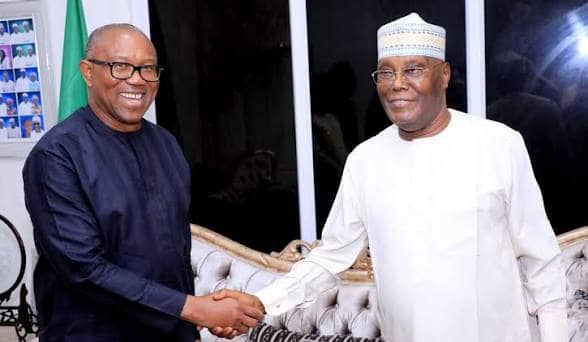
Former Vice President Atiku Abubakar and former Anambra State Governor Peter Obi have found fresh common ground in the growing opposition push associated with the G-100 movement, as both political figures intensified their attacks on President Bola Tinubu’s administration and called for a change of leadership ahead of the 2027 presidential election.
Although operating under different political platforms, Atiku and Obi have aligned their latest criticisms around similar concerns, including worsening economic hardship, insecurity and what they described as misplaced government priorities, further strengthening opposition voices seeking to challenge the ruling administration in 2027.
Atiku, the presidential candidate of the African Democratic Congress (ADC), and Obi, the Nigeria Democratic Congress (NDC) presidential candidate, separately urged Nigerians to reject the Tinubu administration in the next general election.
Their latest criticisms followed President Tinubu’s reported three-week holiday in Europe, which both opposition figures said came at a time when Nigerians were facing severe economic and security challenges.
Atiku said the major concern confronting the country was not political rivalry but the increasing difficulty millions of Nigerians faced in meeting their basic needs.
“Tinubu, the issue is not Atiku. The issue is that Nigerians can no longer afford to live,” the former vice president said.
He accused the administration of failing to sufficiently address the rising cost of food, transportation, education, healthcare and other basic necessities.
According to him, the true measure of economic policies should be their impact on ordinary Nigerians.
“Atiku has more important people to engage directly: the mother struggling to feed her children; the civil servant whose salary disappears into transportation; the farmer paying more to move produce to market; the student being pushed into debt simply to remain in school,” he said.
Atiku also questioned why the Federal Government was only recently promising measures aimed at reducing transportation costs and improving food production after Nigerians had endured years of rising prices.
“Why did Nigerians have to suffer for more than three years before your government discovered that economic growth must reach the dining table and the pocket?” he asked.
The ADC candidate further accused the government of inconsistency, arguing that proposals aimed at reducing living costs were criticised when advanced by opposition politicians but later repackaged under the administration’s Renewed Hope agenda.
“You cannot condemn cheaper living when Atiku proposes it and rename the same objective Renewed Hope when you promise it. That is not economic consistency. It is political convenience,” he said.
Atiku also criticised the high cost of petrol, arguing that Nigeria, despite being an oil-producing country, had continued to experience high fuel prices.
He compared Nigeria’s petrol prices with those in several other oil-producing countries and argued that expensive fuel had contributed significantly to rising transportation, food production and household costs.
According to him, the cost of petrol affects virtually every sector of the economy because transportation expenses are eventually transferred to consumers.
Atiku said his proposed Atiku Economic Recovery Plan would focus on reducing production and transportation costs through support for domestic refining and a transparent framework for supplying crude oil to local refineries.
“Reduce fuel costs and you reduce pressure on transportation. Reduce transportation costs and you reduce the cost of moving tomatoes, rice, yam, livestock and manufactured goods,” he said.
“Reduce those costs and more of a worker’s income remains available for food, rent, education and healthcare. That is structural relief.”
The former vice president also rejected claims that student loans were sufficient evidence that education had become affordable.
“Celebrating NELFUND as proof that education has become affordable under your government is like setting school fees on fire and then boasting that you lent students a bucket of water,” he said.
“A student loan is not a scholarship. It is a liability.”
Atiku called for greater transparency over government revenues and expenditure and questioned what Nigerians had gained from the removal of petrol subsidy.
He argued that citizens had accepted higher fuel and transportation costs but were still struggling with declining purchasing power.
Atiku also demanded explanations regarding revenue entries, government deductions and import duty exemptions.
He questioned the timing of promises of economic relief, arguing that Nigerians deserved long-term solutions rather than temporary interventions as the 2027 elections approached.
He also criticised Tinubu’s trip to Europe, saying the president’s absence came while many Nigerians continued to struggle with economic hardship.
“While you rest in Europe, millions of Nigerian parents lie awake at night, staring at empty cupboards and wondering how they will face their children in the morning. That is the reality on our streets,” he said.
Peter Obi, on his part, also intensified his criticism of the Tinubu administration, urging Nigerians to embrace a change of leadership in 2027.
Obi said the President’s latest vacation came at a period when Nigerians were confronting rising living costs, insecurity and difficulties accessing basic services.
“Yet, at this critical moment, the President has left the country for another holiday,” Obi said.
The former Anambra State governor also expressed concern about insecurity, including reports of the abduction of hundreds of people in Niger State.
Obi questioned reported government expenditure on presidential trips and travel, claiming that billions of naira had been spent on foreign travel since the Tinubu administration assumed office.
He argued that government spending priorities should be reviewed, particularly at a time when critical sectors such as healthcare required increased funding.
“A government that can spend tens of billions on presidential travel while critical sectors remain starved of funds, and Nigerians are asked to endure worsening hardship, must not be allowed to continue,” Obi said.
According to him, leadership requires setting priorities that directly address the needs and welfare of citizens.
“When citizens cannot feed their families, move safely, access healthcare, send their children to school, or sleep peacefully in their homes, the President should be more concerned about fixing the country than repeatedly leaving it,” he said.
Obi also called for greater promotion of domestic tourism, arguing that Nigeria’s leaders should demonstrate confidence in the country’s tourism potential.
He said Nigerian destinations across different regions could benefit from increased local tourism, creating opportunities for businesses and employment.
“I look forward to a Nigeria where our President can vacation in Kano, Katsina, Sokoto, Cross River State, Bauchi, Ebonyi, and many other destinations across our country,” he said.
According to Obi, investment in tourism could support hospitality, transportation, agriculture, entertainment, crafts and small businesses while also attracting investment and generating foreign exchange.
“We cannot continue to export our wealth and import our pleasures while our own enormous potential remains neglected,” Obi said.
Obi maintained that Nigerians deserved leadership that placed the country’s interests and citizens’ welfare at the centre of government policies.
The renewed convergence in the positions of Atiku and Obi comes as opposition political forces, including figures linked to the emerging G-100 coalition, continue efforts to build a broader front capable of mounting a formidable challenge against Tinubu and the ruling All Progressives Congress in the 2027 presidential election.
Their shared criticism of the administration signals an early effort to build common ground around economic hardship, insecurity, government spending and leadership priorities, issues expected to play prominent roles in the battle for Nigeria’s presidency.

Leave a Reply