
By George Omagbemi Sylvester
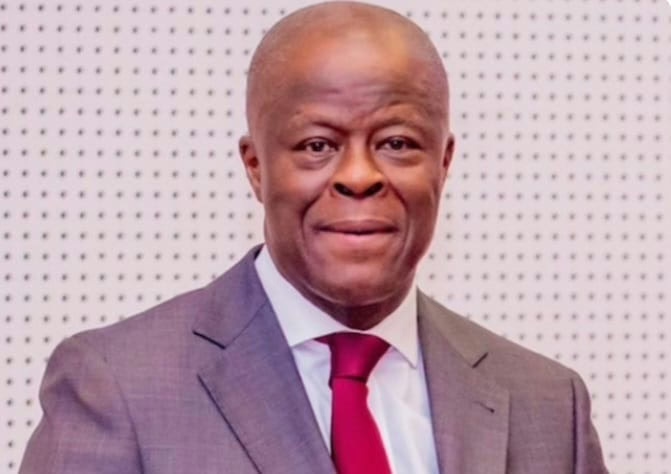
Abuja — The Senate Committee on Appropriations grilled Finance Minister and Coordinating Minister of the Economy, Wale Edun, on Wednesday over persistent oil revenue shortfalls and Nigeria’s rising N152 trillion public debt in the proposed 2026 Appropriation Bill.
Lawmakers questioned why actual oil revenue fell below projections (by 18 per cent in one year and 36.5 per cent in another) raising concerns over the credibility of federal budget assumptions. Solomon Adeola, chairman of the committee, described the shortfalls as structural, demanding clarity on the government’s plans to bridge the revenue gap while maintaining high security spending.
Edun acknowledged the shortfalls but defended the fiscal strategy, citing prioritisation of security and asserting that the economy is growing at about four per cent. “Our priority has been to stabilise the macroeconomic environment while ensuring national security. Growth has rebounded and reforms are yielding results,” he said.
The Chairman of the Nigeria Revenue Service, Zacch Adedeji, attributed the gaps to “unrealistic and overly optimistic budgeting,” noting that projections often exceed operational capacity and fail to account for oil market volatility. He added that tax reforms and revenue diversification are ongoing to reduce reliance on crude.
Oil production has been hampered by pipeline vandalism, theft, underinvestment and technical issues. Analysts note that past budgets assumed daily output benchmarks (often above 1.7 million barrels) that proved difficult to sustain. Dr. Muda Yusuf, CEO of the Centre for the Promotion of Private Enterprise, warned, “Persistent variance between projections and outcomes erodes investor confidence and complicates debt management.”
Development economist Professor Pat Utomi similarly cautioned, “An economy that anchors its fiscal survival on volatile commodity assumptions will struggle with planning discipline.”
The hearing highlighted structural challenges: ensuring accurate forecasting, improving revenue mobilisation and balancing security spending with debt sustainability. Edun emphasised reforms such as subsidy removal, exchange rate unification and enhanced non-oil revenue collection as measures to strengthen fiscal fundamentals.
While the economy grows, lawmakers stressed that growth must translate into sustainable revenue. The Senate’s scrutiny sends a clear message: optimistic projections must match operational realities to avoid repeating past fiscal shortfalls and mounting debt pressures.






Leave a Reply