
By Paul Joseph
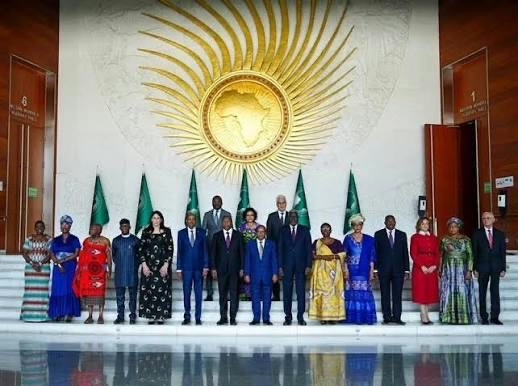
The African Union (AU) has chosen Burundi’s President Évariste Ndayishimiye to serve as its chair for 2026, as leaders at the bloc’s 39th summit emphasized the importance of water security, institutional reform, and peace—issues that have direct relevance for Nigeria.
Ndayishimiye succeeds Angola’s President João Lourenço in the rotating leadership role at the conclusion of the two-day Assembly of Heads of State and Government held at the AU headquarters in Addis Ababa, Ethiopia.
The summit was centered on the theme of ensuring sustainable water access and safe sanitation systems, aligning with Agenda 2063, the AU’s long-term development strategy.
Leaders highlighted the necessity of water access as a critical factor for development, public health, and security in a continent grappling with climate challenges, rapid urban growth, and conflict.
For Nigeria, the emphasis on water security is particularly significant, given the country’s ongoing issues with unequal access to clean water, environmental degradation, and conflicts between farmers and herders.
Abuja has consistently advocated for enhanced continental collaboration on infrastructure and climate resilience.
During the assembly, AU Commission Chair Mahmoud Ali Youssouf cautioned against “increasing geopolitical turbulence,” ongoing conflicts, and a resurgence of unconstitutional government changes in various African regions.
He urged member states to hasten political and economic integration while decreasing dependence on external funding.
“Institutional reform and financial independence are now essential as external financing diminishes,” he stated, calling for better domestic resource mobilization and quicker execution of key projects in industrialization, agriculture, energy, and infrastructure.
In his opening remarks as outgoing chair, Lourenço emphasized the need to “silence the guns,” referencing crises in Sudan, the Sahel, the eastern Democratic Republic of Congo, and Somalia.
The instability in the Sahel is particularly relevant to Nigeria, which continues to face insurgency and cross-border armed groups in its northern areas.
Ethiopian Prime Minister Abiy Ahmed urged African nations to move from merely responding to global events to actively influencing the international agenda, stressing the significance of technological independence and continental confidence as the AU approaches its 25th anniversary.
Additionally, UN Secretary-General António Guterres reiterated support for enhanced cooperation between the UN and AU and renewed calls for reforming the UN Security Council to ensure stronger African representation, a long-standing position advocated by Nigeria and other African nations.
The new AU leadership for 2026 will include Ghana as first vice-chair, Tanzania as second vice-chair, a North African country to be confirmed as third vice-chair, and Angola as rapporteur.
Discussions continue with a focus on water security and peace initiatives, as member states strive to align continental goals with national priorities



Leave a Reply