
By George Omagbemi Sylvester
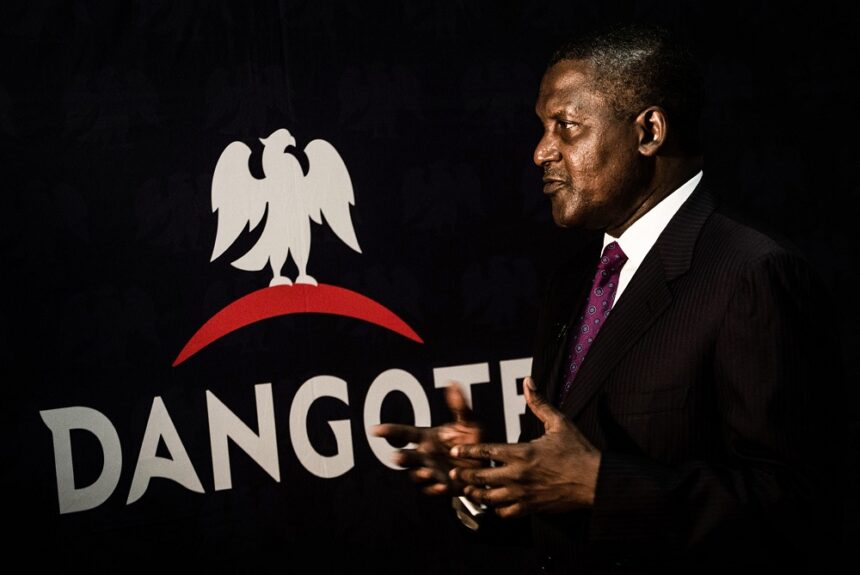
Africa’s richest man, Aliko Dangote, has projected that the naira could appreciate to ₦1,000 per dollar before the end of 2026, citing expanded domestic production and the growing impact of the Dangote Petroleum Refinery.
Dangote made the projection in February 2026 during a high-level economic engagement in Abuja focused on industrial policy and private-sector growth. He argued that Nigeria’s longstanding dependence on imported refined petroleum products has placed unsustainable pressure on foreign exchange reserves and weakened the local currency.
According to him, with the $20 billion refinery now operational and scaling output, Nigeria is positioned for a structural shift. Reduced fuel imports could significantly cut foreign exchange demand, strengthen reserves and support a recovery of the naira.
At the time of his remarks, the currency was trading above ₦1,300 per dollar at the official window. A move to ₦1,000/$ would represent roughly a 25 per cent appreciation from prevailing levels — one of the most significant currency reversals in Nigeria’s recent history.
Dangote’s optimism aligns with similar views expressed by investor Femi Otedola, who has argued that large-scale domestic refining and improved energy infrastructure could strengthen the naira by reducing import dependence. Both businessmen maintain that Nigeria must expand domestic production to achieve currency stability.
Economic analysts say the projection hinges on multiple factors. Full operational capacity at the refinery could sharply reduce petrol and diesel imports. In addition, exports of refined products to regional markets may generate fresh foreign exchange inflows, while improved energy supply could lower manufacturing costs and attract investment.
However, experts caution that currency stability extends beyond industrial output. Monetary tightening, fiscal discipline, inflation control and global oil prices remain critical determinants. The Central Bank of Nigeria continues to pursue measures aimed at stabilising inflation and rebuilding external reserves.
Political economist Pat Utomi has long argued that productive capacity is essential to economic sovereignty, noting that nations heavily dependent on imports struggle to defend their currencies. Still, he emphasises that transparency and institutional credibility are equally important for sustaining investor confidence.
Development economist Dani Rodrik has similarly maintained that industrial policy must be anchored in coherent macroeconomic management, warning that infrastructure gains alone cannot guarantee currency appreciation without sound fiscal governance.
Analysts note that for the naira to reach ₦1,000/$, Nigeria would likely need sustained export diversification, stronger non-oil revenues, improved agricultural productivity and stable capital inflows. The economy remains exposed to external shocks, including volatility in global oil prices and tightening international financial conditions.
Nonetheless, the refinery represents one of the most significant industrial investments in Nigeria’s history and could materially alter trade balances if it consistently operates at high capacity.
The naira’s performance affects everyday life, influencing the cost of food, fuel, school fees and medical supplies. A stronger currency could ease inflationary pressures and reduce the burden of servicing foreign-denominated debt, while failure to stabilise it may dampen investor confidence.
Whether the naira reaches ₦1,000 per dollar by 2026 remains uncertain. Market forces and global conditions will play decisive roles. For now, Dangote’s projection has injected renewed debate into Nigeria’s economic reform agenda, placing industrial expansion at the centre of the country’s currency outlook.




Leave a Reply