
By George Omagbemi Sylvester
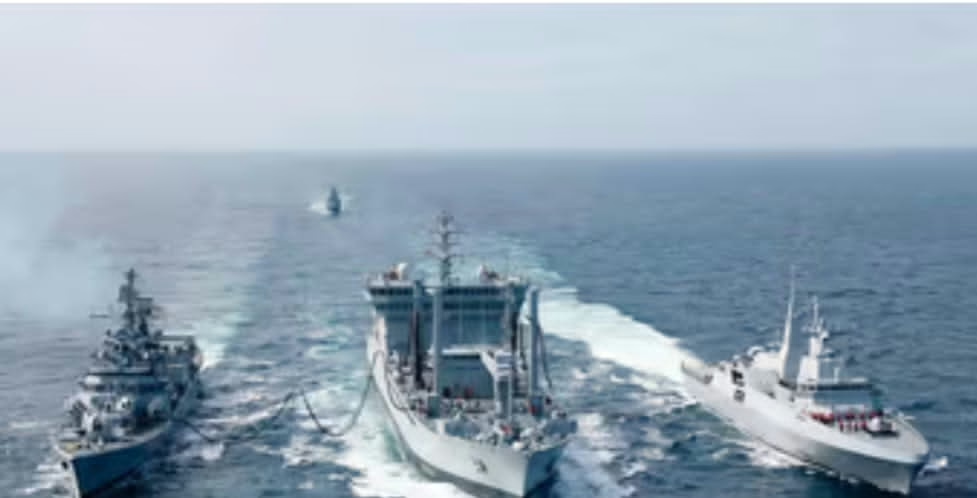
Across Africa’s vast coastline (stretching from the Mediterranean to the Atlantic and the Indian Ocean) maritime security remains one of the continent’s most neglected defence priorities. While a handful of countries have invested in modern patrol vessels and surveillance systems, many others still operate skeletal naval forces with limited reach. The result is a widening gap between maritime threats and the capacity to confront them.
Recent global military strength assessments for 2026 show that several African states maintain extremely small or non-existent naval fleets. In some cases, the weakness is structural, rooted in geography or prolonged instability. In others, it reflects limited defence budgets and competing priorities on land.
Based on fleet size, operational capability and defence resources, the following countries rank among Africa’s weakest naval powers in 2026:
Somalia, Liberia, Sierra Leone, Benin, Madagascar, Gabon, Mauritania and Senegal (all coastal states with small or lightly equipped patrol forces) alongside Burkina Faso and the Central African Republic, both landlocked and without navies.
In many of these countries, the weakness is not the result of a single event but decades of economic hardship, internal conflict or institutional fragility. Somalia, for example, is still rebuilding state structures after years of civil war, while Liberia and Sierra Leone only recently emerged from prolonged periods of instability that drained defence resources and maritime infrastructure.
Where this matters most is along some of the world’s busiest and most vulnerable sea routes. The Gulf of Guinea, the Horn of Africa, and parts of the western Indian Ocean have been persistent hotspots for piracy, illegal fishing, and arms trafficking. Yet the countries most exposed to these threats often possess the weakest fleets.
The contrast becomes stark when compared with Africa’s leading naval powers. States such as Nigeria, Egypt, Algeria, Morocco and South Africa operate far larger fleets, including frigates, submarines and offshore patrol vessels capable of sustained operations. This imbalance leaves smaller coastal nations dependent on regional or international support to police their waters.
Naval weakness has consequences beyond the military sphere. More than 90 percent of global trade moves by sea and most African economies depend heavily on maritime imports and exports. Weak maritime enforcement enables piracy, oil theft, illegal migration and unregulated fishing activities that cost African economies billions of dollars each year.
British naval historian Geoffrey Till once observed that sea power is fundamentally about protecting trade, enforcing law and projecting influence. His insight underscores why inadequate navies create vulnerabilities far beyond the defence sector.
Similarly, maritime security scholar Christian Bueger has argued that insecurity at sea is largely a governance problem, where limited state capacity allows criminal networks to flourish.
Responsibility for naval modernization lies primarily with national governments, but regional and international actors have increasingly stepped in. Organisations such as the Economic Community of West African States and the African Union have promoted joint patrols and information-sharing frameworks. External partners (including the United States, the European Union and China) have also provided training, funding and equipment.
Still, naval development remains expensive and politically less visible than land-based security operations. Many governments continue to prioritise internal stability over maritime capability.
As American naval strategist Alfred Thayer Mahan famously warned, control of the seas shapes national power and economic destiny. For many African states in 2026, those seas remain only lightly guarded; a costly blind spot in an era when maritime security is inseparable from national survival.






Leave a Reply