
By George Omagbemi Sylvester
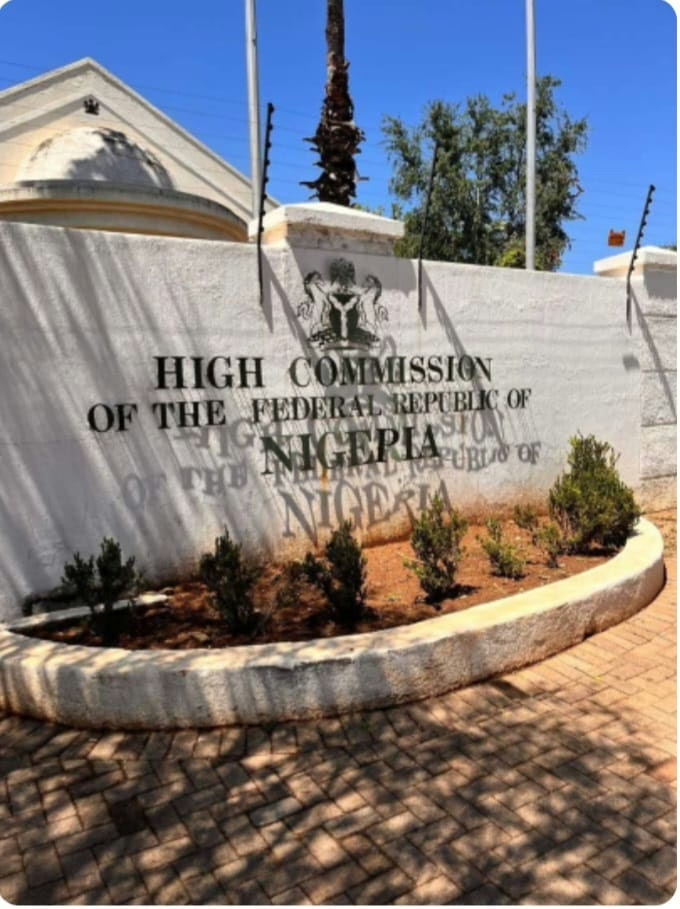
It began as a brief outage and a sudden darkness casting its shadow not over ordinary homes or businesses, but over the diplomatic mission of one of Africa’s most populous nations in the heart of South Africa’s administrative capital. Electricity at the Nigerian High Commission in Pretoria was disconnected by the City of Tshwane authorities because of unpaid municipal utility bills, a dramatic action publicly confirmed by the city’s Executive Mayor, Dr. Nasiphi Moya, in a message shared on social media. The cut-off and its subsequent resolution (as power was later restored after the outstanding debt was settled) quickly ignited debates on diplomatic conduct, institutional accountability, and the state of governance within Nigeria’s foreign service.
To many observers, this was more than a local administrative enforcement; it was a symbolic moment with profound implications. In an era where soft power and diplomatic reputation matter as much as policy positions and economic strength, a foreign mission losing electricity over unpaid bills is not easily brushed aside as an administrative oversight. It is a moment that invites critical reflection about how nations honor their obligations abroad, how diplomatic missions are funded and managed, and what it means when the lights go out on international representation.
When Municipal Enforcement Meets International Diplomacy.
At first glance, the City of Tshwane’s action appears to fall squarely within the realm of routine municipal governance. Under the banner of the TshwaneYaTima initiative (a campaign to enforce credit control and recover unpaid utility charges from consumers, institutions, and government entities) the city’s leadership insisted that no entity, regardless of status, is above the law when it comes to settling accounts for services rendered. “We’ve disconnected electricity at the High Commission of the Federal Republic of Nigeria. They owe the city for utility services,” Dr. Moya wrote.
This framing reflects an insistence that civic responsibility and legal obligation apply universally, a principle that governs modern municipal administration. The City of Tshwane’s stance is supported by practices in many jurisdictions where local governments, even when dealing with foreign missions and embassies, expect payment for utilities consumed, unless specific exemptions are negotiated and extended through diplomatic channels.
Yet in the world of international protocol, embassies and high commissions occupy a special place. They represent sovereign nations and are extensions of national identity on foreign soil. Traditional diplomatic norms underline respect for host-country laws while also invoking certain privileges and immunities to facilitate effective representation. The Vienna Convention on Diplomatic Relations, for instance, outlines obligations and protections for diplomatic missions, but it does not grant carte blanche exemption from all local financial responsibilities. The prevailing interpretation among international law scholars is that payment for ordinary municipal services such as electricity and water is expected unless explicitly waived. The debate in Pretoria thus sits at the intersection of legal obligation and diplomatic courtesy.
A Pattern, Not an Isolated Incident.
The episode in Pretoria was striking but not without precedent. Reports from recent years show that Nigerian diplomatic properties in South Africa have faced similar utility challenges, including power disconnections at the consulate in Johannesburg over overdue accounts. These recurring disruptions point to a pattern that goes beyond occasional oversight; they suggest systemic issues in how foreign missions are funded, managed and held accountable.
Some analysts argue that these instances reflect broader budgetary constraints within Nigeria’s foreign service apparatus, exacerbated by delays in the enactment of national budgets and irregular funding releases, factors that can cripple operational efficiency in missions abroad. Official responses have indicated that funding shortfalls and bureaucratic delays are partly responsible for the inability to settle utility accounts on time, underscoring the ripple effect of fiscal governance challenges on diplomatic functions.
In a world where diplomatic missions are expected to uphold the dignity and stature of their nations, such financial missteps risk undermining the very purpose of international representation. When embassies or high commissions are embroiled in unpaid bills and service disruptions, the optics can damage a country’s reputation and credibility on the global stage. It raises questions about administrative capacity and the prioritization of diplomatic engagement in national governance structures.
Diplomacy in Darkness: The Broader Implications
The image of a diplomat’s office plunged into darkness is chilling not just literally, but symbolically. Diplomatic missions are the frontlines of a nation’s international engagement — places where negotiations, cultural exchange, foreign investment discussions, and consular services take place. To disrupt the physical infrastructure of such a mission is to impede its capacity to function effectively and to project national interests with dignity.
Prominent international relations scholar Professor Aisha Bello has argued that “the operational integrity of diplomatic missions is a reflection of national strength and coherence. When a nation’s representation abroad is impaired by administrative lapses, it not only affects service delivery but communicates vulnerability to the world.” Her assessment highlights the intangible costs that accompany such incidents and costs that extend beyond electricity bills and municipal enforcement.
Additionally, the optics of a high commission cut off from basic utilities can fuel narratives of dysfunction and decline that adversaries and critics may exploit. In diplomatic engagements, perception often shapes influence. A nation that cannot keep the lights on in its foreign missions may struggle to persuade partners, attract strategic investment, or defend its interests with moral authority.
A Call for Institutional Accountability.
The Pretoria outage is a clarion call for robust institutional reforms in the management of Nigeria’s diplomatic machinery. Diplomatic missions must be afforded the resources, oversight, and strategic planning necessary to ensure that basic operational needs are met consistently and transparently. This includes predictable funding mechanisms, timely disbursement of allowances for embassies and high commissions and strengthened administrative systems that prevent overdue liabilities from accumulating.
Veteran diplomacy expert Dr. Samuel Okafor has emphasized that “diplomatic effectiveness requires more than elite envoys; it demands operational excellence in the everyday functioning of missions. Neglecting routine obligations like utilities erodes trust and diminishes the moral standing of a nation in the eyes of host countries and international partners.”
Dr. Okafor’s words underscore a vital point: diplomacy is as much about relationship management and operational discipline as it is about grand summits and public pronouncements. To lead with integrity abroad, a nation must first demonstrate competence and reliability in the fundamental aspects of representation.
Beyond Bills: A Mirror to National Governance.
The Pretoria incident also holds up a mirror to broader governance challenges. At home and abroad, the seamless delivery of public services (electricity, water, sanitation, infrastructure) is a foundational expectation of responsible governance. When a nation’s own diplomatic mission struggles to meet basic financial obligations, it reflects deeper fissures that may be present in domestic public administration, budget execution and institutional accountability.
The irony is stark: while citizens wrestle with inconsistent electricity supply at home, their nation’s diplomatic property abroad also faces power cutoffs. This juxtaposition invites reflection on how priorities are set, how resources are allocated, and how governance frameworks support or hinder national objectives in a globally interconnected world.
Final Take: Rekindling Light and Purpose.
When the lights came back on at the Nigerian High Commission in Pretoria after the settlement of outstanding utility bills, it ended the immediate crisis. But the episode reverberates beyond the momentary dark. It demands introspection, institutional reform and a renewed commitment to the dignity of international representation.
Diplomacy is not luxurious ornamentation; it is a vital instrument of national power, rooted in credibility, consistency and operational excellence. How a nation manages the basic responsibilities of its foreign missions says much about its governance ethos and priorities. It is time to ensure that when the world watches Nigeria’s flag flying abroad, it is supported not by shadowed rooms and unpaid bills, but by the bright, unwavering glow of disciplined stewardship and national pride.





Leave a Reply