

By George Omagbemi Sylvester
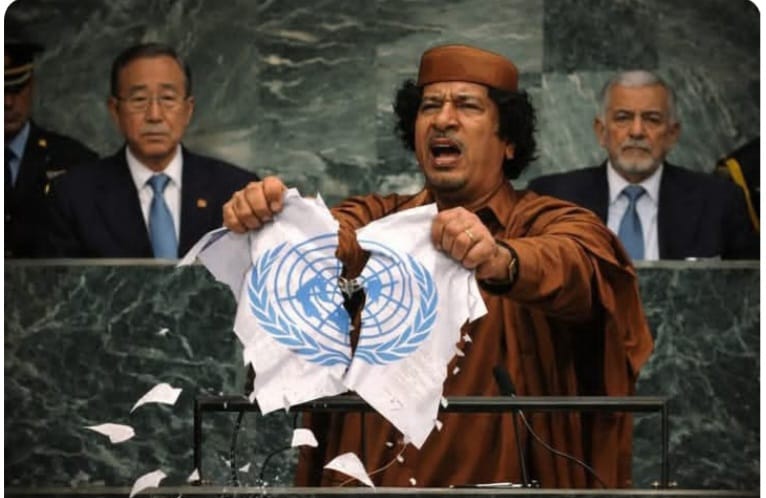
Muammar Gaddafi, the then‑leader of Libya and President of the African Union, delivered one of the most extraordinary speeches in the history of the United Nations General Assembly on 23 September 2009 at the UN headquarters in New York City. Originally allotted just 15 minutes, Gaddafi’s address stretched to nearly 100 minutes and became infamous for its confrontational tone toward the UN Security Council’s structure and global power imbalances.
Gaddafi’s central message was a fierce critique of the permanent members of the Security Council (the United States, Britain, France, Russia and China) and their veto powers. He questioned whether an institution founded on principles of equality and peace could truly function when a handful of powerful states could unilaterally block action on urgent global crises. “The veto is against the charter, we do not accept it and we do not acknowledge it. Veto power should be annulled,” he declared in his address.
He held up a simple paperback copy of the UN Charter, reading sections aloud in front of diplomats, kings, presidents and delegates, and at times even tossing it aside to dramatize his point that the rules of international law mean little when selectively applied.
What Gaddafi Argued: Inequality at the Heart of the UN
Gaddafi’s speech was not merely rhetorical theatre; it was an unfiltered expression of frustration shared by many countries of the Global South, who view the UN’s highest decision‑making body as outdated and unrepresentative of global realities. According to his speech, the Security Council “did not provide us with security but with terror and sanctions,” a stinging indictment of how powerful nations have wielded war, intervention and punitive measures with little accountability.
Scholars and analysts have since weighed in on the structural issues Gaddafi raised, even if they disagree with his broader worldview. Professor Andrzej Polus, a political economist at the University of Wrocław, notes that the Security Council’s composition “reflects the situation of 1945 when it was created,” a geopolitical reality vastly different from the world of today. He explains that although many African countries gained independence in the 1960s, “Africa remains excluded from real influence within this structure”; a point that echoes elements of Gaddafi’s critique, even if not his rhetoric.
The Veto Debate: Scholarly Voices on a Flawed Mechanism
The heart of the controversy lies in the veto power, a unique privilege that allows any of the five permanent members to block substantive decisions, even if all other members vote in favour. Critics argue this mechanism creates a persistent “veto‑dilemma,” where the Council’s ability to act decisively on humanitarian crises (genocide, war crimes or severe conflict) is often stymied by narrow national interests. A legal study from the University of Cape Town highlights that even reforming the veto itself can be blocked by the veto, revealing a deep structural paradox that undermines effectiveness and human rights protection.
Scholars like those cited in a comprehensive review of Security Council dynamics spanning 1990–2022 conclude that “veto usage consistently delays or weakens responses”, especially in crisis‑related resolutions, exposing the tension between great power interests and collective security. Such research underscores that while the veto system was originally conceived as a safeguard for peace among major powers, in practice it has often paralyzed action and diminished the Council’s legitimacy.
Another academic analysis argues that the veto has “evolved from a collective safeguard into a political instrument” that obstructs accountability and inhibits effective humanitarian responses. The author suggests alternative mechanisms like a “Veto Accountability Index” and measures to restrict veto use in atrocity contexts to mitigate these effects; reforms that would preserve the broader structure while addressing some of its most damaging consequences.
Critics and Reformers: Beyond Gaddafi’s Rhetoric
Although scholars may agree on the need to reform the Security Council’s structure, they caution that simply abolishing the veto is no silver bullet. Achieving meaningful reform requires collective diplomatic consensus among the very powers reluctant to yield influence; a daunting political challenge. As one expert study notes, even legal mechanisms to regulate veto power are tangled in procedural hurdles that can themselves be blocked under current rules.
In the United Nations General Assembly debates of recent years, multiple member states have urged limiting or suspending veto use, especially in cases of genocide, war crimes, and crimes against humanity. Delegates emphasise that “the veto should not serve as a weapon of hatred and war” and that without structural change, the Council’s legitimacy and broader reputation will continue to erode amidst ongoing global conflicts.
Why It Still Matters: The Legacy of 2009
Gaddafi’s speech was polarising, with some contemporary commentators dismissing it as rambling or opportunistic. Yet the core elements of his critique (the inequality embedded in global decision‑making, the power disparities between rich and poor nations, and the need for a more representative international order) remain central to scholarly and diplomatic dialogues today.
Professor Polus’s reminder that the current system was designed in a geopolitical context that no longer exists captures the essence of this debate. Many countries, particularly in Africa, Asia, and Latin America, continue to advocate for expanded representation or fundamental restructuring, whether through increasing the number of permanent seats or creating new models of weighted voting that reflect 21st‑century power distributions.
Critics of the veto, like institutional reform advocates and academic analysts, caution that while Gaddafi’s dramatic performance was controversial, his underlying question (Can international peace and equality be achieved if a few states can single‑handedly block action?) remains a central challenge confronting the UN.
Truth, Power and the Future of Global Governance
More than a decade later, the riffs between rhetoric and reform persist. Gaddafi’s 2009 address remains a symbolic flashpoint; not because it reshaped the United Nations overnight, but because it brought into stark relief the tensions between the ideals enshrined in the UN Charter and the realpolitik of international power.
For many scholars and diplomats today, the road to a more equitable United Nations is neither straightforward nor simple. But the debate over veto power (whether it should be retained, limited, or reformed) continues to shape discussions on international justice, collective security, and the legitimacy of global governance in an increasingly interconnected world.




Leave a Reply