

By Paul Joseph
Canada’s Supreme Court has cleared the way for Quebec to enforce its controversial secularism law restricting certain public employees from wearing religious symbols while on duty, following a landmark ruling affirming the province’s right to invoke a constitutional provision to protect the legislation.
The ruling, delivered on Friday, November 27, 2026, upheld Quebec’s use of the notwithstanding clause to shield its 2019 secularism law, known as Bill 21, from certain constitutional challenges.
The legislation prohibits specified public employees, including public schoolteachers and police officers, from wearing religious symbols while performing their official duties.
However, the Supreme Court’s decision did not amount to an unconditional victory for Quebec. The court clarified that legislation passed under the notwithstanding clause could still be declared inconsistent with constitutional rights, leaving room for future legal challenges.
The court also stopped short of determining whether Bill 21 itself violated the Canadian Constitution.
The notwithstanding clause allows federal and provincial governments to temporarily override certain rights protected under Canada’s Charter of Rights and Freedoms. The provision remains effective for five years before requiring renewal.
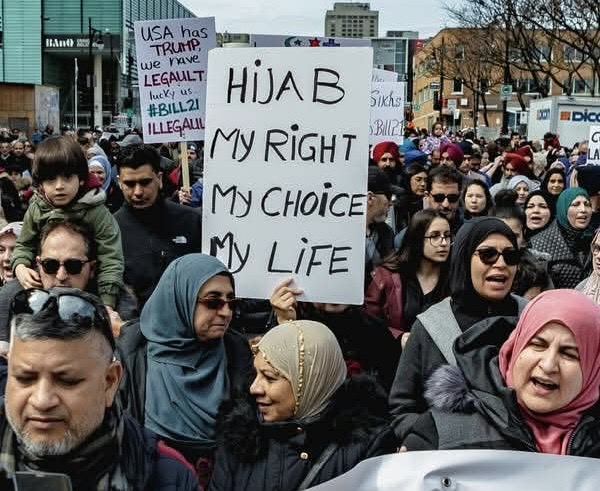
Quebec’s reliance on the clause has generated widespread criticism from religious and linguistic minority groups, particularly Muslim and Sikh organisations, which argue that the law discriminates against people whose religious beliefs require them to wear specific symbols or clothing.
The English Montreal School Board and other organisations challenged the legislation, arguing that it infringed on constitutional guarantees of religious freedom, equality and freedom of expression.
Reacting to the judgment, Bloc Québécois leader Yves-François Blanchet described the decision as a victory for Quebec, saying the country’s highest court had affirmed the province’s right to use the constitutional provision to protect its identity.
However, Joe Ortona, chairman of the English Montreal School Board and a leading plaintiff in the case, expressed disappointment with the outcome.
Stephen Brown, chief executive of the National Council of Canadian Muslims, also raised concerns about the increasing use of the notwithstanding clause, arguing that a provision originally intended as a last resort was becoming an ordinary instrument of government.
Quebec’s nationalist government has defended Bill 21 as necessary to preserve the neutrality of public institutions and maintain the separation of religion and the state.
The controversy has also taken on political significance following the return of the separatist Parti Québécois to power in October, after 12 years. The party has promised to organise a referendum on Quebec’s independence after 2029.
The province’s new premier, Paul St-Pierre Plamondon, has also indicated plans to extend secularism restrictions, including a proposed prohibition on religious clothing and symbols for pupils in public primary schools.
Beyond Quebec, the Supreme Court’s decision carries implications for other Canadian provinces that have increasingly invoked the notwithstanding clause to protect controversial legislation from constitutional challenges.
Alberta and Saskatchewan have used the provision to defend laws restricting children under 16 from changing their names or pronouns at school without parental consent. Ontario has also relied on it to protect legislation concerning election advertising restrictions and the termination of an education workers’ strike.
The judgment has therefore renewed debate over the balance between provincial legislative authority and individual constitutional rights in Canada, particularly as governments increasingly turn to the notwithstanding clause to advance their policies.






Leave a Reply