
By George Omagbemi Sylvester
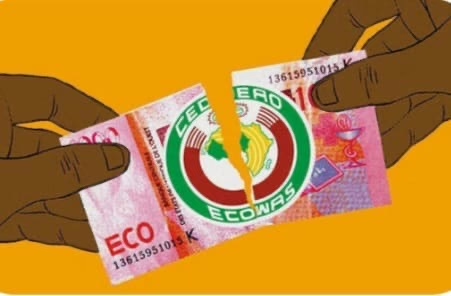
West Africa’s long-delayed ambition to introduce a single regional currency took centre stage in early February 2026, as Liberia hosted a high-level meeting of the West African Monetary Zone (WAMZ) Technical Committee in Monrovia. The gathering, held from February 4 to 13, brought together central bank governors, finance ministry officials, and senior regional policymakers to review progress toward the proposed ECOWAS single currency, the “Eco,” now targeted for launch in 2027.
The meetings were convened jointly by the Economic Community of West African States (ECOWAS) and its key monetary institutions, including the West African Monetary Agency (WAMA), the West African Monetary Institute (WAMI), and the West African Institute for Financial and Economic Management (WAIFEM).
Officials described the Monrovia sessions as a decisive moment for the region’s economic integration agenda. Liberia’s Central Bank Executive Governor, Henry F. Saamoi, told delegates the gathering represented a “critical step” toward deeper monetary cooperation across West Africa.
At the heart of the discussions was the revised 2027 deadline for launching the Eco—an ambitious target that has already been postponed multiple times over the past two decades due to macroeconomic instability, political disagreements, and the failure of member states to meet convergence criteria.
The Monrovia meetings featured a cross-section of regional decision-makers and institutions, including:
- Henry F. Saamoi, Executive Governor, Central Bank of Liberia
- Boima S. Kamara, Director-General, West African Monetary Agency (WAMA)
- Dr. Abdulsalam Sikiru Abidemi, Director-General, West African Monetary Institute (WAMI)
- Dr. Baba Yusuf Musa, Director-General, WAIFEM
- Senior officials from finance ministries and central banks of WAMZ member states—Nigeria, Ghana, Liberia, Sierra Leone, The Gambia, and Guinea.
The core objective of the Monrovia meetings was to assess macroeconomic performance, evaluate progress toward convergence benchmarks, and align policy frameworks ahead of the 2027 currency target.
Boima Kamara, Director-General of WAMA, acknowledged the challenges but insisted the Eco remained achievable. “The launch day seems steep but not insurmountable,” he told delegates, stressing that decisive policy action was needed across member states.
The Eco project is intended to eliminate currency-conversion costs, boost intra-regional trade, and deepen economic integration across ECOWAS. The bloc currently operates a fragmented monetary system, with eight countries using the CFA franc while others maintain separate national currencies.
Despite official optimism, the road to 2027 remains uncertain. Several member states continue to struggle with key convergence criteria, including inflation limits, fiscal deficits, and foreign-reserve thresholds.
Currency instability, especially in major economies such as Nigeria, has become a central concern. The success of any monetary union depends heavily on macroeconomic stability in its largest member states, and persistent volatility in the naira has raised doubts among economists about the feasibility of a unified currency timeline.
Renowned economist Robert Mundell, widely regarded as the father of the theory of optimum currency areas, once warned that a successful monetary union requires “sufficient economic convergence and flexibility to absorb shocks.” His insight remains central to debates about the Eco, as West African economies differ widely in structure, fiscal discipline, and export dependence.
Similarly, former European Central Bank President Mario Draghi noted during the eurozone crisis that “a monetary union without fiscal coordination is inherently fragile,” a caution that resonates strongly in West Africa, where fiscal deficits and debt levels vary sharply across member states.
The Eco was initially scheduled for launch in 2003, then postponed to 2005, 2010, 2015, and later to 2020. The COVID-19 pandemic and persistent macroeconomic divergence forced ECOWAS leaders to adopt a new roadmap targeting 2027.
Even now, scepticism persists. Some regional officials have previously described the 2027 deadline as unrealistic unless member states undertake serious structural reforms and fiscal discipline.
The Monrovia meetings are expected to produce country-specific recommendations and policy adjustments to accelerate convergence.
Officials say the likely approach will be phased adoption—allowing countries that meet the criteria to join first, while others follow later.
That strategy reflects a pragmatic shift from earlier all-or-nothing timelines, but it also underscores a deeper reality: the Eco remains more a political aspiration than an economic inevitability.
As West Africa approaches the 2027 deadline, the success or failure of the single currency will depend less on declarations at technical meetings and more on the difficult domestic reforms each member state must undertake.
For now, the Monrovia gathering signals that the dream of a unified West African currency is still alive, but the clock is ticking, and the region’s economic contradictions remain unresolved.



Leave a Reply