
By George Omagbemi Sylvester
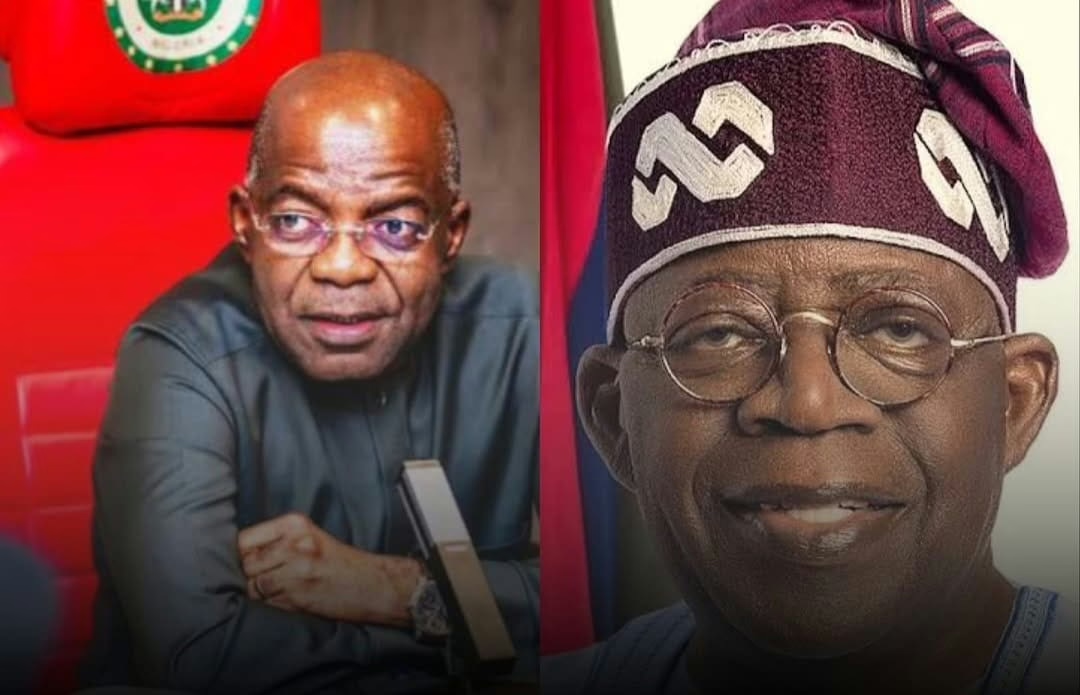
When Abia State Governor Alex Otti publicly defended President Bola Ahmed Tinubu’s newly enacted tax reform laws on February 13, 2026, he did more than just push back at critics, he threw the spotlight back on a fulcrum issue dividing Nigeria’s political and economic classes. Otti’s assertion that Nigerians attacking the tax policy “lack understanding” crystallises a broader fracture in public discourse over fiscal policy, governance and the future of the Nigerian economy.
The comments from Governor Otti came amid an intensifying national conversation over sweeping tax reforms signed into law in June 2025, designed to modernise Nigeria’s tax architecture and expand revenue mobilisation. These reforms (long in the making and championed by a Presidential Fiscal Policy and Tax Reforms Committee chaired by Prof. Taiwo Oyedele) mark the most far‑reaching overhaul of federal tax laws in decades. They include restructuring the Federal Inland Revenue Service into the National Revenue Service (NRS), establishing a Tax Appeal Tribunal and Ombudsman Office, and unifying revenue collection frameworks to improve transparency and efficiency.
Governor Otti’s praise for the new legislation resonated with elements of his own fiscal thinking. Drawing on economic positions he articulated nearly a decade ago, he argued that key principles now entrenched in the law reflect sound fiscal reasoning and long‑standing proposals to strengthen Nigeria’s economic foundations. “Almost 10 years ago, I wrote about the fiscal side of things,” Otti said. “When I read the new tax reform law, I saw many of those arguments reflected in it. I thank Prof. Oyedele. When people attack him, they don’t understand.”
Yet, while Otti’s intervention was meant to de‑escalate public criticism, it instead exposed how complex and emotionally charged the issue of taxation has become in Nigeria. Critics, both inside and outside government, argue that the reforms have not been adequately explained to citizens and that many fear the measures will aggravate hardship amid already high costs of living. One prominent voice of dissent, fiscal policy analyst Aborisade, warned that without transparency and clear communication on how tax revenues will be collected and returned to the people, “these reforms risk becoming deeply unpopular.” Critics also highlight that any tax increase implemented without demonstrable improvements in public services could fuel resentment and mistrust in governance.
That mistrust is not abstract. For years, Nigeria has struggled with weak tax compliance, low revenue‑to‑GDP ratios compared with other emerging economies, and public scepticism over how government revenues are utilised. Many Nigerians remember episodes where policy changes were not accompanied by visible improvements in infrastructure, healthcare or power delivery, reinforcing the belief among skeptics that new taxes equate to greater burden with little reward.
For supporters like Otti and others in government policy circles, the reforms represent a long‑overdue attempt to widen the tax net and reduce Nigeria’s chronic dependence on volatile oil revenues. Advocates argue that a modernised tax system can enhance domestic revenue mobilisation, reduce fiscal deficits, and create a more resilient economy. They point out that reforms provide exemptions and reliefs for low‑income earners and small businesses and are aimed at building a fairer, more transparent system for all stakeholders.
Still, bridging the gap between these competing narratives is challenging. Opposition voices contend that even well‑designed tax policy may fail if the state lacks the capacity to implement it equitably or if the public’s confidence in leadership remains weak. “Without accountability and clear benefits for their contributions, any tax reform risks becoming deeply unpopular,” Aborisade emphasised, warning that heavy taxation without trust can fracture the social contract.
The debate over Tinubu’s tax reform illustrates a deeper truth about contemporary Nigeria: that economic policy no longer exists in a vacuum but is deeply intertwined with public sentiment, political legitimacy, and social cohesion. As one respected economist put it, “Taxation is not just a fiscal tool, it is a trust‑building exercise between the state and its citizens.” When that trust is fragile, even technically sound reforms can be seen as punitive rather than constructive.
Analysts suggest that meaningful public engagement (including sustained information campaigns, transparent revenue utilisation reporting and constructive dialogue with civil society) is essential to soothe anxieties and build confidence in the new system. Without this, what began as an effort to stabilise public finances could widen political and social divides.
In defending the tax reforms, Governor Otti has framed the challenge as one of comprehension rather than critique. But the controversy unfolding across Nigeria is not simply about misunderstanding; it underscores a profound gap between policy design and public perception. For a reform of this magnitude to succeed, Nigerians must be assured not only of its economic merits, but also of its fairness, transparency and tangible impact on everyday lives.
As the implementation phase continues through 2026 and beyond, the Tinubu administration, state governments and economic stakeholders face the critical task of translating legislative change into broader public trust – a task as difficult as any technical reform the tax laws themselves seek to achieve.




Leave a Reply