

By George Omagbemi
Nigeria’s N70,000 national minimum wage can no longer adequately carry workers amid rising economic pressures, Minister of Aviation and Aerospace Development, Festus Keyamo, has acknowledged.
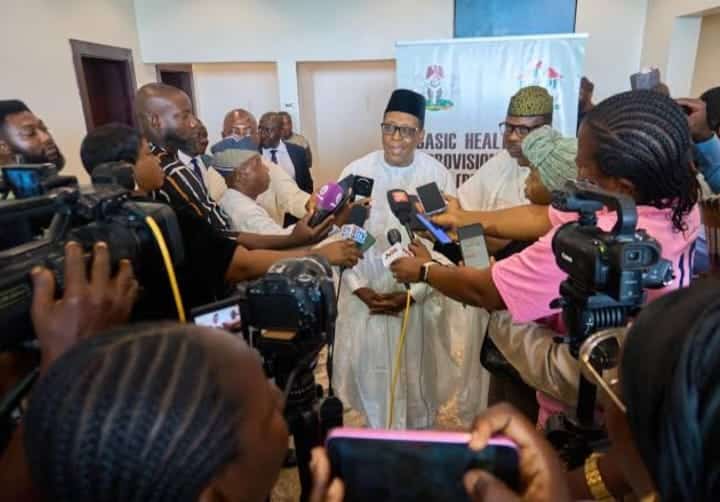
Keyamo made the remarks at the 2026 National Pre-Retirement Summit organised by XEM Consultants Limited in Abuja, where he said rising living costs had significantly eroded workers’ purchasing power.
The minister, who previously served as Minister of State for Labour and Employment, recalled the negotiations that led to the increase of the national minimum wage from N30,000 to N70,000 in 2024.
However, he said the current wage was still insufficient to absorb the economic pressures confronting Nigerian workers and urged the Federal Government to meet organised labour halfway in discussions on workers’ wages.
Keyamo noted that organised labour was demanding as much as N500,000, underscoring the growing debate over what constitutes an adequate wage under current economic conditions.
But even as the debate over a new and higher minimum wage gains momentum, some Nigerian workers are yet to fully benefit from the N70,000 benchmark introduced in 2024.
Reports have indicated that implementation remains incomplete in a number of states and sectors, with some workers, particularly in certain local government and public-sector categories, reportedly still receiving the old N30,000 wage or amounts close to it.
This creates another layer to Nigeria’s wage crisis: while labour is demanding a review of N70,000 because of its declining purchasing power, some workers are still struggling to receive the current statutory benchmark.
The situation means that two workers performing similar duties can face substantially different pay conditions depending on their state, sector and whether their employer has fully implemented the new wage structure.
Nigeria Labour Congress President Joe Ajaero has also argued that minimum-wage negotiations should focus on workers’ actual purchasing power rather than simply agreeing on a nominal figure.
Ajaero called for wages and pensions to be linked to inflation or a cost-of-living index, arguing that such a system could allow workers’ incomes to respond more directly to changing economic conditions.
Meanwhile, preliminary consultations for another minimum-wage negotiation process have already begun, although the Federal Government has said formal negotiations have not yet started and no new wage figure has been announced.
For Nigerian workers, the debate is therefore no longer only about whether N70,000 is enough. It is also about ensuring that whatever wage is eventually agreed upon is actually implemented, protects purchasing power and reaches workers across the country.





Leave a Reply