
By George Omagbemi
The Federal Government has approved ₦40.76 billion for the third-quarter 2026 disbursement under the Basic Health Care Provision Fund (BHCPF), while extending health insurance coverage to approximately 90,000 inmates in correctional facilities nationwide.
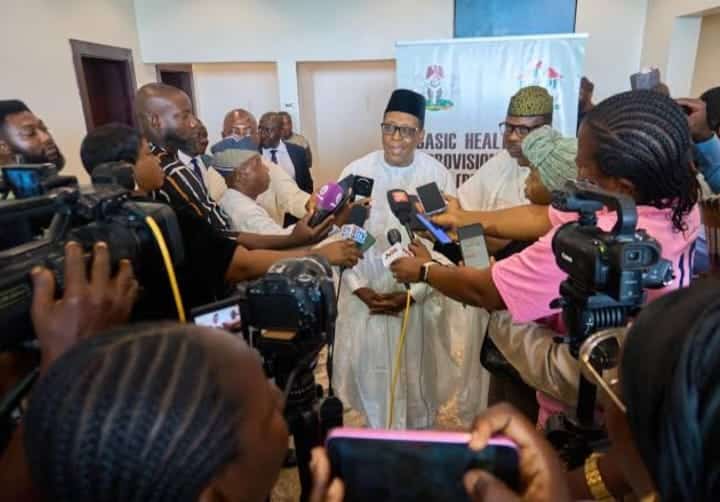
The decisions were announced by the Coordinating Minister of Health and Social Welfare, Professor Muhammad Ali Pate, following the 16th meeting of the BHCPF Ministerial Oversight Committee in Abuja.
According to the Federal Ministry of Information and National Orientation, the approved allocation of ₦40.758 billion represents an increase of about ₦7.88 billion over the ₦32.88 billion approved for the second quarter of 2026.
The funding will be distributed through four designated channels: the National Health Insurance Authority (NHIA), which will receive ₦19.87 billion; the National Primary Health Care Development Agency (NPHCDA), allocated ₦18.34 billion; Emergency Medical Treatment, with ₦2.04 billion; and the Nigeria Centre for Disease Control and Prevention (NCDC), which will receive approximately ₦509.48 million.
The government said the fund is intended to strengthen primary healthcare delivery and improve access to essential medical services, particularly for poor, vulnerable and underserved Nigerians.
Inmates to receive health insurance
The Ministerial Oversight Committee also approved the extension of health insurance coverage to approximately 90,000 inmates through the NHIA, following a request from the Nigerian Correctional Service.
The initiative is expected to enable eligible inmates to access basic healthcare under the Vulnerable Group Health Insurance Fund. Inmates already covered by state health insurance schemes will be excluded, while implementation will be subject to reporting requirements and safeguards.
The decision marks an expansion of efforts to extend basic healthcare protection to vulnerable populations, including people in correctional facilities.
More primary healthcare centres to benefit
The Federal Government also plans to expand the number of primary healthcare facilities supported by the fund from 8,309 to 13,521 nationwide, adding 5,212 facilities across the 36 states and the Federal Capital Territory.
The proposed expansion will take account of factors including population, disease burden, equity and distance from existing healthcare services.
The committee also approved measures to improve access to essential medicines through pooled procurement arrangements, with pricing benchmarks and supply-chain monitoring intended to strengthen transparency and value for money.
To address delays in the movement of funds through national agencies, states and local government areas to health facilities, the committee resolved to establish a subcommittee to investigate bottlenecks and submit its report within six weeks.
Accountability and state funding
Professor Pate emphasised that increased funding must translate into timely disbursement, transparent financial management and measurable improvements in healthcare outcomes.
The government also said it was working with the Independent Corrupt Practices and Other Related Offences Commission (ICPC) to monitor health-sector spending and prevent the misuse of public funds.
The minister urged state governments to fulfil their counterpart funding obligations and invest additional resources in healthcare delivery, including responses to outbreaks such as Lassa fever, cholera and diphtheria.
The BHCPF was established under the National Health Act, 2014, to support basic healthcare services and improve access to essential treatment, particularly for vulnerable Nigerians.
The latest allocation and planned expansion are part of the Federal Government’s efforts to strengthen primary healthcare financing and widen access to essential services across the country.






Leave a Reply