
By George Omagbemi
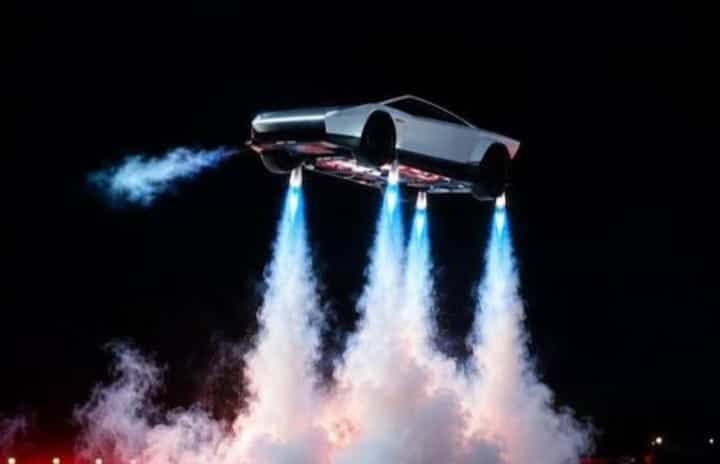
Technology billionaire Elon Musk has unveiled a redesigned Tesla Roadster featuring rocket-style thrusters capable of lifting the sports car into the air, reviving the long-standing dream of flying cars while raising questions about safety, affordability and whether the technology can be used legally on public roads.
The demonstration took place on Thursday, October 15, at a SpaceX testing facility in Texas, where the electric sports car performed a series of aerial manoeuvres before landing on its wheels.
The vehicle, developed through a collaboration between Musk’s electric vehicle company, Tesla, and his aerospace company, SpaceX, uses high-pressure compressed air and specialised thrusters to produce its unusual movements. A suction system also enables it to travel up an inverted ramp during the demonstration.
Tesla presented the Roadster as a high-performance vehicle capable of accelerating from zero to 60 miles per hour in less than one second. Musk has described the project as a major engineering achievement, although he acknowledged that its success is not guaranteed.
The demonstration was conducted without a person inside the vehicle, according to reports, underscoring the experimental nature of the technology.
Can it hit the road?
The short answer is that the Roadster is designed as a road-going sports car, but its ability to perform airborne manoeuvres does not automatically make it legally suitable for flying over public roads.
A vehicle intended to operate in the air must meet relevant aviation safety and certification requirements, while its use on public roads remains subject to applicable vehicle safety regulations. The legal requirements for a car that can also fly would depend on its final design, certification and intended operation.
The Roadster is not yet available for normal customer use, and Tesla has indicated that production is targeted for 2028. The company has not established that the flying capability demonstrated at the event has received all the approvals required for routine public use.
A costly glimpse of the future
The project also raises questions about cost and practicality. Although the Roadster is expected to occupy the high-performance end of the electric vehicle market, the demonstration did not establish that flying functionality would be affordable or practical for ordinary motorists.
Musk has repeatedly delayed the next-generation Roadster since its original unveiling in 2017. The latest demonstration has renewed interest in the project, but the distance between a spectacular prototype demonstration and a commercially available, fully certified vehicle remains significant.
For now, the flying Roadster represents an ambitious attempt to combine electric motoring with aerospace engineering. Whether it eventually becomes a practical vehicle for everyday transport will depend on further development, production readiness, safety testing and regulatory approval.






Leave a Reply