
By Opeyemi Adelakun
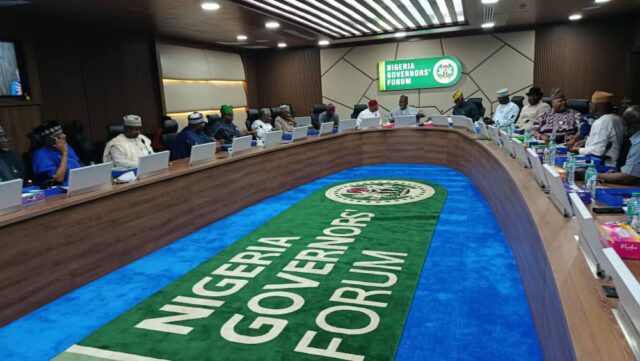
Thirty-three Nigerian states spent at least N512.10bn on Government Houses, governors’ offices and travel-related expenses in the first six months of 2026, according to an analysis of state budget implementation reports.
The expenditure is significantly higher than the official salaries of the governors, whose combined six-month basic pay was estimated at N108.65m.
The analysis showed that N420.01bn was recorded under Government House, Governor’s Office and related executive administration expenditure, while another N92.09bn was spent on travel and transport.
Together, the two expenditure categories amounted to N512.10bn.
By comparison, the stated monthly salary of a Nigerian governor is N503,000, translating to N3.018m over six months. For all 36 governors, the figure amounts to N108.65m.
The comparison highlights the enormous difference between the official salaries of governors and the wider cost of maintaining the executive structures attached to their offices.
However, the N512.10bn should not be interpreted as the personal income or spending of governors. Government House and Governor’s Office expenditure covers a broad range of government activities, including administrative operations, staffing, maintenance, utilities, official residences, security-related activities, protocol and state functions.
Travel and transport expenditure also covers official movements and related transportation costs across the wider state public service.
The analysis was based on available first- and second-quarter 2026 Budget Implementation Reports, using the largest identifiable Government House, Governor’s Office or executive administration expenditure line in each state, alongside the general travel and transport expenditure head.
Comparable data were available for 33 states, while figures for Edo, Osun and Rivers were unavailable.
Kogi, Ogun, Lagos Lead Spending
Kogi recorded the highest identifiable Government House and Governor’s Office expenditure at N65.34bn during the period.
Ogun followed with N45.26bn, while Lagos recorded N45.04bn.
Kano spent N25.87bn, followed by Ekiti with N25.22bn and Cross River with N23.92bn.
Bayelsa recorded N22.99bn, Imo N19.43bn and Enugu N16.20bn.
At the lower end, Oyo recorded about N1.95bn, Sokoto N2.20bn, Kwara N2.59bn and Abia N2.78bn.
Kogi’s N65.34bn expenditure represented more than 15 per cent of the identifiable Government House and Governor’s Office spending captured in the 2026 dataset.
On travel and transport, Plateau recorded the highest identifiable expenditure at N10.11bn, followed by Lagos with N8.23bn and Taraba with N5.16bn.
Niger spent N4.45bn, Ekiti N4.41bn, Bauchi N3.75bn and Yobe N3.68bn.
Oyo recorded about N667.52m in the category, while Kano spent N626.95m.
Spending Falls From 2025 Level
The analysis showed that expenditure under the comparable categories was lower in the first half of 2026 than in the corresponding period of 2025.
Available records showed that states spent N465.07bn under Government House, Governor’s Office and similar executive administration heads in the first six months of 2025.
A further N92.73bn was recorded for travel and transport, bringing the combined 2025 figure to N557.80bn.
The 2026 figure of N512.10bn therefore represents a decline of about N45.70bn, or 8.19 per cent.
Government House and Governor’s Office spending accounted for most of the reduction, falling from N465.07bn in 2025 to N420.01bn in 2026 — a decline of N45.05bn, or 9.69 per cent.
Travel and transport spending, however, remained relatively stable, dropping marginally from N92.73bn to N92.09bn, a reduction of about N643.66m, or 0.69 per cent.
Wide Differences Among States
The state-by-state figures showed significant variations in spending patterns.
Kogi’s Government House and Governor’s Office expenditure rose from N51.99bn in the first half of 2025 to N65.34bn in 2026, representing an increase of about N13.34bn, or 25.66 per cent.
Bayelsa’s spending increased from N14.48bn to N22.99bn, a rise of N8.51bn, or 58.75 per cent.
Cross River recorded one of the sharpest increases, moving from N9.91bn to N23.92bn, representing a 141.37 per cent rise.
Ogun, however, recorded a decline from N49.83bn in 2025 to N45.26bn in 2026, while Kano’s expenditure fell from N28.84bn to N25.87bn.
Lagos recorded a significant increase, with identifiable expenditure rising from N25.86bn to N45.04bn, representing an increase of about N19.18bn, or 74.16 per cent.
Salary Debate
The figures come amid renewed debate over the remuneration of Nigerian governors.
Delta State Governor, Sheriff Oborevwori, recently stated that his monthly salary was N503,000, arguing that some senior civil servants, including permanent secretaries, earn about N900,000 monthly.
Development economist Aliyu Ilias said the wider expenditure associated with executive offices should be considered when assessing the actual financial benefits attached to political office.
He argued that focusing solely on governors’ basic salaries gives an incomplete picture of the cost of maintaining political offices.
Ilias also criticised what he described as excessive spending on executive offices and linked the situation to the influence political office holders exercise over the structures and budgets under their control.
The issue also raises questions about the cost of governance at the state level, particularly as state governments have received increased revenues following recent economic reforms.
The Revenue Mobilisation Allocation and Fiscal Commission is responsible for determining the remuneration of governors and other political office holders, while a broader review of the remuneration framework is reportedly being processed.
Meanwhile, the increased flow of funds to state governments has intensified scrutiny over how public resources are being deployed and whether higher revenues are translating into improved infrastructure and public services.

Leave a Reply