
By George Omagbemi Sylvester
A fresh legal controversy has erupted around Abia State’s share of the Paris Club refund, following revelations contained in court records and petitions that allege irregular settlements, disputed consultancy agreements and attempts to seize state funds. The dispute centres on competing claims by consultancy firms, the role of a former Attorney-General, and judicial orders that have shaped the fate of billions of naira.
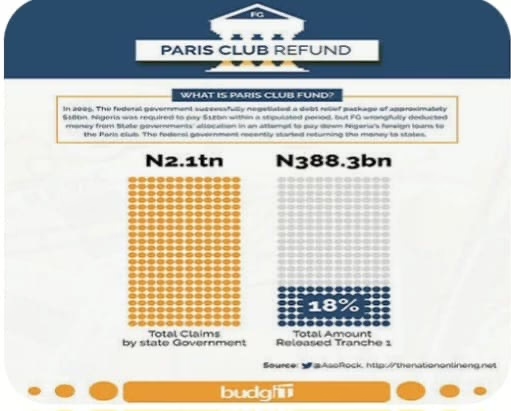
At the heart of the controversy is the Paris Club refund; funds returned by the Federal Government to states after it was established that Nigeria had over-deducted money from state allocations to service foreign debts. Like many states, Abia hired consultants to assist in recovering its share. Over time, however, multiple parties emerged, each claiming entitlement to a substantial percentage of the recovered funds.
Court filings show that Ziplon Concept Ltd, Mauritz Walton Nigeria Ltd, Techno Consult (Nigeria) Ltd, and even other actors laid claim to consultancy fees tied to the same recovery exercise. In one ruling in December 2018, a judge of the Federal Capital Territory High Court reportedly noted that the existence of multiple claims of between 24 and 30 percent commission on the same transaction suggested “an element of fraud,” warning that the court should not become a vehicle for illegality.
According to legal documents, Ziplon Concept Ltd claimed it had a memorandum of understanding with Abia State dating back to May 2012, entitling it to 24 percent of the payout. However, records indicated that the document relied upon was undated, while other firms presented competing agreements with the state.
The controversy intensified in October 2022, when the then Attorney-General of Abia State, Uche Ihediwa (SAN), reportedly entered into a settlement with Ziplon Concept Ltd. The settlement allegedly awarded the company about ₦3.923 billion, said to represent 24 percent of the Paris Club refund received by the state. The agreement also required the state to set aside additional funds in escrow and make provision for contingent liabilities.
Further controversy followed the inclusion of a payment clause directing that about five percent of the commission (close to ₦200 million) be paid to a third party described in court records as a “professional fee” for mediating the settlement.
On 7 November 2022, the settlement was reportedly adopted as a consent judgment by a High Court judge, despite the existence of similar claims by other consultants in separate suits.
In 2023, Mauritz Walton Nigeria Ltd petitioned the Abia State Government, alleging that Ziplon Concept was a front for the family of a former governor of the state. The company claimed it was the legitimate consultant and accused rival parties of attempting to divert funds.
Earlier testimony in related proceedings showed that the Chief Executive of Mauritz Walton, Dr. Maurice Ibe, had petitioned anti-corruption authorities, claiming he refused to participate in what he described as a questionable payment arrangement after discovering that Ziplon had already received funds.
The legal struggle escalated into attempts to attach Abia State’s funds at the federal level. In February 2025, a judge of the FCT High Court discharged an order previously obtained by Ziplon Concept Ltd to seize funds belonging to the state from the Federation Account. The Court of Appeal later directed the company to return to the High Court to prove its claims.
While the controversy continues, it is important to note that the former Attorney-General at the centre of the settlement, Uche Ihediwa, was cleared in February 2025 by the Legal Practitioners’ Privileges Committee in an unrelated misconduct matter and reinstated to the rank of Senior Advocate of Nigeria.
The unfolding case highlights the complexity of Nigeria’s Paris Club refund saga, which has generated litigation across several states. Competing consultancy contracts, political transitions, and opaque agreements have often left courts to untangle claims worth hundreds of millions of dollars.
Legal scholars have long warned that poorly structured public-sector consultancy arrangements create fertile ground for disputes and corruption. As the American jurist Roscoe Pound once observed, “Law must be stable, and yet it cannot stand still.” In the Nigerian context, analysts argue that stability requires transparent procurement processes, clear contracts and strict oversight of public funds.
Public policy expert Prof. Pat Utomi has similarly cautioned that governance without accountability “invites rent-seeking and institutional decay,” a warning that resonates with the tangled web of consultancy claims now confronting Abia State.
For the current administration in Abia, the case represents both a legal and political test. The outcome will determine not only the fate of the disputed funds but also the credibility of the state’s commitment to transparency and fiscal discipline.
What remains clear from court records is that the dispute involves multiple consultants, a controversial settlement in 2022, petitions alleging front companies and improper payments and ongoing litigation over who is legitimately entitled to billions of naira from the Paris Club refund.
As the courts continue to weigh the evidence, the case stands as a cautionary tale about the high stakes of public finance, the dangers of opaque contracts and the enduring need for accountability in the management of state resources.


Leave a Reply