
By George Omagbemi Sylvester
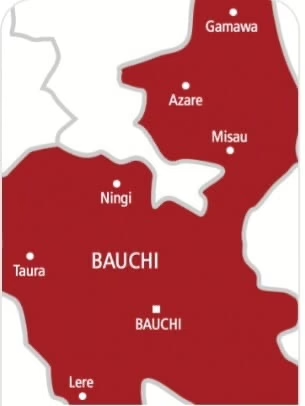
In a harrowing incident that has jolted national conscience and raised uncomfortable questions about human dignity, the Bauchi State Police Command on 16 February 2026 rescued a man who had been confined and leg-chained for 17 years by his own father in Shadawanka Village, Bauchi Local Government Area of Bauchi State. The victim, identified as Muhammad Lawan, popularly known as Babangida, is approximately 40 years old. His father, Malam Mohammed Lawan, aged about 72, has been arrested and is now in police custody as investigations intensify.
The grotesque discovery was made public after a community member alerted police, prompting officers from the ‘B’ Division and the command’s public relations unit to visit the father’s home. There, they found Muhammad in a dire state emaciated, physically weakened and restrained by a heavy chain fastened to a log. He was immediately freed, given urgent medical care at ATBU Teaching Hospital, and placed under rehabilitation, as ordered by Commissioner of Police Sani-Omolori Aliyu. The police have opened a formal investigation and intend to transfer the case to the State Criminal Investigation Department.
This case is not only an extreme aberration of parental duty but also a stark indictment of systemic failures. Human rights specialists underscore that prolonged physical restraint and confinement may amount to serious violations of both domestic law and international human rights norms. The Bauchi State Penal Code expressly criminalises unlawful confinement and concealment of persons, stipulating penalties comparable to kidnapping for such offences.
Globally, scholars have long emphasised the imperative of social protection systems that prevent such abuses. Renowned human rights expert Martha C. Nussbaum argues that: “True respect for human dignity requires institutions that protect the most vulnerable from neglect, isolation and arbitrary control.” In this case, the absence of intervention for nearly two decades raises urgent questions about community awareness, access to welfare services and police responsiveness.
Why did this tragedy remain hidden for so long? Local sources suggest that the victim’s condition was treated as a familial or private matter by neighbours who either feared interfering or assumed the confinement was justified by medical or behavioural issues. Yet the police’s response (prompted by one individual’s decision to report) demonstrates how civic courage can be a catalyst for justice. John Stuart Mill, the 19th-century philosopher, remarked that “Bad men need nothing more to compass their ends, than that good men should look on and do nothing.” In Shadawanka Village, good citizens eventually spoke up, but only after 17 years of suffering.
The social dynamics of Bauchi and similar rural settings also play a role. Stigma surrounding mental health, disability, or behavioural disorders can drive families to isolate loved ones rather than seek help. While authorities have yet to publicly determine whether Muhammad suffered from any psychological or physical condition that might have influenced his father’s behaviour, what is clear is that decades of confinement without care constitutes disregard for fundamental human rights.
Law enforcement officials now face the task of not only prosecuting this case but also ensuring that systemic safeguards are strengthened to prevent recurrence. Police have vowed rigorous prosecution, a necessary step to signal that no person is above the law and even within the family compound. As Amartya Sen, the Nobel-winning economist, has asserted: “The real test of justice is not what is done for the powerful, but what is done for the powerless.”
At a moment when Nigeria is grappling with complex challenges (from insurgency and economic instability to public health crises) this shocking abuse highlights the often-overlooked plight of the internally marginalised. It serves as a reminder that human rights must not only be protected in theory but enforced in practice in every corner of society.
The immediate focus now rests on the rehabilitation of Muhammad and the legal proceedings against his father. Authorities have pledged transparency and due process, important to uphold both accountability and justice. Though beyond the courtroom, this incident must prompt a national conversation on community vigilance, social welfare networks and the moral obligations that bind citizens and the state in protecting human dignity.
In a society seeking cohesion and progress, the chains that bound one man for 17 years must serve as a symbol of the urgent need to dismantle the deeper barriers to justice, care and human respect. The world is watching and history will judge not just the perpetrators, but the collective response of a nation to its most vulnerable.




Leave a Reply