
By George Omagbemi Sylveste .
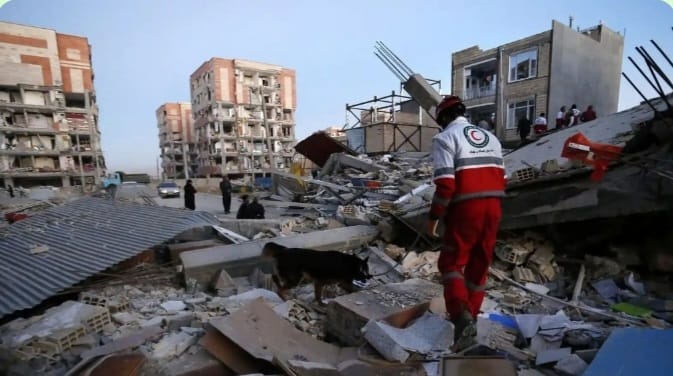
Residents in southern Iran were thrown into fear and confusion on March 4, 2026, after a 4.4 magnitude earthquake struck Hormozgan Province a coastal region already tense due to escalating military activity in the Gulf.
According to the Iranian Seismological Center, the tremor caused no major structural damage, but the psychological impact was immediate. In towns and cities across the province, families rushed out of their homes, some clutching children, others making frantic phone calls to loved ones. For many, it wasn’t just the shaking ground that unsettled them it was the timing.
“I thought it was another strike,” one resident reportedly said, reflecting a growing fear among civilians who have been living under the shadow of conflict in recent days.
Tensions in the region have been rising sharply following coordinated air and missile strikes by the United States and Israel targeting key Iranian military sites. These operations, aimed at weakening Iran’s strategic capabilities, have triggered retaliatory responses from the Islamic Revolutionary Guard Corps (IRGC), including missile and drone attacks.
While experts emphasize that the earthquake is purely a natural event and unrelated to the ongoing military exchanges, its occurrence during such a volatile period has deepened public anxiety. In communities already on high alert, the tremor blurred the line between natural disaster and man-made threat.
Emergency responders in Hormozgan faced an added challenge—managing panic in an environment where fear is already heightened. Some residents reportedly hesitated to return indoors, worried about both aftershocks and the possibility of further attacks.
Humanitarian observers warn that this combination of natural and geopolitical stress could have lasting consequences. Hospitals and emergency services, already stretched by security concerns, may struggle if either situation worsens. Supply chains, especially in coastal areas, could also face disruptions, affecting access to essential goods.
For ordinary Iranians living in the south, the experience is becoming increasingly overwhelming. The uncertainty of not knowing whether the next disruption will come from the earth or the sky is taking a psychological toll.
The events of March 4 highlight a sobering reality: for many in southern Iran, life is now shaped by two unpredictable forces—nature and conflict. And as both continue to unfold, the path ahead remains uncertain..


Leave a Reply