
By Opeyemi Adelakun
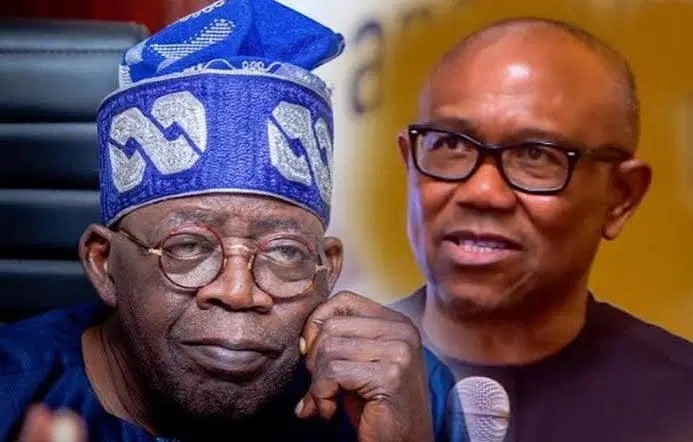
The Presidency and the All Progressives Congress, APC, have challenged Peter Obi’s claim that he won the 2023 presidential election, after the presidential candidate of the Nigeria Democratic Congress, NDC, renewed his assertion ahead of the 2027 poll.
Obi, who contested the 2023 election on the platform of the Labour Party, made the claim during an interview on Arise News, where he also unveiled his proposed approach to governance, economic management, infrastructure and national security.
According to the official results declared by the Independent National Electoral Commission, INEC, Bola Tinubu won the 2023 presidential election ahead of Atiku Abubakar and Obi.
However, Obi maintained that the election was won by him, arguing that those who conducted the exercise were aware of what happened.
“I did, and I will maintain that as long as I live that I won the 2023 election. Those who conducted it know the records; they know why there was a glitch and what happened,” Obi said.
APC Rejects Obi’s Claim
Reacting to the former Anambra State governor’s position, the APC National Chairman, Prof. Nentawe Yilwatda, through his Special Adviser on Media and Information Strategy, Abimbola Tooki, questioned how Obi could have won the election without being declared the winner.
“How can he say that he won the 2023 poll? How did he win it? Where is the result? He had no agents in many states of the North. Why didn’t the INEC declare him as winner? He should go and prepare for another imminent loss in 2027,” Tooki said.
The APC official also defended the Tinubu administration over Obi’s criticism of the government’s handling of fuel subsidy savings.
“He should ask state governors what they were getting as federal allocation before President Tinubu came and what they are getting now. He should check the last time we had fuel queues in Nigeria. When was the last time we had a strike? He should check if students in tertiary institutions are not receiving their NELFUND loans. Does he want the N16 trillion to be transported to his bedroom?” he said.
The Presidency also dismissed Obi’s claim, with the Special Adviser to President Tinubu on Media and Public Communications, Sunday Dare, accusing the NDC candidate of refusing to accept the outcome of the 2023 election.
“Mr. Obi is fat on ambition but drunk on political arrogance.
“Peter Obi wallows freely in a political fantasy land. To still insist he won the presidential election after the country’s highest court, the Supreme Court, delivered a final judgment is clear hallucination.
“Who imbued him with the power to concede or not? He lacks such power. Only the Nigerian people have the power of the votes. And in 2027, they will deliver their votes massively for President Tinubu, leaving no room for the kind of antics Obi is already front-loading,” Dare said.
Meanwhile, Senator Abdulaziz Yari, Director-General of the APC presidential campaign council, said none of the presidential aspirants challenging Tinubu in 2027 possesses up to 10 per cent of the President’s qualities.
Yari spoke on Wednesday in Gusau, Zamfara State, while canvassing support for Tinubu among members of the Nigerian Union of Road Transport Workers.
“That is how politics is. When you put all the aspirants contesting against Bola Tinubu on a scale, I don’t think the scale would even accept them,” he said.
“We all know that none of the aspirants contesting against him are on his level when it comes to merit and quality; we don’t think any of them have even 10 per cent of what Bola Tinubu possesses.”
Obi, however, said he would not seek an extension beyond a first four-year term if elected president, arguing that the country could achieve significant structural changes within one mandate.
“I will not spend one extra day. Four years is enough to engender change and I did it as Governor of Anambra State,” he said.
He said his administration would focus on setting clear priorities, appointing competent officials and ensuring that the president remained directly responsible for government decisions.
“I will be in charge and I will not run the government by proxy. I will be answerable to the people,” Obi said.
He also criticised the government’s handling of fuel subsidy savings, arguing that the benefits of the policy had not translated into meaningful relief for Nigerians.
Obi said the subsidy system had been undermined by corruption but maintained that its removal should have been accompanied by productive investment capable of creating wealth and employment.
“The subsidy regime in Nigeria was enmeshed with corruption and criminality. I have said clearly that I will remove subsidy and fight corruption and criminality. It is only when you remove it that you will know exactly whether we have a subsidy or not. I believe that if you remove corruption, there might not be subsidy. That’s my belief,” he said.
He advocated greater support for local refining and said Nigeria’s status as an oil-producing country should enable it to reduce the impact of global petroleum price shocks on citizens.
“I believe that the price of petroleum products today is high. We are an oil-producing country, which means that if we can do regular supply of crude to our local refineries, working with them competitively to refine for domestic consumption, the prices can come down,” Obi said.
He also cited Indonesia’s subsidised lending to small businesses as an example of how government intervention could be directed towards productive sectors.
Obi said his administration would focus heavily on agriculture, skills development, healthcare and manufacturing in northern Nigeria, arguing that the region possessed significant economic potential.
“I know the problems in the northern part. I will deal with the issue of poverty the way it has not been dealt with before, and in a non-corrupt way, where they will see it. The North has an asset. Nobody in this country, none of us, none of the areas, can say they have what the North has. I will deal with that asset, and that asset is agriculture. We’ll invest in it. We’ll give the subsidy to it. We will ensure that it will take all those poor people, almajirai, back to education, support them in different areas,” he said.
He also promised to revive industries in major northern commercial centres, including Kano, as part of efforts to tackle unemployment and insecurity.
The NDC candidate further accused the Tinubu administration of failing to meet Nigerians’ expectations, describing some of its spending as reckless.
“I think you should ask the people. But if you ask me, they’ve not done well. They’ve been a bit reckless in what they’re doing,” he said.
Asked whether Tinubu was fully in control of government, Obi said, “At times, I believe he’s not in charge. Because if he’s in charge, he will even be explaining to the people. That’s what I’m talking about, which is capacity. I will be in charge. Nobody will talk for Peter. Because I’m the one that’s elected. I’ll be answerable to the people. And for every penny, I’ll be answerable to the people.”
He also said his administration would prioritise rehabilitation of existing infrastructure rather than embark on unnecessary new projects.
“We will not build new roads until we fix the existing ones,” he said.
On security, Obi opposed ransom payments to kidnappers and bandits, promising to strengthen intelligence, security personnel welfare and tactical operations against criminal groups.
On the 2027 election, Obi said he would accept defeat if the process was free, fair and credible.
“I will concede defeat if the process is free, fair and credible,” he said.
He said his campaign organisation was working towards an independent parallel result-transmission system through which polling-unit results could be transmitted to a citizen-led situation room in real time.
The NDC candidate also reiterated that he had no objection to discussions among opposition parties seeking to form an alliance, but said such negotiations should be conducted between political parties rather than individual politicians.
“I’m a candidate, yes. So, my leader, Atiku, is candidate of another party. I am a candidate for another party. So, you are talking about two parties coming together; it is no longer him or me,” he said.
“All those parties have candidates. So, it is a discussion. It is no longer me, as Peter is talking. It is like a situation where two corporations are trying to come together. It is no longer something the two CEOs go to a drink and say we are going to work together. They need to look at how to bring these two corporations together,” Obi added.
He also denied rejecting an offer to become Atiku’s running mate, saying no such offer had been made to him.
“I don’t know where that was said. I wasn’t even in a position where that was being offered, and I refused,” he said.
Obi was Atiku’s running mate in the 2019 presidential election, but both contested separately in 2023.
The NDC candidate said one policy of the Tinubu administration he would retain if elected was the floating exchange rate regime, although he said he would focus on increasing productivity to strengthen the naira.
“Yes. One. It’s floating of the naira. I’m not going to defend it, but I’m going to put productivity to work to make it more valuable to the people,” he said.
Obi also criticised the country’s political leadership for what he described as inadequate generational transition, noting that no Nigerian born after 1960 had become president since independence.
“Since 1960, nobody born outside 1960 has been president of Nigeria. This is 66 years of independence; no other country in the world has had this happen to, and they tell youths they’re the leaders of tomorrow,” he said.


Leave a Reply