
By George Omagbemi Sylvester
South Africa’s modern confrontation with cholera has been shaped by a deadly outbreak, regional disease pressures and a renewed national push to strengthen water safety and emergency response systems. Though the country is not currently among Africa’s worst-hit states, health authorities remain on high alert as cholera resurges across the continent and threatens to spill across borders.
The most defining recent episode occurred in May 2023 in Hammanskraal, a township north of Pretoria in Gauteng Province. Residents began reporting severe diarrhoeal illness, and within days the situation escalated into a confirmed cholera outbreak. By late May, authorities reported 29 laboratory-confirmed cases and at least 17 deaths, with over 160 patients treated at local hospitals.
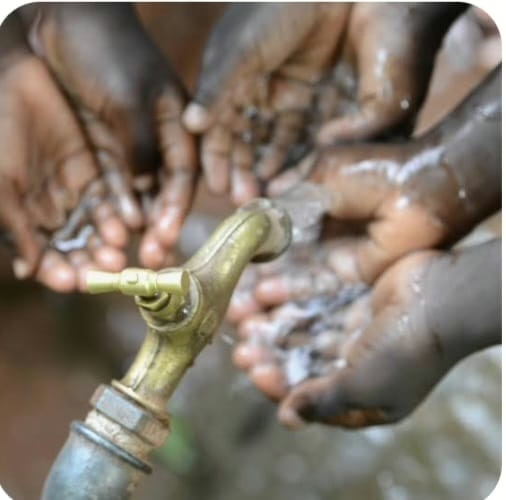
The outbreak was traced to contaminated municipal water, exposing long-standing failures in sanitation and wastewater treatment systems. Investigations pointed to chronic infrastructure neglect and the collapse of water purification processes, allowing bacteria to enter household supplies.
At the time, President Cyril Ramaphosa publicly apologised to residents for the state’s failure to provide safe drinking water, while national and provincial health officials mobilised emergency responses. Among the key figures involved were:
President Cyril Ramaphosa, who addressed the crisis and apologised to affected communities.
Dr. Sandile Buthelezi, Director-General of the National Department of Health, who ordered hospitals to treat severe diarrhoeal cases as suspected cholera.
Aneliswa Cele, Acting Chief Director for Communicable Diseases Control, who warned of the high risk of imported cases from neighbouring countries.
Local authorities in the City of Tshwane, responsible for water and sanitation interventions.
The outbreak exposed a harsh truth: cholera is rarely just a medical problem. It is a disease of infrastructure, governance, and inequality. As the World Health Organization repeatedly notes, cholera is “a disease of inequity,” thriving where clean water and sanitation are absent.
South Africa’s 2023 outbreak did not occur in isolation. Across the continent, cholera has been surging at alarming rates. By 2025, Africa recorded over 300,000 cases and more than 7,000 deaths, marking the continent’s worst outbreak in a quarter century, according to the Africa Centres for Disease Control and Prevention.
Southern Africa has been particularly vulnerable. Major outbreaks in Mozambique, Malawi, Zambia and Zimbabwe have placed neighbouring countries at risk. Health experts warn that cross-border movement and flooding significantly increase the danger of imported cases into South Africa.
In early 2024, for example, health authorities confirmed imported cholera cases in Limpopo Province linked to travellers from Zimbabwe, prompting heightened surveillance at border posts and health facilities.
By 2025 and early 2026, regional floods across southern Africa again raised concerns about cholera outbreaks, as displaced populations struggled without proper sanitation. Aid workers warned that crowded camps and contaminated water could accelerate transmission.
South African health authorities have responded with a layered strategy: surveillance, public education, water infrastructure upgrades and coordination with regional health bodies. The National Institute for Communicable Diseases (NICD) has repeatedly stressed that while South Africa has not faced large-scale outbreaks since Hammanskraal, the country remains at “high risk” due to regional transmission and climate-related sanitation disruptions.”
Public health experts emphasize that the solution is not merely medical but structural. Dr. Tedros Adhanom Ghebreyesus, Director-General of the World Health Organization, has warned that cholera “thrives where poverty, conflict and climate shocks deny people access to safe water and sanitation,” underscoring that prevention lies in infrastructure not just vaccines.
Similarly, UNICEF’s regional leadership has stressed the centrality of water access. “Access to safe water is a fundamental need… and most importantly, a human right,” said UNICEF Regional Director Etleva Kadilli, noting that inadequate sanitation systems remain the main driver of outbreaks.
The South African experience reflects that reality. The Hammanskraal tragedy was not caused by an exotic pathogen or a sudden foreign import; it was the result of contaminated tap water in a community that had repeatedly complained about poor service delivery.
Since the outbreak, authorities have accelerated plans to upgrade wastewater treatment plants and restore water quality in affected areas. Emergency chlorination, tanker water deliveries and public awareness campaigns were rolled out to contain the crisis. These measures helped halt transmission, but they also highlighted deeper structural failures that still require long-term investment.
Today, South Africa’s fight against cholera is less about a current national outbreak and more about preventing the next one. With regional cases rising, floods increasing and sanitation infrastructure under strain, the country’s health security depends on the reliability of its water systems.
As public health scholar Dr. Rita Colwell once observed, “Cholera is a marker of the health of a society’s water.” In South Africa, that marker has already issued a warning. Whether the country heeds it will determine if the next outbreak is contained or catastrophic.




Leave a Reply