
By George O Sylvester
As rising socio‑political tensions intertwine celebrity, activism and ethnic grievances, Nigeria witnesses a blistering online confrontation that cuts to the heart of political accountability and public trust.
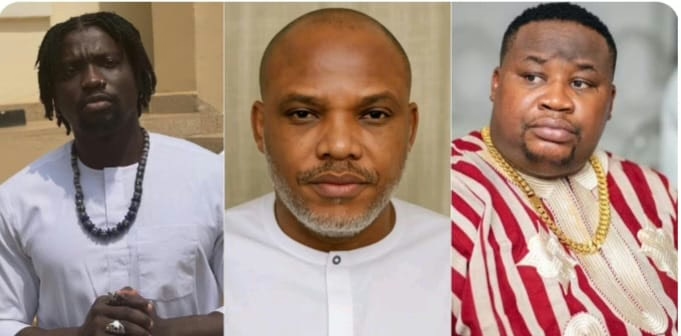
In a viral social media video that has electrified Nigerian public discourse, popular online activist Martins Vincent Otse, better known as VeryDarkMan (VDM), publicly castigated nightlife entrepreneur and socialite Pascal Okechukwu, widely known as Cubana Chief Priest, for what he described as an opportunistic political alignment with the ruling All Progressives Congress (APC) and an apparent abandonment of earlier public statements concerning the detention of Indigenous People of Biafra (IPOB) leader Nnamdi Kanu.
The confrontation erupted in early February 2026 after Cubana Chief Priest’s increasingly visible ties to key APC personnel and his endorsement of President Bola Ahmed Tinubu’s party ahead of the 2027 general elections became undeniable. VDM, whose influence spans millions of followers across socio‑political social platforms, challenged the socialite’s consistency and moral bearings, questioning why a figure who once publicly tied Southern electoral support for APC to the release of Kanu now appeared to champion the party regardless of Kanu’s continued incarceration.
VDM’s critique was direct and unambiguous: “You used it to get a lot of clout so that your people will think that you’re fighting for them… Nnamdi Kanu is still in prison… If him no comot by the end of February, you’re a snake and a terrible person… you’re a typical user that was using his people.”
Cubana Chief Priest’s political evolution is emblematic of a wider trend in Nigerian public life where entertainers and business magnates increasingly cross into overt political engagement. Once associated with support for the Labour Party and the 2023 presidential campaign of Peter Obi (even while serving as a special adviser to Imo State Governor Hope Uzodinma of the APC) Chief Priest has now publicly aligned himself with the governing party and even announced his intention to contest for a seat in the House of Representatives under the APC banner.
In explaining his shift, Cubana Chief Priest stated unequivocally that he cannot effect the release of Nnamdi Kanu from the opposition bench, adding that he has “always been an APC” and referring to his political benefactor, Governor Uzodinma, as “my father.” He contended that membership in the ruling party offers real opportunities to advance regional interests and secure outcomes that social commentary alone cannot achieve.
This rationale resonates with a central debate in democratic societies regarding the efficacy of activism outside formal political structures. Political scientist Dr. Aisha Bello observes that, “Influencers and civil advocates often face a crossroads between symbolic protest and institutional engagement – the former raises awareness, the latter seeks power to enact change.”
Yet she cautions that *“without clear accountability to public commitments, such transitions risk being perceived as opportunistic rather than principled.”
Critics contend that Cubana Chief Priest’s pivot betrays core expectations of leadership and undermines collective struggle. Media personality Radiogad, echoing sentiments similar to VDM’s, lambasted the socialite for focusing on personal wealth and status instead of prioritising pressing communal issues like Kanu’s detention, a matter that remains sensitive in Nigeria’s Southeast where questions of justice, identity and marginalisation are deeply felt.
The political context deepens when placed against Cubana Chief Priest’s prior statements warning that the APC risked losing electoral traction in the Southeast if Kanu remained imprisoned – comments he made in 2025 that suggested a hardline stance against his continued detention. Yet, by early 2026, his public embrace of the APC drew sharp rebukes over perceived inconsistency.
Legal scholar Prof. Chidi Okeke offers a broader lens, noting: “Detention of political figures like Nnamdi Kanu has become not only a legal matter but a symbol of ethnic grievance and democratic fairness. Public figures who invoke such issues bear a responsibility to reconcile their political choices with the moral weight of those claims.”
Indeed, Nnamdi Kanu’s life sentence has been a polarising issue. The IPOB leader, convicted of treasonable offences by a Nigerian federal court in 2024 and subsequently sentenced to life imprisonment, remains incarcerated in Sokoto State – a flashpoint of tension in national debates about federal authority, regional equity and civil liberties. While his detention has been condemned by human rights advocates, the government maintains that the charges and sentence are grounded in Nigeria’s criminal and anti‑terror laws. Crucially, opinions vary widely on the legitimacy of Kanu’s activism and the appropriate avenues for his redress. (General background established from known legal context.)
The rift between VDM and Cubana Chief Priest is not merely a clash of personalities but a striking manifestation of the collision between digital activism and realpolitik within Nigeria’s fraught political landscape. For many observers, the heart of the debate is not about celebrity allegiances but the expectations Nigerians place on public figures when they speak on matters of justice and governance.
As the 2027 elections approach, VDM’s critique underscores a broader call for integrity and consistency: that public endorsements, particularly from influential voices, should be measured against unwavering principles rather than shifting political winds.
Whether Cubana Chief Priest’s trajectory reflects genuine strategic calculation or opportunism remains a subject of intense contestation, one that will play out not only online but in the courts of public opinion and at the polling booths.
In the words of veteran political commentator Kunle Ajibade, “Nigeria’s democracy is still in its adolescence; its strength will be measured not by the power of celebrity endorsements, but by the steadfastness of those who dare to hold all leaders, regardless of status, to account.”
The VeryDarkMan vs Cubana Chief Priest episode thus transcends social media theatrics, it has become a touchstone for how Nigerians dissect leadership, loyalty and the responsibilities of influence in a country yearning for both justice and political maturity.

Leave a Reply