
By Paul Joseph
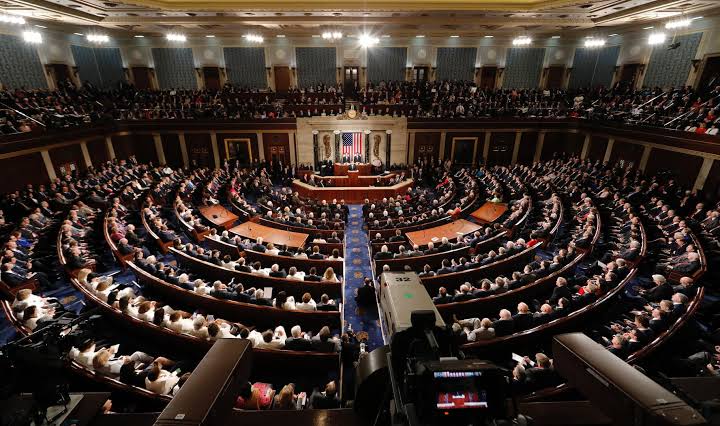
The United States House of Representatives has voted to limit President Donald Trump’s ability to continue military operations against Iran without congressional approval, delivering a rare bipartisan rebuke to the White House amid growing concerns over the escalating conflict.
In a closely watched vote on Wednesday and Thursday Nigerian time, lawmakers approved a war powers resolution by 215 votes to 208, with four Republicans joining Democrats in support of the measure. The resolution seeks to require the president to withdraw U.S. forces from the conflict or obtain authorization from Congress before pursuing further military action.
Although largely symbolic at this stage, the vote represents mounting pressure on the Trump administration as public opposition to the war increases and fuel prices continue to rise across the United States.
The White House has dismissed the resolution, arguing that it represents an unconstitutional attempt to restrict presidential authority as commander-in-chief.
The measure marks the fourth effort by lawmakers to curb Trump’s war powers since the conflict with Iran began in February. A similar resolution advanced through the Senate in May but has yet to receive a full vote in the upper chamber.
If approved by the Republican-controlled Senate, the concurrent resolution would not require the president’s signature, though legal experts expect it could face constitutional challenges.
The vote also exposed growing divisions within the Republican Party, coming days after conservative lawmakers forced the administration to abandon plans for a controversial $1.8 billion “anti-weaponisation” fund.
Republican Representatives Thomas Massie, Brian Fitzpatrick, Tom Barrett and Warren Davidson broke ranks with party leadership to support the resolution, joining Democrats in backing the measure. Democratic Representative Jared Golden of Maine also switched positions after previously opposing similar efforts.
Speaking after the vote, Barrett defended his decision, emphasizing Congress’s constitutional responsibility over declarations of war.
“Congress alone declares war, that’s something certainly we need to be protective of,” he said, adding that he was prepared to accept any political consequences for voting according to his conscience.
Democrats hailed the vote as a significant challenge to the administration’s handling of the conflict.
Representative Gregory Meeks, the ranking Democrat on the House Foreign Affairs Committee and a co-sponsor of the resolution, described the measure as a major step toward ending what he called an “illegal and costly war.”
According to Meeks, the military campaign has failed to achieve its stated objectives while contributing to higher fuel prices and complicating diplomatic efforts aimed at resolving concerns surrounding Iran’s nuclear programme.
“The passage of this measure today signals a significant turning point,” Meeks said. “More and more Republicans are listening to their constituents who do not want another open-ended war in the Middle East.”
The conflict began on February 28 when the United States and Israel launched strikes against Iranian targets. Tehran responded with attacks on Israel and U.S.-allied Gulf states and moved to effectively shut down the Strait of Hormuz, one of the world’s most important maritime trade routes.
In April, Washington announced a blockade targeting vessels travelling to and from Iran’s coastline, further intensifying tensions in the region.
Although the two sides reached an initial ceasefire agreement on April 8, hostilities have continued. Recent U.S. strikes inside Iran prompted retaliatory attacks by Tehran, including drone strikes against Kuwait, a key American ally in the Gulf.
Despite the ongoing violence, President Trump has maintained that negotiations aimed at ending the conflict are progressing.
Speaking at the White House before the House vote, Trump expressed optimism that an agreement could be reached within days.
“In theory they’re pretty close to signing a paper,” Trump told reporters. “We’ve actually gotten along with them very well.”
He added that members of his administration hoped to resolve the crisis through diplomacy rather than prolonged military action.
The House vote is unlikely to have an immediate impact on military operations, but analysts say it sends a powerful political message as lawmakers increasingly seek a greater role in decisions involving war and national security.
With the Senate yet to act and diplomatic negotiations continuing, the future direction of U.S. involvement in the Iran conflict remains uncertain.






Leave a Reply