
…Incumbent touts infrastructure record, APC candidate promises to tackle poverty
…ADC, AAC candidates pitch peace, accountability and people-centred governance
By Opeyemi Adelakun
With barely days to the August 15 governorship election, the contest for Osun State has moved beyond campaign rallies and party slogans, with the leading candidates offering sharply different visions of what the state should become under their watch.
At an Arise Town Hall Meeting in Osogbo, the candidates confronted questions on governance, security, infrastructure, poverty, accountability and the influence of the Federal Government, while also attempting to convince voters that they possess the capacity to steer the state for another four years.
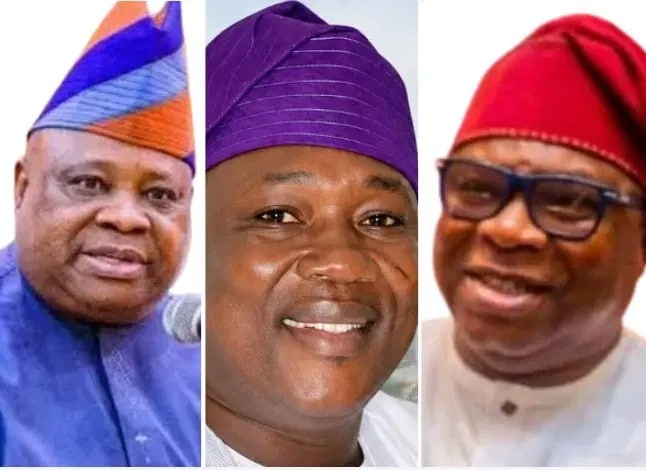
Governor Ademola Adeleke, seeking re-election on the platform of the Accord Party, projected himself as a tested administrator whose record should earn him another term.
His major challenger, the All Progressives Congress candidate, Asiwaju Munirudeen Bola Oyebamiji, argued that Osun requires a change of government and promised to make hunger, poverty, security and human capital development central to his administration.
The African Democratic Congress candidate, Dr Najeem Salaam, presented himself as a combination of political experience, academic training and administrative knowledge, while promising to restore peace and end political thuggery.
For the African Action Congress candidate, Olajide Esan, the central problem is a disconnect between government and citizens. His proposed solution is greater public participation, transparency and accountability.
The debate therefore offered voters a glimpse into four competing approaches to the future of the state.
Adeleke: ‘I Am A Bulldozer’
Adeleke opened the debate with an aggressive defence of his administration and an emphatic rejection of concerns over the political influence of the Federal Government and APC governors campaigning for Oyebamiji.
He described himself as a “bulldozer” and insisted that he was not intimidated by the political machinery backing his opponent.
“I am a bulldozer. I am talk and do. I am not afraid of federal might and governors backing the APC candidate. If they like, they should bring all the governors,” Adeleke said.
The governor also downplayed the significance of the APC governors’ support for his opponent, saying their presence in Osun would not translate into votes.
“Those governors are my friends. I am a civilised administrator. They won’t vote; they can only come and dance, and after the election, we will meet,” he said.
At the heart of Adeleke’s campaign is his claim that his administration has delivered visible infrastructure and social-sector improvements.
He said his government had constructed about 350 kilometres of roads, while another 160 kilometres were under construction. He also claimed that several roads abandoned by previous administrations had been completed.
“I promised my people of Osun State that I would govern with the fear of God and bring home what is called the dividends of democracy. Our work speaks for itself.”
Adeleke said the transformation carried out by his administration had become visible enough to surprise visitors to the state.
“A lot of people have come down to Osun State, especially the state capital, and they missed their way because of the transformation we have accomplished.”
Healthcare also featured prominently in his defence of his record.
According to the governor, about 200 healthcare centres had been rehabilitated and equipped with facilities including beds and solar lighting.
“When I came in, I went around all our health centres. I said this is not acceptable. As of today, we have fixed about 200 healthcare centres. We put poles, solar lights, beds and everything is looking so beautiful,” he said.
On agriculture, Adeleke said his administration had purchased 31 tractors and supplied farmers with seedlings and other inputs.
He rejected APC criticisms of the quality of roads constructed under his administration, dismissing them as propaganda.
The governor also addressed criticism over his public dancing, arguing that his personality outside official duties should not be confused with his performance in office.
“I am a very prudent person and a very serious person. Nobody will stop me from dancing. As I am dancing, I am working. Dancing is a hobby that doesn’t disturb or affect my work.”
He challenged his critics to examine his record.
“Go and fact-check it. You will know how much I’ve done,” he said.
Security And The Question Of Militarisation
Security emerged as one of the most sensitive issues surrounding the election.
Adeleke rejected allegations that his administration had militarised Osun ahead of the poll, stressing that the deployment of the armed forces was outside his constitutional powers.
“I did not militarise Osun. I have no such capacity. I am not the Commander-in-Chief of the Armed Forces. Mr President is the Commander-in-Chief,” he said.
He said his administration had instead strengthened the Amotekun security outfit, claiming that more than 1,500 personnel had been recruited and trained by retired military and police officers.
On the conduct of the election, Adeleke appealed directly to voters to protect their ballots.
“I am always preaching free and fair elections because I know what is called democracy. It is the people. It is the Osun people that will decide.”
He further urged voters not to leave polling units immediately after casting their ballots.
“My people, this election is going to be a free and fair election. No violence. When you vote, stay and make sure your vote is counted. Follow your vote from the unit to the collation centre.”
Adeleke also expressed support for state police, saying his commitment to the rule of law would apply even where those involved were politically or personally connected to him.
“I believe in state police. When I was in the Senate, I was the one that introduced State Policing. If it is my son that committed an offence, he will go and face the law.”
“I am not going to bend for anybody. I believe in the rule of law,” he added.
Ede, The Airport And The Politics Of Development
One of the criticisms directed at Adeleke has been the allegation that his administration favours Ede, his hometown, in the distribution of projects.
The governor rejected the allegation, particularly in relation to the proposed airport.
He said the location was determined after experts examined different possible sites.
“It’s not my fault that my town got blessed with lands. I invited all the experts to go and look for land where they can site the airport. They went around and ended up in Ede,” he said.
Asked whether he would congratulate his opponent if he lost the election, Adeleke was unequivocal.
“Forget about it. I’m not going to lose this election because I’m so confident.”
Oyebamiji: ‘We Want To Banish Hunger And Poverty’
Oyebamiji approached the debate from the standpoint of an opposition candidate seeking to turn dissatisfaction with the incumbent into a demand for change.
He rejected the suggestion that his candidacy was dependent on the influence of the Federal Government or APC governors.
Instead, he said his campaign had been driven by direct engagement with residents across the state.
For Oyebamiji, governance must not be restricted to particular communities or political strongholds.
“Governance is about people, it’s not about segments. It’s not about an area. It’s not about a city. It is not about a town. It’s the entirety of the state,” he said.
His economic pitch centred on food security, poverty reduction and investment in key sectors.
“We want to banish hunger and poverty. I want to invest seriously in agriculture, education, and health,” he said.
He also promised to make security, human capital development and residents’ welfare priorities of his administration.
Oyebamiji challenged Adeleke’s claim that the Federal Government was mobilising political forces to influence the election, saying he had not encountered evidence of such a plan during his extensive campaign.
“I actually listened to Mr. Governor and I can see that most of the answers to that question were not true. I have visited 30 local government areas in Osun State three times. Nobody has ever heard that,” he said.
He said his interactions with community leaders, party members, artisans, traders, lawyers and civil servants had convinced him that there was an appetite for political change.
“I am convinced beyond reasonable doubt that our people in Osun are ready for a change. I’m coming here as the incoming governor of Osun, come August 15, 2026,” he said.
The N650bn Question
The APC candidate also mounted a financial challenge to Adeleke’s administration, questioning how federal allocations received during the governor’s tenure had translated into development across the state.
Oyebamiji claimed Osun received about N650 billion in federal allocations during Adeleke’s three-and-a-half years in office, compared with about N450 billion received over 12 years under the APC administrations of former governors Rauf Aregbesola and Gboyega Oyetola.
He further claimed that Adeleke inherited about N15 billion from Oyetola.
The APC candidate questioned the relationship between the money received by the state and what residents could see on the ground.
“How does N650 billion match what we see in Osun today?”
He also alleged that about 97 per cent of the resources were concentrated in only two local government areas, describing the situation as unacceptable.
“That is an aberration; actually, it is criminal,” he queried.
The claims formed part of Oyebamiji’s broader argument that the election should be treated as a referendum on the performance of the incumbent administration.
Salaam: ‘Osun People Do Not Want Thuggery Again’
For Salaam, the defining issue in Osun is not merely who can build more roads or announce more projects, but who can restore confidence and peace in a state where political violence has become a recurring concern.
The ADC candidate said his background in governance, political science and agriculture had prepared him for the demands of office.
“I’m contesting to build on achievements of past governments that did it well and to correct the challenges that we have today,” Salaam said.
He promised to run a government centred on citizens and accountability.
“My government is going to be a people-centred government,” he said.
Salaam placed considerable emphasis on his academic background, noting that his doctorate was in political science.
“My doctorate degree is not honorary. It’s a doctor of philosophy in political science. I read political science in my first degree, second degree, and up to the PhD level,” he said.
But his strongest message was directed at political violence.
“Osun people do not want thuggery again because they see us as the most peaceful party. They also know the only candidate that can bring peace is Najeem Salaam and the only party that can bring peace is the ADC,” he said.
He alleged that weapons and political thuggery remained serious problems in the state.
“Osun people know that if they give it to A or B, they will fight. I can tell you that Osun is filled with thuggery and ammunition. So, we will bring peace,” Salaam said.
His broader promise was to build a state where governance delivers tangible benefits to citizens.
“To build a better today and tomorrow for Osun. I will go in to develop Osun in a better way, give people what belongs to them. I am more fit than any other governor,” he said.
Esan: ‘Give Governance Back To The People’
Esan’s campaign pitch was built around a different proposition: that Osun’s biggest governance challenge is the distance between public officials and the citizens they are supposed to serve.
The AAC candidate accused politicians of turning poverty and other social difficulties into tools for political mobilisation rather than problems to be solved.
His answer, he said, was to make citizens active participants in governance.
“Going into my vision, what is important to me is to give governance back to the people, because instead of leaders serving the people in Nigeria, especially in Osun State, it is the people who are serving the leaders,” he said.
Esan proposed the creation of an Osun Residents Database, which he said would provide government with accurate information for planning and service delivery.
“Part of the plans, we have what I call the Osun residents database. This database will give us the opportunity to have the information of Osun residents and to also be able to put the right things in place for Osun people,” he said.
He also proposed a financial dashboard that would allow citizens to monitor government expenditure.
“Financial dashboard will give Osun people the opportunity to monitor and to track government spendings, so that if one error happens, they can call me, ‘youth governor, where is our one naira?’” Esan said.
For him, transparency is central to breaking the cycle of politics as a business.
“Accountability is very important. Because the lack of accountability is what is making politics a lucrative business to career politicians,” he said.
Four Visions, One Election
The town hall meeting exposed the central fault lines in the Osun election.
Adeleke is asking voters to judge him by the physical projects and interventions he says his administration has delivered, while portraying himself as an incumbent unafraid of the political machinery backing his challenger.
Oyebamiji is presenting the election as a choice between continuity and change, using poverty, resource management and the perceived condition of the state to make his case for the APC.
Salaam is seeking to make security and peace the centre of the debate, positioning himself as a candidate capable of moving Osun away from political violence.
Esan, meanwhile, is offering a governance model built around citizen participation, financial transparency and data-driven administration.
Beyond the rhetoric, however, the decisive question will ultimately belong to Osun voters.
The candidates have made their promises. They have defended their records, attacked their opponents and offered competing explanations of what has gone wrong — and what can be fixed.
On August 15, the electorate will determine which of those competing visions deserves the mandate to govern Osun.




Leave a Reply