
By Paul Joseph
As global climate change continues to impact Nigeria, the country’s climate outlook for 2026 suggests a challenging scenario characterized by both early and late rainfall, changes in cessation times, prolonged dry spells, higher-than-average temperatures, and increased risks across various sectors.
This information was shared by the Nigerian Meteorological Agency (NiMet) during the launch of the 2026 Seasonal Climate Prediction (SCP) in Abuja, underscoring the urgent need for climate-conscious national planning.
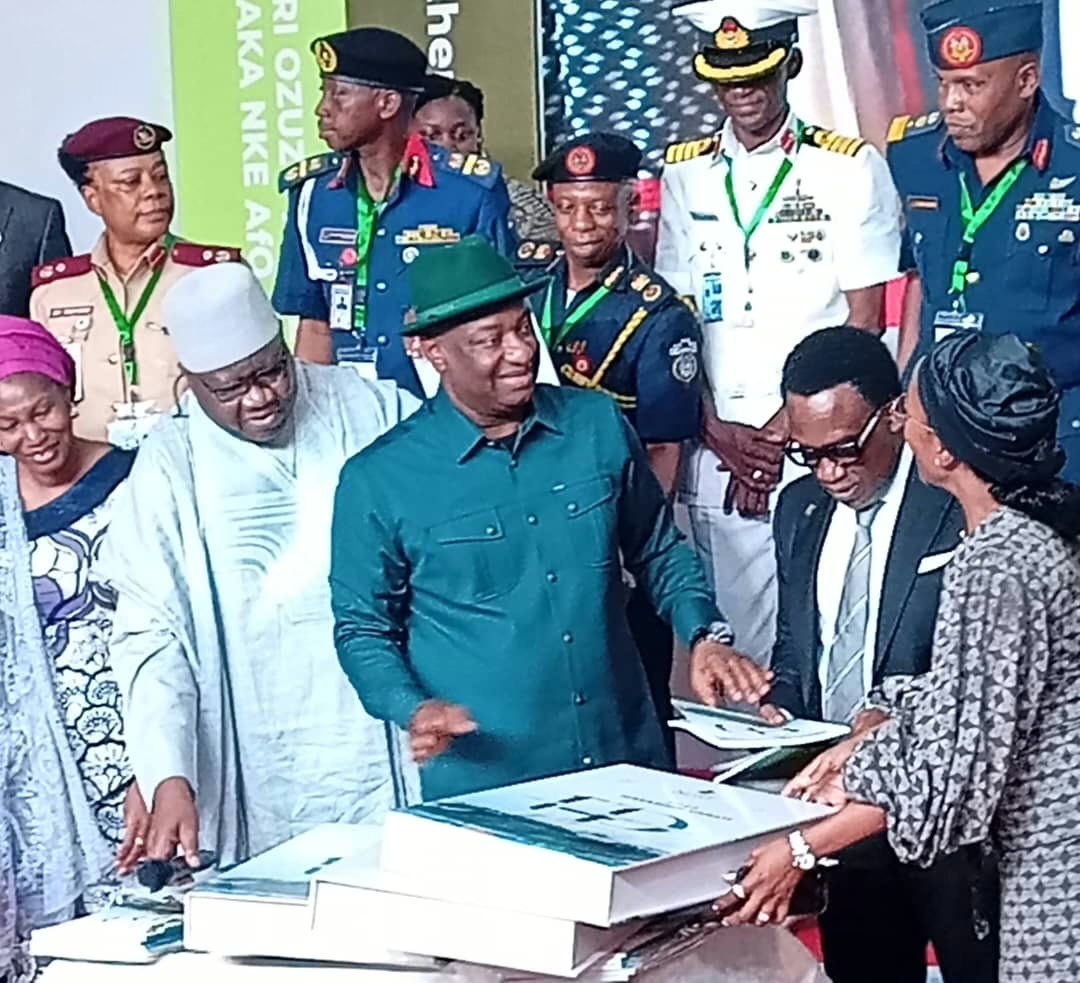
The SCP was unveiled on February 10, 2026, at the Nigerian Air Force Conference Centre in Abuja, with attendance from senior government officials, policymakers, scientists, development partners, and representatives from the private sector.
The event also featured the release of the 2025 State of the Climate in Nigeria, highlighting the link between climate science, economic resilience, and national development.
In his keynote speech, the Minister of Aviation and Aerospace Development, Barrister Festus Keyamo, described the Seasonal Climate Prediction as a vital national resource that has evolved from basic weather forecasting into a crucial tool for governance and economic decision-making.
“The Seasonal Climate Prediction is no longer just about weather forecasts,” Keyamo stated. “It has become an essential asset for national planning, investment strategies, disaster risk management, and economic resilience.”
He noted that NiMet’s early warning systems have significantly improved agricultural productivity and disaster preparedness in recent years, earning recognition from both public and private sector stakeholders.
The minister stressed that climate variability and change are now integral to modern governance, affecting aviation safety, food security, national security strategies, infrastructure development, and the overall welfare of citizens.
“Extreme weather events like heatwaves, droughts, severe thunderstorms, windstorms, and sandstorms are increasingly frequent,” Keyamo observed.
“This reality requires governments to incorporate climate data, meteorological science, and early warning systems into their national planning frameworks.”
He pointed out that under President Bola Ahmed Tinubu’s administration, the Federal Government has prioritized economic stability, food security, infrastructure resilience, climate adaptation, and the protection of lives and livelihoods.
“In this context, timely and accurate weather and climate information is no longer optional,” he emphasized. “It is a strategic enabler of development and effective governance.
The 2026 SCP directly supports the Renewed Hope Agenda by translating complex climate signals into actionable guidance for policymakers and investors.”
Reaffirming his ministry’s backing for the Nigerian Meteorological Agency (NiMet), Keyamo emphasized that dependable meteorological services are crucial for safe, efficient, and sustainable development.
He provided historical context by tracing Nigeria’s climate forecasting history back to 1886, when the first weather observation station was established, praising NiMet for its evolution into a modern, multi-sectoral agency.
“For over 140 years, NiMet has developed into an institution that serves various sectors including agriculture, disaster risk reduction, water resources, health, transportation, energy planning, and national security,” he stated.
Regarding the scientific foundation of the forecast, Keyamo revealed that the 2026 Seasonal Climate Prediction (SCP) was created using global best practices, integrating long-term climatological data, current observations, and significant global climate influences such as the El Niño–Southern Oscillation and the Indian Ocean Dipole.
The SCP predicts an early rainy season in states like Bayelsa, Rivers, Akwa Ibom, Cross River, Benue, Kogi, Nasarawa, and Oyo, while Borno State is expected to experience a later onset.
Rainfall is anticipated to conclude earlier than usual in parts of Ogun, Osun, Ondo, Imo, Rivers, Akwa Ibom, Kogi, and Niger States, whereas a delayed end to the season is forecast for Lagos, Ogun, Anambra, Enugu, Cross River, Benue, Nasarawa, and Kaduna States.
Most of the country is projected to receive near-normal annual rainfall, with above-normal levels expected in Borno, Sokoto, Kebbi, Kaduna, Enugu, Cross River, Abia, Ebonyi, Akwa Ibom, and the Federal Capital Territory. In contrast, below-normal rainfall is predicted for regions in Katsina, Zamfara, Kwara, Oyo, and Ogun States.
The report also highlights the potential for significant dry spells, including severe dry periods lasting over 15 days from March to May in parts of Oyo and Ogun States, and extended dry spells of up to 21 days during the June, July, and August period in several northern and central states.
The August Break is expected to be particularly severe and prolonged in Lagos, Ogun, Ekiti, and parts of Oyo States.
The launch of the 2026 Seasonal Climate Prediction (SCP) in Abuja has garnered attention from international government officials, including Professor Celeste Saulo, Secretary-General of the World Meteorological Organization (WMO), Mohamed Dkhissi, Permanent Representative of Morocco to WMO, Dr. Eric Asuman, Permanent Representative of Ghana to WMO, and a representative from the South African Weather Service, among others.






Leave a Reply