
By George Omagbemi Sylvester
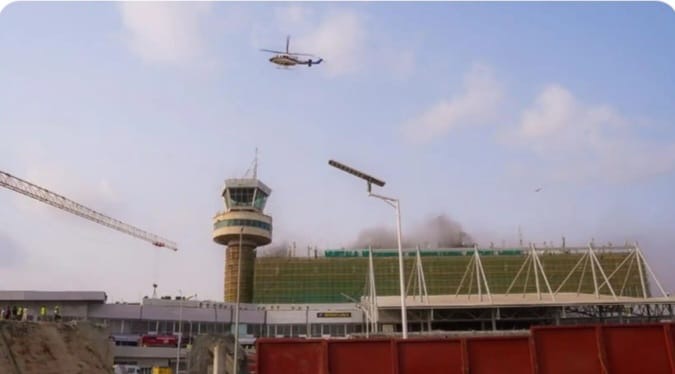
The Federal Government has temporarily closed Nigerian airspace following a fire outbreak at the international terminal of Murtala Muhammed International Airport in Ikeja, Lagos, in a decisive move aimed at safeguarding lives and preventing further operational risk. The incident occurred in the early hours of Sunday, February 23, 2026, sending shockwaves through the aviation sector and prompting immediate emergency response from airport authorities and federal agencies.
According to preliminary findings released by the Federal Airports Authority of Nigeria (FAAN), the fire originated from an electrical fault within the terminal’s power control section. The blaze reportedly affected parts of the departure screening and administrative areas before it was contained by the airport’s fire and rescue services in collaboration with the Lagos State Fire Service. No fatalities were recorded, though several sections of the terminal sustained structural and electrical damage, leading to flight disruptions and the diversion of inbound aircraft.
The Minister of Aviation and Aerospace Development, Festus Keyamo (SAN), confirmed that the closure of airspace was a precautionary measure pending a full safety audit. He stated that while the fire was swiftly contained, aviation safety protocols required a comprehensive inspection of navigational systems, terminal facilities, and electrical infrastructure before normal operations could resume. “Safety is non-negotiable in global aviation practice,” he said, emphasizing Nigeria’s commitment to international standards.
FAAN’s Managing Director, Olubunmi Kuku, disclosed that initial investigations point to a power surge linked to aging electrical infrastructure. Engineers are currently conducting forensic assessments to determine the precise trigger mechanism and whether routine maintenance protocols were adequately followed. The Nigerian Civil Aviation Authority (NCAA) has also commenced an independent review.
Aviation safety experts argue that the incident underscores long-standing concerns about infrastructure resilience at Nigeria’s busiest airport. Professor John Ojikutu, Secretary-General of the Aviation Safety Round Table Initiative, has previously warned that “systemic neglect of airport electrical systems can create catastrophic vulnerabilities in high-traffic facilities.” Similarly, industry analyst and former commandant of the Murtala Muhammed Airport, Group Captain John Ojikutu (rtd), has stressed that preventive maintenance, not reactive response, must define airport management culture.
Murtala Muhammed International Airport, commissioned in 1978 and named after former Head of State General Murtala Ramat Muhammed, remains Nigeria’s primary international gateway, handling millions of passengers annually. While modernization projects have been undertaken in recent years, experts maintain that portions of its legacy infrastructure require sustained upgrades.
The Lagos State Fire and Rescue Service confirmed that emergency responders arrived within minutes of distress alerts, preventing escalation into adjoining terminal sections. Airport police units and the Department of State Services coordinated crowd control and security management during the evacuation process.
Passengers were advised to contact airlines for updates as several outbound flights were delayed or rerouted to Abuja and Port Harcourt. Airline operators are working with FAAN to assess the operational and financial implications of the shutdown.
Dr. Akin Olateru, former Director-General of the NCAA, once observed that “aviation safety is built on layers of prevention; when one layer weakens, the system becomes exposed.” The Lagos fire incident has now brought that warning into sharp focus.
As investigations continue, the Federal Government faces renewed scrutiny over infrastructure maintenance, regulatory enforcement and investment in aviation safety systems. While the swift containment of the fire averted casualties, the closure of national airspace reflects the seriousness of the threat and the high stakes involved.
For Nigeria, the episode is both a warning and an opportunity: a warning against complacency in critical infrastructure management and an opportunity to implement lasting reforms that align its aviation sector with global best practices.





Leave a Reply