
By Opeyemi Adelakun
Nigeria’s 2027 presidential race is gradually moving beyond early declarations and political consultations into a more structured phase, with opposition figures exploring different platforms, alliances and strategies ahead of the election.
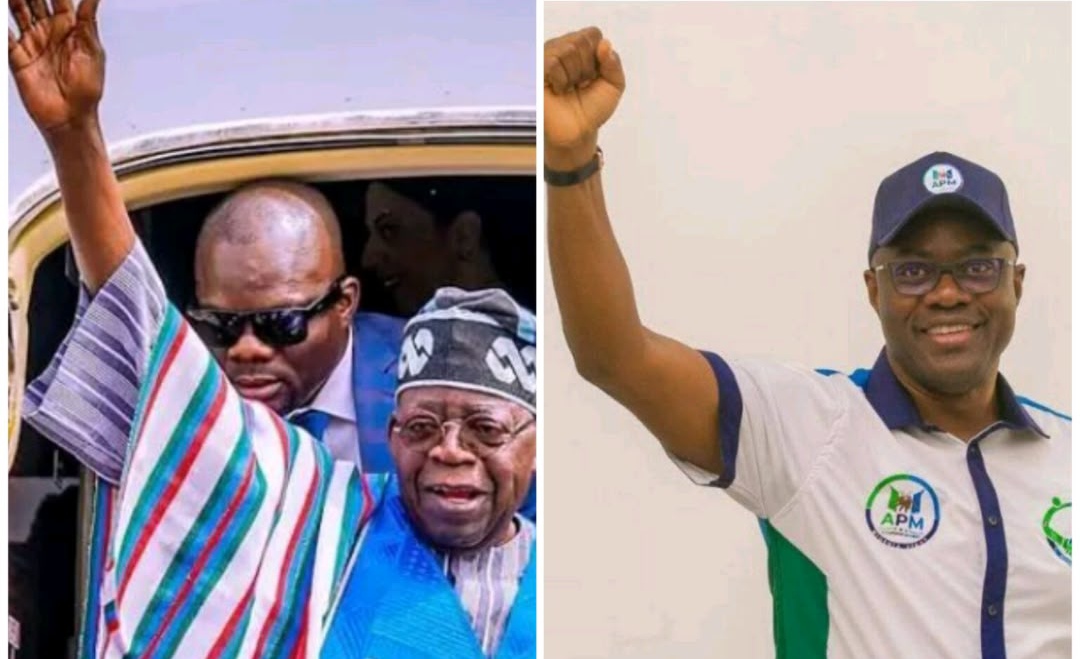
Among the developments attracting attention is the emergence of Oyo State Governor Seyi Makinde as the presidential candidate of the Allied Peoples Movement (APM), alongside the party’s efforts to build a broader national political structure.
Makinde formally declared his presidential ambition in May under an arrangement involving the PDP and APM and was subsequently presented as APM’s presidential candidate. The party has since commenced its campaign activities, including the commissioning of its presidential campaign office in Abuja in September.
The development has placed Makinde in a crowded opposition field that includes other prominent presidential contenders.
But the central issue is no longer simply whether Makinde is running.
The bigger question is whether APM can develop the political structure, alliances and national reach required to make his candidacy a significant factor in the 2027 contest.
From Oyo to Abuja
Makinde brings with him an unusual political asset: he is entering the presidential contest as a sitting governor with an established record in Oyo State.
He won the governorship in 2019 and secured a second term in 2023. His administration has consistently highlighted infrastructure, education, investment and public-sector reforms as key areas of its record.
That experience provides a foundation for a national campaign built around governance rather than solely opposition to the incumbent administration.
Makinde has also increasingly presented his presidential project around the idea of a broader national reset. At the commissioning of his APM campaign office in Abuja, he described the campaign as an opportunity to engage Nigerians on what should change in the country.
The challenge, however, is translating a state-level political structure into a genuinely national organisation.
APM gives Makinde a platform outside the traditional PDP-APC contest.
But the party must now answer a practical question: how does it build a nationwide political machine capable of competing across Nigeria?
The party has already begun taking steps in that direction. In September, the Makinde/Daura campaign announced zonal town-hall meetings designed to engage stakeholders across the six geopolitical zones.
That suggests an attempt to move beyond campaign rallies towards issue-based engagement.
Still, national political organisation requires more than public events. It requires functioning structures, candidates, local mobilisation, financing, polling-unit presence and alliances capable of surviving the pressures of an election campaign.
The opposition coalition question
Perhaps the most important variable is the broader opposition landscape.
Makinde is not operating in isolation. Atiku Abubakar, Peter Obi and other political figures are pursuing their own political projects, while different opposition parties and factions continue to discuss cooperation.
Makinde and Obi have also appeared together in recent political engagements. Obi attended the commissioning of Makinde’s APM presidential campaign office in Abuja and publicly described Makinde as qualified to contest for the presidency, while also calling for opposition politicians to focus on issues affecting Nigerians.
But political engagement should not automatically be interpreted as a concluded electoral alliance.
Indeed, there have been competing positions over the reported PDP-APM arrangement. In May, FCT Minister Nyesom Wike publicly rejected the claim that a formal PDP-APM alliance existed, while Makinde and APM had presented their arrangement as an opposition collaboration.
That disagreement illustrates the larger difficulty facing opposition politics: cooperation may be widely discussed, but translating discussions into binding agreements over candidates, platforms and political structures is considerably more complicated.
Beyond regional calculations
Regional politics is also likely to feature prominently in the 2027 debate.
Makinde comes from the South-West, the same geopolitical zone as President Bola Ahmed Tinubu. Arguments about regional rotation and where the presidency should go next are already forming part of political discussions.
But there is no constitutional provision requiring the presidency to rotate between regions.
For Makinde, the challenge is therefore broader than regional identity. A presidential campaign would have to demonstrate an ability to connect its message with voters across the six geopolitical zones.
Oyo as political evidence
Makinde’s experience in Oyo remains central to his national pitch.
His supporters can point to his two governorship victories as evidence of his ability to build electoral coalitions in a state where the political landscape has shifted significantly over the past seven years.
The national contest, however, presents a different scale of challenge.
A presidential election requires a candidate to build support across multiple regions, political interests and demographic groups. A political strategy that works in Oyo must therefore be substantially expanded before it can become a national electoral strategy.
Recent political movements in the state, including the movement of politicians between parties, also show that political alignments remain fluid ahead of 2027.
The road ahead
The Makinde-APM project now faces several tests.
The first is organisation: can APM establish a durable national structure?
The second is coalition-building: can different opposition interests agree on common objectives without allowing disagreements over leadership and candidacy to break the arrangement?
The third is messaging: can Makinde’s Oyo experience be translated into a national programme that addresses economic hardship, security, employment, infrastructure and other concerns confronting Nigerians?
The fourth is political durability. Early alliances and public endorsements can generate attention, but their significance ultimately depends on whether they translate into sustained organisation and electoral support.
APM has already moved from speculation to formal campaign activity. Its presidential campaign office has been opened, Makinde has begun presenting his national message, and the campaign has announced consultations across the country.
Whether those steps develop into a broader opposition structure remains an open political question.
For now, the Makinde-APM project represents one of several attempts to reshape the opposition landscape ahead of 2027.
Its eventual significance will depend less on the number of political meetings, endorsements or defections and more on whether it can convert its emerging alliances and campaign structures into a coherent national organisation capable of competing across Nigeria.
That is the test that lies ahead.



Leave a Reply