
By George Omagbemi Sylvester
In the restless commercial heartbeat of Lagos, where millions wake each morning to the blare of traffic horns and the urgency of survival, a rock musician has chosen an unusual method to deliver a simple but powerful message: pause, breathe, and feel loved.
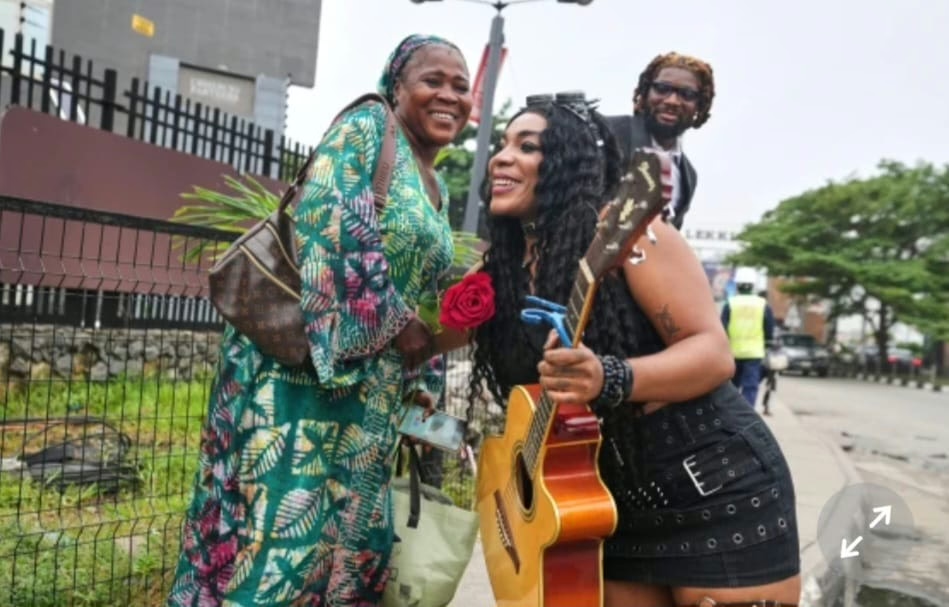
In the days leading up to Valentine’s Day 2026, Nigerian rock artist Bianca “Clayrocksu” Okorocha took to the streets of Lagos with her guitar, serenading unsuspecting commuters and handing out single-stem roses. The spontaneous street performances, carried out alongside fellow musician Daniel Onyemachi-Chiweolu, aimed to inject moments of warmth into a city increasingly defined by economic hardship and social anxiety.
The scenes unfolded in typical Lagos fashion: busy sidewalks, impatient traffic, and residents rushing through the day. Then, suddenly, a guitar chord cut through the noise, followed by a love song and an outstretched rose. Initial shock often turned into smiles as strangers realised the gesture was genuine.
Okorocha explained that the idea was born from the heavy mood that currently hangs over the country. “We just thought it was a special and nice thing to do for people,” she said, noting that much of the news cycle has been dominated by hardship and uncertainty.
Her message is deliberately simple but socially resonant: love should not be limited to romantic partners. “Valentine is really just about sharing love,” she said, emphasising that compassion should extend to strangers, friends, and the less privileged.
The timing of the initiative is significant. Since President Bola Tinubu’s economic reforms began in 2023, including the removal of a decades-old fuel subsidy, Nigeria has experienced one of the sharpest cost-of-living crises in recent memory. Food prices have surged, and insecurity in the country’s north has disrupted agricultural production, further straining urban households.
In such an environment, even symbolic gestures carry social weight. Nigerian residents who encountered the musicians described the experience as uplifting. One commuter, Barbara Lulu, said the unexpected serenade interrupted a stressful day and left her smiling.
Scholars of urban life argue that such small acts can play an important role in cities under pressure. American sociologist Jane Jacobs once observed that the vitality of a city is not measured solely by infrastructure or wealth, but by “the countless small interactions” that create trust and belonging. Her insight resonates strongly in a megacity like Lagos, where anonymity and economic strain often overshadow human connection.
Similarly, social psychologist Erich Fromm argued in The Art of Loving that love is not merely an emotion but a deliberate social practice that must be cultivated through everyday actions. In this sense, Okorocha’s street performances represent more than a Valentine’s gimmick; they are an attempt to restore a sense of shared humanity in a climate of economic distress.
Cultural analysts also note that music has historically served as a coping mechanism in societies facing adversity. Nigerian music historian Benson Idonije has often argued that Nigerian popular music, from highlife to Afrobeat and rock, has functioned as “both an escape and a mirror,” reflecting hardship while offering emotional relief. Okorocha’s approach fits squarely within that tradition, using melody and symbolism to soften the harsh edges of urban life.
What distinguishes this initiative, however, is its immediacy. Rather than performing on stage or releasing songs online, the artist chose direct human contact; serenading strangers in real time, on real streets, amid real struggles. It is an old-fashioned, almost analogue approach in a digital era, yet one that appears to have struck a chord.
For many Lagos residents, Valentine’s Day often revolves around commercial romance: gifts, dinners, and social media displays. Okorocha’s message challenges that narrative, redefining love as a communal ethic rather than a private celebration. In a city where survival frequently overshadows sentiment, even a brief moment of kindness can feel revolutionary.
In the end, the story is simple but profound. A guitarist, a rose, a song, and a fleeting reminder that even in the most unforgiving urban rhythms, there is still room for tenderness.
As Lagos continues to navigate economic turbulence and social strain, such gestures may not solve structural problems. But they do something equally important: they remind people that amid the chaos, someone, somewhere, still believes in the power of lov





Leave a Reply