

By George Omagbemi
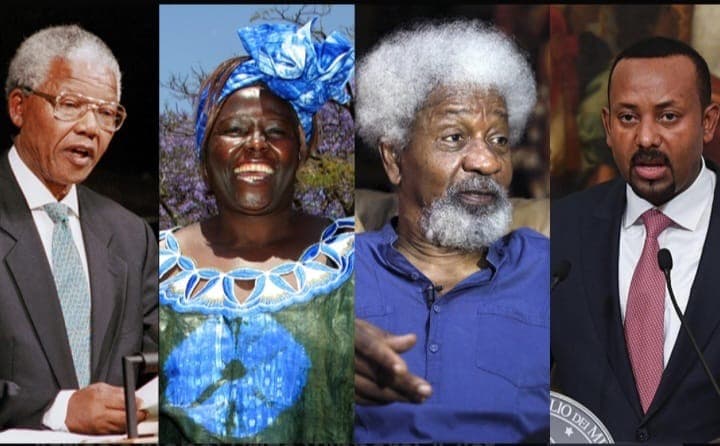
From the struggle against apartheid to groundbreaking discoveries in medicine, chemistry and physics, and from literature to international peace-building, Africans have made remarkable contributions to humanity.
Over the decades, individuals connected to the African continent have received the Nobel Prize, one of the world’s most prestigious international honours. Their achievements demonstrate that Africa’s contribution to global knowledge, human rights, scientific advancement and cultural development extends far beyond the continent’s political and economic challenges.
The Nobel Prize was established through the will of Swedish inventor Alfred Nobel. The first awards were presented in 1901. The recognised categories include Physics, Chemistry, Physiology or Medicine, Literature and Peace. The Sveriges Riksbank Prize in Economic Sciences in Memory of Alfred Nobel was introduced in 1969.
Between 1960 and 2026, several African nationals and Africa-born individuals have received these honours. Their stories deserve recognition, particularly because many of their contributions remain insufficiently known among younger generations across the continent.
The Pioneers: 1960–1989
- Albert John Luthuli – South Africa (1960, Nobel Peace Prize)
Albert Luthuli made history in 1960 when he became the first Black African to receive the Nobel Peace Prize. As president of the African National Congress (ANC), he was recognised for his non-violent struggle against apartheid in South Africa. His commitment to racial equality and peaceful resistance made him an important figure in the global anti-apartheid movement.
- Anwar Sadat – Egypt (1978, Nobel Peace Prize)
Egyptian President Anwar Sadat shared the 1978 Nobel Peace Prize with Israeli Prime Minister Menachem Begin for their efforts to negotiate peace between Egypt and Israel. His historic 1977 visit to Jerusalem and the subsequent Camp David Accords paved the way for the 1979 Egypt-Israel peace treaty.
- Allan MacLeod Cormack – South Africa (1979, Nobel Prize in Physiology or Medicine)
Born in Johannesburg, Cormack shared the 1979 prize with British scientist Godfrey Hounsfield for developing computer-assisted tomography, commonly known as CT scanning. Their work transformed medical imaging and helped doctors examine the human body without surgery.
- Aaron Klug – South African-associated scientist (1982, Nobel Prize in Chemistry)
Born in Lithuania, Klug moved to South Africa with his family as a young child. He was honoured for developing crystallographic electron microscopy and explaining the structures of biologically important nucleic acid-protein complexes.
- Desmond Tutu – South Africa (1984, Nobel Peace Prize)
Archbishop Desmond Tutu received the Nobel Peace Prize for his leadership in the non-violent campaign against apartheid. He became one of the most influential religious and moral voices opposing racial discrimination and advocating equality and reconciliation.
- Claude Simon – Madagascar-born French writer (1985, Nobel Prize in Literature)
Born in Antananarivo, Madagascar, Claude Simon received the Literature Prize for his innovative writing, which combined literary and visual techniques to explore memory, history and the human condition.
- Wole Soyinka – Nigeria (1986, Nobel Prize in Literature)
Nigeria’s Professor Wole Soyinka became the first Black African to receive the Nobel Prize in Literature. A playwright, poet, novelist and political activist, Soyinka was recognised for his wide-ranging literary work and his ability to explore human existence through powerful dramatic and poetic expression.
His achievement remains a landmark in Nigerian and African literary history. It demonstrated that African stories, languages, cultural experiences and intellectual traditions belong on the world’s most respected literary platforms.
- Naguib Mahfouz – Egypt (1988, Nobel Prize in Literature)
Mahfouz became the first Arabic-language writer to receive the Nobel Prize in Literature. His novels explored Egyptian society, family relationships, politics, religion and social transformation. His famous Cairo Trilogy remains an important contribution to world literature.
The 1990s: Democracy, Science and Human Rights
- Nadine Gordimer – South Africa (1991, Nobel Prize in Literature)
Gordimer was recognised for her powerful novels and stories examining apartheid, racial injustice and the moral challenges facing South African society. Her writing became an important literary record of life under institutionalised racial discrimination.
- Nelson Mandela – South Africa (1993, Nobel Peace Prize)
Nelson Mandela shared the Nobel Peace Prize with former South African president F.W. de Klerk for their efforts to peacefully dismantle apartheid and establish the foundations of democratic government.
Mandela’s life became a symbol of resistance, reconciliation and the struggle for human dignity. After spending 27 years in prison, he became South Africa’s first democratically elected Black president in 1994.
- F.W. de Klerk – South Africa (1993, Nobel Peace Prize)
De Klerk shared the award with Mandela for his role in ending apartheid and facilitating the country’s transition to democracy. His government released Mandela in 1990 and lifted bans on liberation movements, creating the conditions for negotiations.
- Claude Cohen-Tannoudji – Algeria-born French physicist (1997, Nobel Prize in Physics)
Born in Constantine, Algeria, Cohen-Tannoudji shared the 1997 Physics Prize with Steven Chu and William D. Phillips for developing methods of cooling and trapping atoms using laser light. Their discoveries advanced modern atomic physics.
- Ahmed Zewail – Egypt (1999, Nobel Prize in Chemistry)
Zewail was recognised for developing femtosecond spectroscopy, a technique that allows scientists to observe chemical reactions at extremely short timescales. His work opened new possibilities in understanding how molecules change during chemical reactions.
2000–2010: Africa’s Contributions to Peace, Medicine and Science
- Kofi Annan – Ghana (2001, Nobel Peace Prize)
The former United Nations Secretary-General shared the Peace Prize with the United Nations for their work towards a better-organised and more peaceful world. Annan championed international cooperation, human rights and efforts to address global challenges.
- Sydney Brenner – South Africa (2002, Nobel Prize in Physiology or Medicine)
Brenner shared the prize with H. Robert Horvitz and John E. Sulston for discoveries concerning genetic regulation of organ development and programmed cell death. His work helped advance modern molecular biology.
- J.M. Coetzee – South Africa (2003, Nobel Prize in Literature)
The novelist was recognised for literary works that examine power, colonialism, morality and the experiences of outsiders. His celebrated novels include Waiting for the Barbarians and Disgrace.
- Wangari Maathai – Kenya (2004, Nobel Peace Prize)
Maathai became the first African woman to receive the Nobel Peace Prize. She founded the Green Belt Movement, which mobilised women to plant trees and protect the environment. Her work connected environmental conservation with democracy, women’s rights and sustainable development.
- Mohamed ElBaradei – Egypt (2005, Nobel Peace Prize)
ElBaradei shared the award with the International Atomic Energy Agency, where he served as Director-General. They were recognised for efforts to prevent nuclear energy from being used for military purposes and to promote its peaceful and safe use.
- Doris Lessing – Zimbabwe-associated British writer (2007, Nobel Prize in Literature)
Born in Persia, now Iran, Lessing moved with her family to Southern Rhodesia, present-day Zimbabwe, during childhood. Her experiences in Africa influenced much of her writing. She was recognised for her powerful exploration of women’s experiences, politics and divided societies.
2011–2021: Women’s Leadership, Justice and Literary Excellence
- Ellen Johnson Sirleaf – Liberia (2011, Nobel Peace Prize)
Liberia’s former president shared the award with Leymah Gbowee and Yemen’s Tawakkol Karman. They were recognised for their non-violent struggle for women’s safety and their right to participate fully in peace-building.
Sirleaf also made history as Africa’s first elected female head of state.
- Leymah Gbowee – Liberia (2011, Nobel Peace Prize)
Gbowee mobilised Christian and Muslim women in Liberia to demand an end to the country’s civil war. Her grassroots peace movement helped build pressure for negotiations and greater participation of women in national peace-building.
- Serge Haroche – Morocco-born French physicist (2012, Nobel Prize in Physics)
Born in Casablanca, Haroche shared the Physics Prize with American scientist David Wineland for experimental methods that made it possible to measure and manipulate individual quantum systems.
- Michael Levitt – South Africa-born scientist (2013, Nobel Prize in Chemistry)
Levitt shared the prize with Martin Karplus and Arieh Warshel for developing multiscale models used to understand complex chemical systems. Their work strengthened the relationship between computer modelling and modern chemistry.
- Tunisian National Dialogue Quartet – Tunisia (2015, Nobel Peace Prize)
Unlike the individual laureates, this award went to a coalition of four Tunisian civil society organisations. The quartet played a major role in helping Tunisia avoid political collapse after the 2011 revolution and in supporting a peaceful democratic transition.
- Denis Mukwege – Democratic Republic of the Congo (2018, Nobel Peace Prize)
Mukwege, a gynaecologist and humanitarian, was recognised alongside Nadia Murad for efforts to end the use of sexual violence as a weapon of war. Through Panzi Hospital, he has treated and supported thousands of women who survived sexual violence during armed conflict.
- Abiy Ahmed – Ethiopia (2019, Nobel Peace Prize)
Ethiopian Prime Minister Abiy Ahmed received the Peace Prize for his efforts to achieve peace and international cooperation, particularly his initiative to resolve the long-standing border conflict between Ethiopia and Eritrea. The award followed the 2018 peace agreement between the two countries.
- Abdulrazak Gurnah – Tanzania (2021, Nobel Prize in Literature)
Born in Zanzibar, Gurnah was recognised for his compassionate exploration of colonialism, displacement and the experiences of refugees. His novels examine identity, migration and the lasting consequences of colonial rule.
2026: Navi Pillay Adds to Africa’s Nobel History
- Navi Pillay – South Africa (2026, Nobel Peace Prize)
South African jurist Navanethem “Navi” Pillay received the 2026 Nobel Peace Prize for her efforts to promote peace and international law.
Born in Durban in 1941, Pillay built an internationally distinguished legal career. She served as a judge of the South African High Court, president of the International Criminal Tribunal for Rwanda and United Nations High Commissioner for Human Rights.
Her work helped advance international recognition of sexual violence as a crime against humanity and contributed to the development of legal accountability for serious human rights violations.
The Norwegian Nobel Committee recognised her contributions to international justice, accountability for war crimes and the strengthening of the international legal order.
Her 2026 award adds another significant chapter to South Africa’s Nobel history.
What Africa’s Nobel Record Tells Us
The achievements of these laureates reveal an important story about Africa. The continent’s contribution to humanity is not limited to its natural resources, population or cultural diversity. Africans and people whose lives and work are closely connected to Africa have contributed to scientific discoveries, medical innovation, literature, environmental protection, international diplomacy and the defence of human rights.
South Africa has produced a particularly notable number of Nobel laureates, while Egypt, Nigeria, Ghana, Kenya, Liberia, Tanzania, Ethiopia, the Democratic Republic of the Congo and Tunisia have also featured prominently.
However, there is another important conversation: how can African countries create environments where more scientists, researchers, writers, inventors and peace-builders can develop their talents without having to leave the continent to access world-class facilities and opportunities?
Winning a Nobel Prize is not the only measure of intellectual achievement. Countless African teachers, researchers, doctors, engineers, writers and community leaders make contributions that may never receive international recognition.
The challenge for African governments is to invest in education, research institutions, universities, libraries, laboratories, creative industries and scientific innovation.
Africa must not simply celebrate the achievements of its Nobel laureates; it must build institutions capable of producing the next generation.
The greatest tribute to these men and women would be a continent where talent is discovered, supported, rewarded and allowed to flourish.
Africa has contributed to the world’s knowledge and progress. The next chapter should be about creating even more opportunities for Africans to lead that progress.
Source Credit: This article was inspired by and expanded from Intel Region’s report, “Meet the Africans Who Have Won the Nobel Prize from 1960 to 2026.” Additional biographical details and Nobel Prize information were incorporated to provide a broader account of Africa’s Nobel history.
Written and Compiled by George Omagbemi Sylvester.

Leave a Reply