
By George Omagbemi Sylvester
In a development with profound implications for global security and the volatile Middle East geo‑strategic landscape, Iran has declared that it remains prepared to engage in substantive discussions about its controversial nuclear programme, but only if the United States is willing to seriously address the crippling economic sanctions that lie at the heart of the dispute.
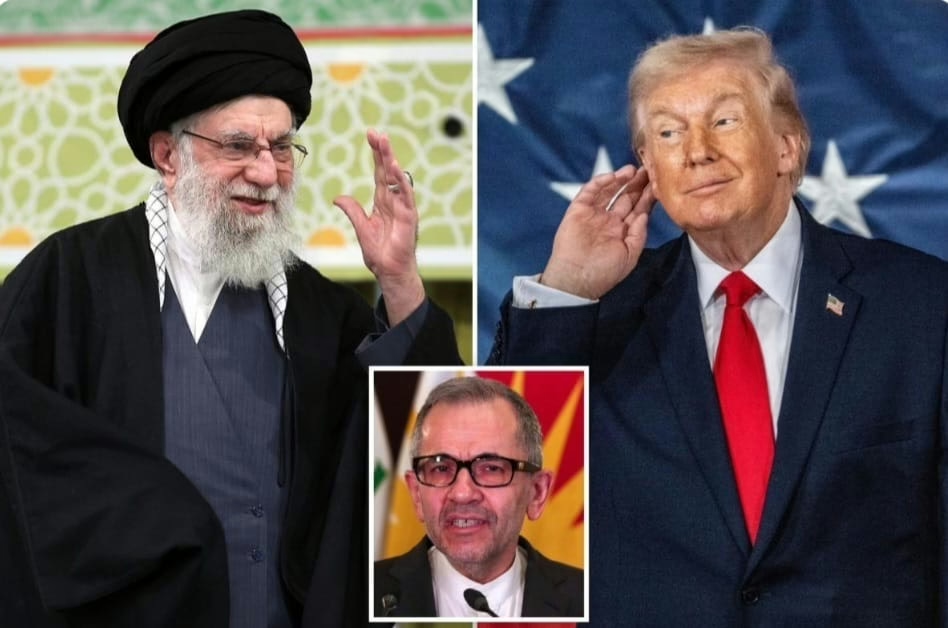
This assertion came most recently from Majid Takht‑Ravanchi, the Iranian Deputy Foreign Minister, in an interview with the BBC. Takht‑Ravanchi stated unequivocally that Tehran is willing to consider “compromises to reach a nuclear deal with the United States” provided Washington is ready to consult on sanctions relief. He underscored that initial indirect talks have been “more or less in a positive direction,” but cautioned it is too early to make definitive judgments.
The backdrop to this announcement is the resumption of direct diplomatic engagement for the first time in years and notably after months of indirect negotiations facilitated by Oman, with a second round of talks scheduled this week in Geneva.
The nucleus of the impasse lies in three core issues:
Sanctions relief: Iran’s demand is straightforward: a rollback of the extensive U.S. sanctions regime that has crippled its economy, including punitive measures targeting its oil exports and banking sectors. Tehran insists it will not meaningfully curtail its nuclear activities without concurrent economic benefits.
Uranium enrichment: Iran currently enriches uranium to high levels (around 60 per cent purity) far above the limits set by the 2015 Joint Comprehensive Plan of Action (JCPOA). This enrichment level, while technically below weapons‑grade, is a red line for the United States and its Western partners, who argue it brings Iran close to the capability to construct a nuclear weapon. Tehran denies any intention of building such weapons and insists its programme is for peaceful purposes.
Missile and regional security issues: The U.S. has sought to fold Iran’s ballistic missile programme and its support for armed groups across the Middle East into any comprehensive deal with a proposition Tehran has consistently rejected as outside the scope of nuclear negotiations.
Analysts and policy experts have highlighted the delicate balancing act Tehran is attempting. Dr. Tina Kaidanow, former U.S. State Department Coordinator for Iran Nuclear Implementation, observes that “Iran’s willingness to engage diplomatically is significant, but it must be matched by Washington’s readiness to deliver tangible incentives. Without that, rhetoric risks collapsing back into confrontation.”
Similarly, Dr. Karim Sadjadpour, senior fellow at the Carnegie Endowment for International Peace, cautions: “Tehran’s gesture on dilution and compromise is tactical, seeking relief from economic distress. However, unless sanctions (including those crippling the banking sector) are meaningfully addressed, any negotiated pause will be precarious.”
These views highlight an enduring tension: Iran sees sanctions as a strategic lever of power and leverage, while the United States views limits on enrichment and transparency as indispensable for global non‑proliferation norms.
This diplomatic overture arrives amid escalating tensions across the Middle East. Just days ago, Israeli Prime Minister Benjamin Netanyahu insisted that any U.S. deal must go further than a halt in enrichment, demanding the dismantling of Iran’s nuclear infrastructure altogether.
Iranian Foreign Minister Abbas Araghchi met with IAEA Director General Rafael Grossi in Geneva, underscoring the technical dimension of ongoing nuclear scrutiny and signaling Iran’s commitment to engage with the U.N. nuclear watchdog amid persistent tensions.
U.S. President Donald Trump (while publicly open to diplomacy) has maintained the specter of military action should negotiations fail, even as he told Netanyahu he had insisted that talks continue despite Israel’s push to expand the agenda.
The stakes transcend the Middle East. Iran’s nuclear programme is at the crossroads of non‑proliferation norms, U.S. foreign policy, regional power dynamics involving Israel and Saudi Arabia and global energy security. Markets are already sensitive with oil prices edging upward in anticipation of the talks.
A failed diplomatic effort risks escalating into a broader military confrontation, undermining not just regional stability but potentially global economic equilibrium. Conversely, a deal that addresses sanctions while ensuring verifiable limits on Iran’s nuclear activities could open a rare window for de‑escalation and economic normalization.
Iran’s declaration of openness to meaningful nuclear negotiations marks a pivotal moment, but one fraught with entrenched positions. Tehran’s readiness to discuss compromise is conditional, firmly anchored to sanctions relief. Washington’s response, and whether it is prepared to reciprocate with concrete concessions, will determine whether the world witnesses a thaw in one of the longstanding flashpoints of modern geopolitics or a descent back toward confrontation.
The ball, as Iranian officials emphasize, is irrevocably in America’s court.




Leave a Reply