
By Editor Drealomalicha Emmanuella
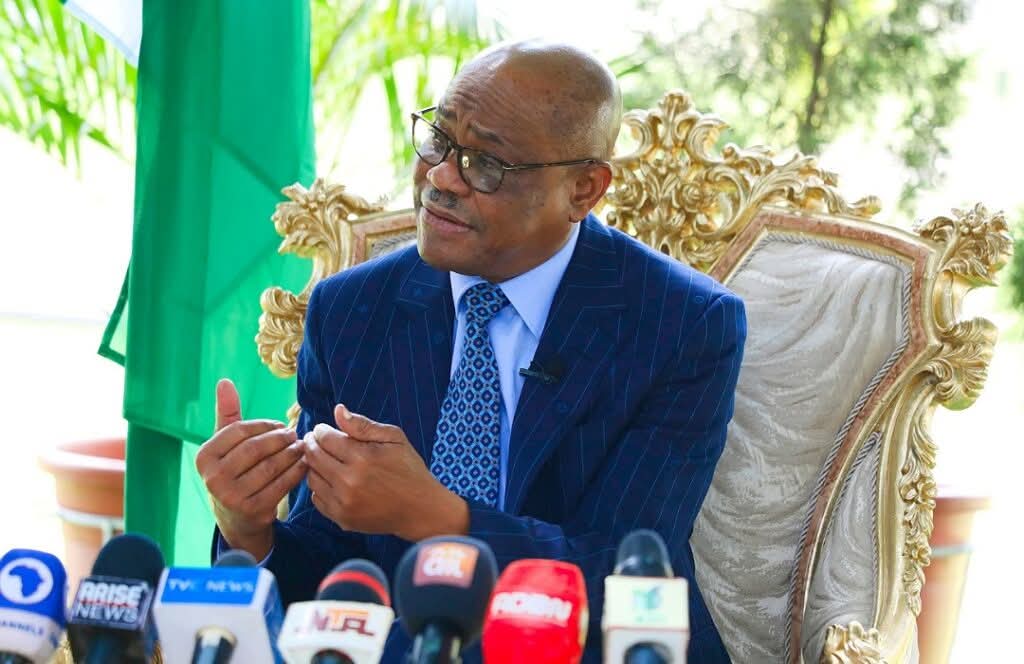
The Minister of the Federal Capital Territory (FCT), Nyesom Wike, has come under scrutiny after admitting he was so angered by a television broadcast that he felt like “shooting through the screen” at a journalist.
Wike made the remark on Friday during a media chat in Abuja, while reacting to comments made by Channels Television presenter Seun Okinbaloye on the programme Politics Today.
The exchange follows Thursday’s broadcast, which examined the leadership crisis within the African Democratic Congress (ADC) and the implications of recent decisions by the Independent National Electoral Commission (INEC).
During the programme, Okinbaloye raised concerns about the state of Nigeria’s democracy, warning against the risks of a weakened opposition. He suggested that if the ADC widely viewed as one of the opposition’s viable platforms fails to participate in the 2027 general election due to internal divisions, it could undermine democratic competition.
He said he was “particularly pained” by the prospect, noting that elections are most meaningful when they are competitive, rather than dominated by a single political force.
Responding, Wike criticised the journalist for what he described as a departure from professional neutrality. He accused Okinbaloye of expressing personal opinions rather than maintaining the impartial stance expected of an interviewer.
“I was thoroughly surprised,” Wike said. “If there was any way to break the screen, I would have shot him. How can you, as an interviewer, say we cannot have only one party? You are now expressing your own views.”
The minister argued that while journalists are entitled to ask probing questions, they must refrain from making statements that could be perceived as taking sides in politically sensitive matters.
Amid the backlash that followed his comments, Wike clarified that his statement was not intended as a literal threat but rather as an expression of frustration.
The incident has since sparked debate about the boundaries between journalistic commentary and neutrality, as well as the tone of public discourse among political leaders.

Leave a Reply