
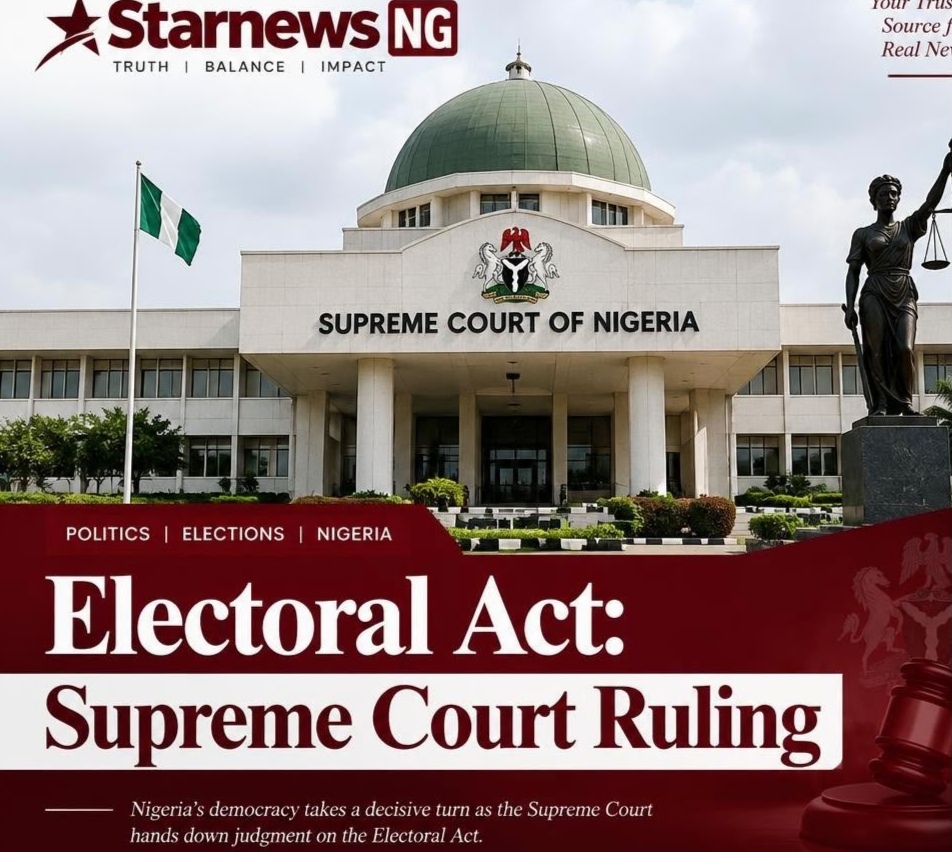
ABUJA, NIGERIA — The Supreme Court of Nigeria has delivered a staggering blow to political “nomads” and multi party ticket arrangements, ruling that candidates who decamp to secondary platforms or loose coalitions after losing initial primary elections stand disqualified from the ballot, Starnews NG can report.
The historic verdict, delivered on Thursday, 24 September 2026, by a seven member panel, upheld an appeal filed by the Independent National Electoral Commission (INEC). In doing so, the apex court set aside an earlier Court of Appeal judgment and fully restored Sections 77(5), 77(6), 77(7), and 84(2) of the Electoral Act 2026.
The Two Fatal Judicial Blows to Defectors
In its sweeping decision, Starnews NG reports that the Supreme Court handed down two definitive rulings that systematically dismantle the traditional backup strategies used by Nigerian politicians:
Strict Ban on Multiple Primaries: The court ruled that anyone who participated in more than one party primary election is disqualified. This means an aspirant can no longer test the waters in a major party’s primary and, upon losing, immediately run in another party’s emergency primary to secure a ticket.
The Absolute May 2026 Cut Off: The court declared that anyone whose name was not in a party’s register as of May 2026 is not a member of that party. By upholding this strict statutory timeline, the court has made it legally impossible for politicians to retroactively register with an alternative party or “rainbow coalition” to pick up a ticket after losing their original party’s primary later in the cycle.
The End of Rainbow Coalitions and Secondary Nominations
For years, a standard playbook existed for wealthy or influential political actors in Nigeria: contest a primary election in a major political party, and if the outcome proves unfavourable, quickly decamp to a “rainbow coalition” or an alternative platform like the Peoples Democratic Party (PDP) to purchase a fresh ticket.
The Supreme Court’s strict validation of Section 77(5) officially throws those candidacies into the lagoon. Because a politician cannot simultaneously appear on multiple submitted registers under the strict statutory cut off dates, any primary loser who jumps ship to grab a coalition ticket will find themselves automatically disqualified under the law.
Parties Face Exclusion Over Non Compliance
The ruling does not just target individual defectors; it places immense structural pressure on political organisations. Under the restored provisions, any political party that fails to submit its authentic membership register within the strict legal timeframe will be declared ineligible to field any candidates for that elective cycle.
Legal experts monitoring the situation for Starnews NG note that this effectively neutralises small “clearance parties”, frequently utilised as emergency vehicle platforms for disgruntled primary losers since they cannot retroactively adjust their baseline rosters to accommodate powerful cross carpers who were not registered members by May 2026.
A New Era of Internal Party Discipline
By cementing Section 84(2), the apex court has reinforced INEC’s authority to strictly regulate candidate nomination processes, limiting loose interpretation of internal party affairs. This judicial finality effectively forces politicians to stay within their respective party structures, support internal primary winners, or accept sitting out the entire election cycle. Opponents now possess an airtight legal weapon to challenge and void the candidacy of any politician attempting to bypass the statutory register guidelines, Starnews NG reports.






Leave a Reply