
By Paul Joseph
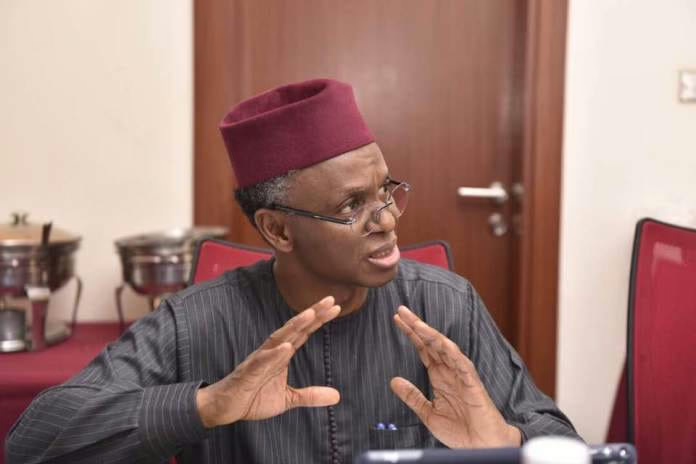
Former Kaduna State governor, Nasir Ahmad El-Rufai has disowned Kaduna State Governor Uba Sani as political son and rejected assertions of being a Godfather to the governor. The assertion also claims that El-Rufai is the political mentor of his successor, Governor Uba Sani, but the former Kaduna governor emphasizes that he has no desire to influence or control any successor after his tenure.
In an interview with Trust TV on Monday, El-Rufai firmly stated, “Governor Uba Sani is not my protégé. I have no interest in my successor. I’m not looking to be a political godfather. I haven’t contacted Uba Sani since leaving office, and I have no relationship with him.”
When asked about the frequent conflicts between political mentors and their protégés, El-Rufai argued that these disputes are often misinterpreted and exaggerated, noting that power dynamics shift naturally once authority is handed over.
He shared a lesson from a former military president: “He told me that even if your own son occupies that position of power, on the first day he will greet you as his father, on the second day he will sit in his role, and by the third day, if you don’t address him respectfully, trouble can arise. That’s the nature of power,” he explained.
El-Rufai stated that this early lesson in his life led to his strong opposition to the concept of godfatherism. “I have never believed in godfatherism. Never. I have always been a vocal critic of it,” he remarked.
He recalled facing backlash for his stance against godfatherism, particularly from political figures in Lagos State. “I even went to Lagos and addressed questions about godfatherism, which resulted in attacks against me.
The supporters of Tinubu came after me because they thought I was referring to him. But I was discussing a principle: when you hold power, use it for the public good, and when you’re done, step aside,” he said.
El-Rufai also pointed to his own actions as evidence of his claims, stating that he intentionally distanced himself from previous positions he held.
“After leaving the Bureau of Public Enterprises, I didn’t return for 23 years. Since I left the Federal Capital Territory, I didn’t go back until a former classmate, who became a minister, invited me. When I complete a task, I move on,” he explained.
Regarding his departure from the Kaduna Government House, El-Rufai mentioned that he communicated his intentions to Governor Uba Sani even before the election. “I told him that once he was elected, I would hand over and leave. I wouldn’t even visit Kaduna for the first six months to give him space to adjust,” he stated.
He reiterated that there has been no communication between him and his successor since he left office. “I have never called Uba Sani since leaving office. Not once. If he wants advice, he should reach out to me,” El-Rufai said, adding that he couldn’t remember the last time the governor contacted him, estimating it to be nearly three years ago.
When asked if their relationship had deteriorated, El-Rufai replied frankly, “We have no relationship.”
When asked if the relationship had deteriorated, El-Rufai replied straightforwardly, “We have no relationship.”
Regarding the comparison between the political divide in Kaduna and the recent conflict between Rabiu Musa Kwankwaso and Kano State Governor Abba Kabir Yusuf, El-Rufai advised against making broad comparisons.
“Context is important,” he stated. “I can discuss Kaduna because I know the details. I’m not familiar with what transpired in Kano, and even if I were, I wouldn’t want to comment on it. Such situations occur in politics. Don’t be surprised if they reconcile in a year.”
He wrapped up by calling for caution in political assessments, emphasizing that “unless you have all the information, you should be very careful in forming opinions.”

Leave a Reply