
By Paul Joseph
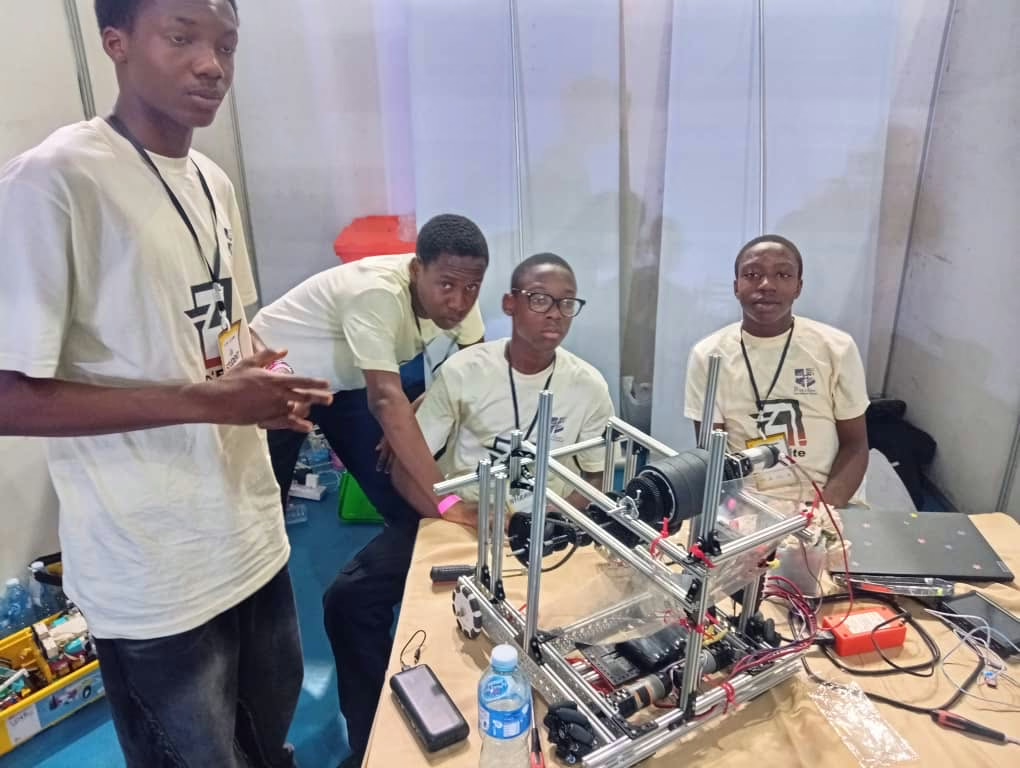
The 2025–2026 First Lego League National Coding Robotics Championships in Abuja, Nigeria, is making strides in promoting tech-driven initiatives among young innovators who are demonstrating their skills at Moshood National Stadium, Package B, Abuja.
On Thursday, Nigerian teenagers confidently took the stage for a three-day global tech event, showcasing their skills with a focus on innovative thinking.
The competition, held at the National Stadium, underscores the increasing influence of Nigerian students in international AI and robotics challenges, with teams designing, coding, and competing using Lego-based technology.
These teenagers are enhancing their knowledge in problem-solving, teamwork, and innovation, proving that Nigeria’s future in artificial intelligence and robotics is promising and already taking shape on the global stage.
The ongoing three-day event is organized by Coderina, led by its founder, Olajire Ademola Ajayi. Speaking to The Trumpet on the opening day of the championship, he expressed enthusiasm about the level of engagement shown by participants and other stakeholders in the initiative.
He acknowledged the positive impact of the collaboration between Coderina and the Federal Ministry of Education, urging them to continue their long term support.
Olajire stated, “I am pleased with the backing from the Nigerian government through the Ministry of Education. Education is becoming more prominent. If you don’t apply what you’ve learned in school, you are falling behind in the technology era.”
He noted that the foundation, established in 2012, has achieved significant success in empowering teachers to teach AI in schools, with both science and non-science students participating. “It is commendable that the government has introduced AI technology into Nigeria’s educational curriculum. Coding and robotics have also been adopted in other countries.”
In addition to introducing robotics, teachers require adequate learning resources to effectively implement these initiatives. We are exploring ways to enhance teachers’ welfare and ensure that young students are taught by well-trained educators. He added.
“We look forward to collaborating with the Nigerian Educational Research and Development Council (NERDC) to provide these essential resources for teachers.
What the students are creating goes beyond the ordinary; they are turning their learning into solid knowledge that will enable them to tackle real-life challenges.
We envision a Nigeria where students and teachers collaborate to develop solutions, fostering creativity and innovation that can compete on a global scale. Our goal is to become exporters of technology rather than importers.
We aim to empower students to become entrepreneurs and teachers to adopt entrepreneurial mindsets. Learning alone is not sufficient; we want to see tangible outcomes being produced”.
Those who excel at this stage will have opportunities to travel to the US, Australia, Canada, and other countries.
During the event, the Minister of Education Dr. Maruf Tunji Alausa, represented by Dr. (Mrs.) Adenike Olodo Muyibat, Director of Technology & Science Education at the Federal Ministry of Education, stated that the government has numerous plans for the youth in the country, including initiatives citing a renowned recent TVET and STEMM initiatives. She emphasized that as the world embraces AI, Nigeria must not be left behind.
“The growing interest among young people in artificial intelligence has prompted the government to invest significantly in this area.
I have always been inspired by this initiative, which has made Nigeria proud on both national and international stages,” she remarked”.
The Nigerian Federal Ministry of Education has been actively promoting technical education.
She added that, the event organized by Coderina in partnership with the Ministry of Education, will continue to showcase a strong collaboration aimed at supporting young innovators through technology.
Dr. Adenike also revealed that the government has many upcoming plans to assist young innovators in uniting their efforts from the various geopolitical zones and bringing them to a national level to maintain their interest in artificial intelligence. “I encourage them to continue this effort in unity,” she stated.
The championship has seen participation from over five hundred thousand individuals across the six geopolitical zones, including federal, unity, state, and private colleges.
Top-performing participants from this tournament will qualify for major championships in three countries, including the United States, Australia, and Canada.






Leave a Reply