

By Paul Joseph
Canada has welcomed a proposal by the European Union to create a new form of “associate membership” for the country, as Ottawa seeks closer cooperation with Europe amid escalating trade tensions with the United States.
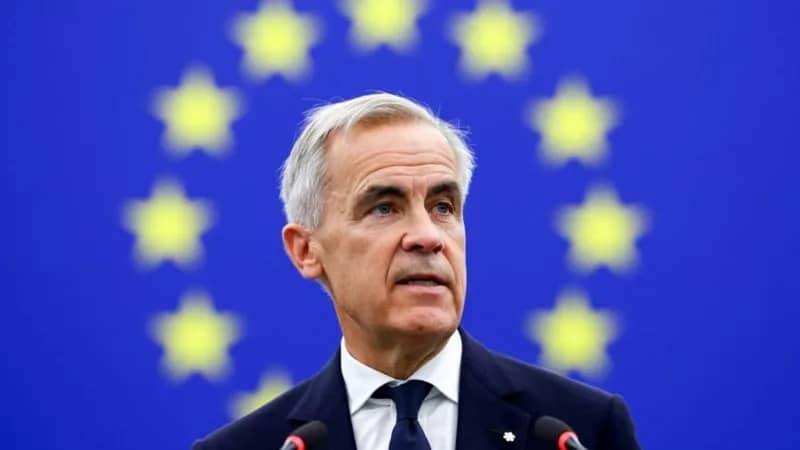
Canadian Prime Minister Mark Carney expressed support for the proposal while addressing the European Parliament in Strasbourg on Thursday, saying Canada and Europe could strengthen cooperation in areas including defence, critical minerals and energy security.
Carney’s comments came a day after European Commission President Ursula von der Leyen proposed opening discussions on making Canada the EU’s first associate member.
The proposed status does not currently exist within the European Union and would require agreement from all 27 member states.
Carney said Canada and Europe were “stronger together” in the face of what he described as major geopolitical changes.
He identified climate change, what he called the erosion of democratic norms and the use of trade measures as instruments of pressure among the challenges facing societies.
According to Carney, closer Canada-EU cooperation could help strengthen the strategic independence of both sides without creating a new geopolitical bloc.
“I am not proposing a third bloc in order to become a great-power rival,” Carney told members of the European Parliament.
The proposal has drawn a warning from US President Donald Trump, who said the United States could impose significant tariffs on Europe if he considered closer Canada-EU ties to be a hostile move.
Trump said that if the proposal was made with “good intention”, he would have no objection, but warned of possible “very heavy tariffs” if he viewed it differently.
Canada and the United States are already engaged in an escalating trade dispute, with both countries imposing tariffs following the collapse of recent bilateral negotiations.
Responding to Trump’s remarks, Carney described the proposed Canada-EU relationship as a positive development.
He also stressed that Canada was not seeking full membership of the European Union, describing the proposed arrangement as a different framework.
Von der Leyen said the proposed relationship could cover manufacturing, technology, defence, energy, critical minerals and economic security.
Canada and the EU already have a free-trade agreement and cooperate in areas such as defence, research and trade.
Carney said Canada could contribute liquefied natural gas and hydrogen to European energy security while benefiting from European expertise in clean-energy technologies.
He also proposed deeper technological cooperation and stronger people-to-people ties, including the possibility of Canada joining the EU’s Erasmus+ programme to expand opportunities for young people to study, work and live across the Atlantic.
Carney said the proposed arrangement remained at an early stage and would be subject to debate and a vote in Canada’s parliament.
A Canada-EU summit is scheduled to take place in Montreal in October, where the two sides are expected to discuss the details of the proposed framework.



Leave a Reply