
By Paul Joseph
The Nigeria Volleyball Federation (NVBF) has taken steps to educate volleyball players at the ongoing 2025 Super Cup in Abuja about the importance of anti-doping as part of a global initiative.
In response to the World Anti-Doping Agency’s concerns regarding the use of performance-enhancing drugs in sports, the NVBF has been proactive in promoting a drug-free environment by hosting an informative seminar for players competing at both national and international levels.
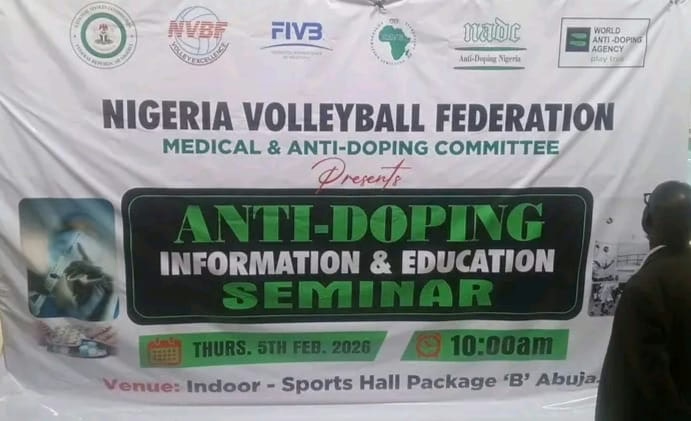
While the matches scheduled for Thursday, February 5th were postponed to pave way for the seminar, the event was held at the Indoor Sports Hall, Package B, of the Moshood Abiola National Stadium, Abuja.
Participants from various clubs in the Super Cup were urged to take anti-doping education seriously, as ignorance of the rules does not protect them from penalties.
Players and officials from over ten clubs, representing both male and female categories, attended the seminar, where they were reminded that understanding anti-doping regulations is a crucial responsibility for elite athletes.
During the Anti-Doping Information and Education Seminar organized by the NVBF Medical and Anti-Doping Committee, the Committee Chair, Mrs. Chinedu Odozor-Onikeku, explained that the initiative aims to educate volleyball players about anti-doping rules and protect their careers in accordance with global standards.
She noted that observations during training sessions indicated a lack of knowledge among athletes regarding proper nutrition, recovery, and medication use, which could harm their performance and lead to anti-doping violations.
Mrs. Odozor-Onikeku pointed out that many athletes are unfamiliar with doping control procedures, as they have never been tested, making the process seem daunting when they encounter it for the first time.
She emphasized the importance of early and ongoing education to help athletes feel comfortable with testing protocols and understand their responsibilities.
She also advised participants to be cautious about their consumption of food, supplements, and medications, stressing that ignorance is not a valid excuse for violations under global anti-doping regulations.
Looking to the future, she highlighted the necessity of incorporating anti-doping education into regular training and competition schedules.
She reaffirmed the Federation’s commitment to promoting clean sport and athlete education, expressing confidence that ongoing awareness programs would better equip Nigerian volleyball players to compete responsibly and confidently on the international stage.
In his lecture, Dr. Paul Onyedo, the former Director of Medicine for the National Sports Commission, cautioned that athletes who are caught doping cannot depend on excuses or requests for leniency, emphasizing that knowledge is the only true protection.
He pointed out that reaching a national level entails responsibilities that extend beyond performance in competitions, insisting that athletes need to be well-versed in anti-doping regulations.
Dr. Onyedo elaborated that violations, whether deliberate or accidental, can destroy careers, stating that claims of ignorance are not acceptable at the elite level, as lack of knowledge is neither a valid excuse nor permissible under anti-doping laws.
He encouraged attendees to retain and study the educational materials provided at the seminar, which serve as a clear guide for what every athlete should understand.
He compared failing to grasp anti-doping rules to scoring an own goal, warning that such ignorance ultimately harms one’s own career. Coaches, athletes, and sports officials were reminded that everyone involved in sports has a responsibility to understand and adhere to anti-doping regulations.
The lecture also emphasized the significance of the World Anti-Doping Agency (WADA), which serves as the global authority in the battle against doping. Athletes were encouraged to become familiar with WADA, its website, and its educational resources. Dr. Onyedo stressed the importance of the World Anti-Doping Code, likening it to a sacred text from which all anti-doping rules and decisions are derived.
He concluded by urging athletes to take charge of their education, warning that a lack of knowledge about anti-doping at the elite level could result in serious repercussions and hinder promising athletic careers.
Additionally, Godspower Odedede, a member of the Anti-Doping Committee for the NVBF and Chairman of the Media Commission, described the anti-doping education seminars as a significant advancement for the development and professionalism of volleyball in Nigeria.
He assured that the program would be maintained through regular training and structured activities, reflecting a shared responsibility within the Nigerian volleyball community to ensure athletes are properly guided and protected as they compete at higher levels.
He stated that the Federation is dedicated to making anti-doping education an ongoing process rather than a one-time event, explaining that regular training sessions would be organized to keep players informed and prevent them from falling victim to avoidable anti-doping violations in the future.
He also mentioned that a detailed program outlining future medical and anti-doping activities would be released soon to keep the media and the public updated on the Federation’s initiatives.
Regarding doping control testing, he confirmed that the Federation is working on implementing testing procedures in collaboration with relevant bodies and qualified personnel, stating, “Yes, testing will be conducted when necessary. We are taking this matter very seriously.”
The initiative to eradicate drug use in global sports was initially spearheaded by the World Anti-Doping Agency, an international organization formed by the governments of over 140 countries in partnership with the International Olympic Committee.
Based in Canada, this agency aims to promote, coordinate, and manage efforts to combat drug use in sports.






Leave a Reply