
By Paul Joseph
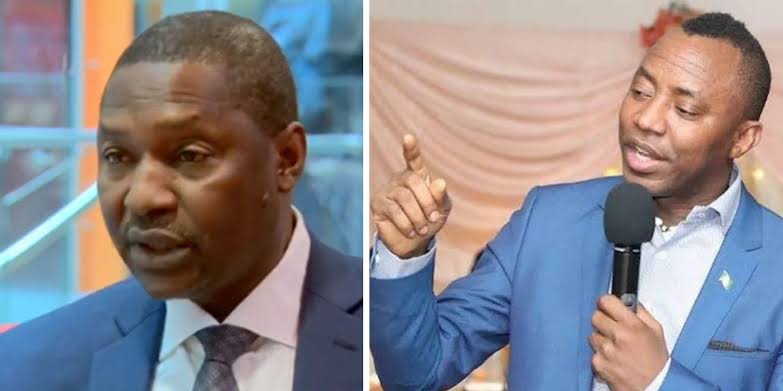
A tense and dramatic exchange unfolded on Monday at the Federal High Court in Abuja as activist and former presidential candidate, Omoyele Sowore, confronted former Attorney General of the Federation, Abubakar Malami, over past prosecutions during the administration of Muhammadu Buhari.
The encounter, which was witnessed by lawyers and court officials, quickly escalated into a heated verbal exchange, with Sowore revisiting what he described as the misuse of state power during Malami’s tenure as the country’s chief law officer.
Sowore, who is also the publisher of SaharaReporters and convener of the #RevolutionNow movement, referenced the treason charges filed against him during the 2019 protests, accusing Malami of targeting dissenting voices.
“The tables have turned,” Sowore said, pointing at the former AGF. “When you were in office, you charged me for treason. Now see how they are dealing with you.”
In a remark laced with sarcasm, Sowore added that he could offer Malami a “RevolutionNow cap,” suggesting that the former minister now better understands the flaws in the system he once oversaw.
Malami, however, maintained a calm and composed stance throughout the exchange, insisting that his commitment to Nigeria remained unchanged.
“I can never be down as far as the Nigerian project is concerned,” he responded.
Sowore went on to recall his court appearances during the Buhari administration, stating that he had warned officials at the time that the government would eventually face criticism over its handling of human rights and rule of law issues.
“When I used to come to court, I told you the regime would end in disgrace. Today, we are on the same side,” he said.
Malami briefly interjected, noting that “the table has a way of turning,” to which Sowore replied that the current situation reflected the consequences of past actions.
The exchange ended with both men reiterating their positions, with Sowore describing Malami’s situation as being on the “side of the oppressed,” while Malami maintained that circumstances evolve over time.
Malami served as Attorney General during a period frequently criticised by civil society organisations over alleged human rights violations, including the prosecution of activists, journalists, and opposition figures.
The courtroom encounter has since drawn attention as a symbolic moment reflecting Nigeria’s shifting political and legal landscape.



Leave a Reply