
By Paul Joseph
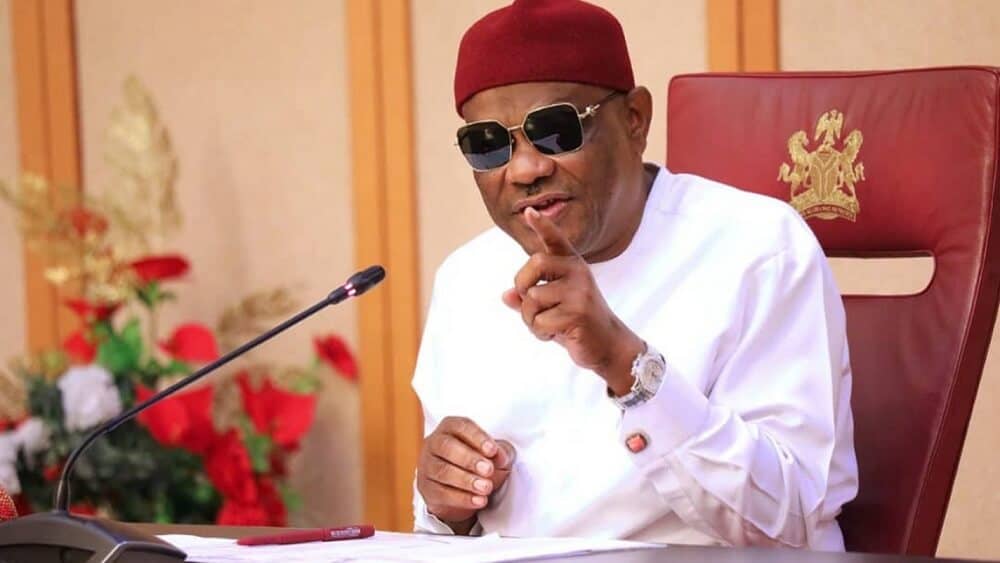
Minister of the Federal Capital Territory, Nyesom Wike, has challenged state governors across the country to publicly account for how they have utilised the additional revenues accruing to states following the removal of the petrol subsidy.
Wike made the call on Wednesday during a media interaction with journalists in Port Harcourt, Rivers State, arguing that individual governors, rather than the Nigeria Governors’ Forum (NGF), should explain to their constituents how the increased allocations have been spent.
The FCT minister said the removal of the subsidy had significantly increased revenues available to the three tiers of government, giving states greater resources to execute projects, pay salaries and pensions and improve public services.
He maintained that the NGF, being an association of governors, could not assume the responsibility of individual state governments to account for public funds.
“What you call the Nigerian Governors’ Forum is an association. I’m a governor of State A, I should be able to defend my State A,” Wike said.
He stressed that governors were elected by citizens of their respective states and therefore owed them direct accountability.
“Rivers State Government is accountable to the citizens of Rivers State. Anambra State Government is accountable because they have been elected by citizens of those states, not by the entire Federation of Nigeria,” he said.
Wike challenged governors to identify projects and programmes funded with the additional revenues received after subsidy removal.
“If Governor Diri says, ‘Look, challenge me. The money that came, see what I’ve done for Bayelsa State,’ fine,” he said, referring to Bayelsa State Governor Douye Diri.
The minister also defended President Bola Tinubu’s decision to remove the petrol subsidy, arguing that the policy had expanded the revenues available to federal, state and local governments.
According to Wike, the success or failure of the policy should ultimately be assessed based on how governments have deployed the additional funds to improve the lives of citizens.
“Today, the states are saying, unlike before, we can’t pay salaries, we can’t pay pensions, strikes all over the places. Are there strikes again now? They can tell you, no,” he said.
He insisted that governments at all levels must demonstrate how public resources had been utilised and show Nigerians tangible results.
Politicians Should Be Consistent, Wike Says
Wike also criticised politicians who he accused of changing their positions on major economic policies for electoral advantage.
“One thing you must take me on is that I am a consistent politician,” he said.
He questioned politicians who previously supported subsidy removal but later promised voters that they would restore the policy if elected.
“If a candidate says yesterday, at the moment you have your vote for me, I’m going to remove subsidy; today the candidate says, ‘No, vote for me, I’m going to bring back subsidy,’ I mean, what kind of candidate is that?” he asked.
The minister urged political candidates to be transparent about their policy positions instead of making promises primarily designed to secure electoral support.
Addressing concerns over whether infrastructure development in Abuja had translated into improved living conditions, Wike rejected the argument that housing should be the only measure of residents’ quality of life.
He said investments in roads, public transportation and other infrastructure had improved movement and access across the Federal Capital Territory.
“Why do we have to only think until everybody gets houses? That’s only when the quality of life has changed. That is wrong,” he said.
Wike argued that better transportation networks, road infrastructure and public services should also be considered when evaluating improvements in residents’ living standards.
On reports of reconciliation with a political associate, Wike confirmed that their differences had been resolved but declined to provide details of their discussions.
“Personal, political, everything settled,” he said.
He added that he had invited the individual for discussions but would not disclose the matters discussed during the meeting.



Leave a Reply