
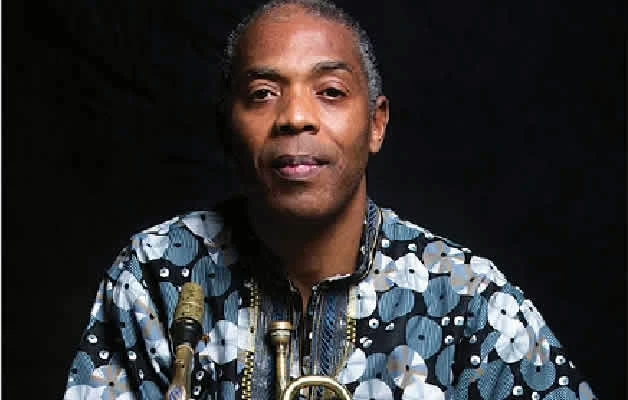
Afrobeat musician Femi Kuti has expressed his regret over the renewed comparisons between contemporary Nigerian music stars and his late father, Afrobeat pioneer Fela Anikulapo-Kuti, describing the debate as unnecessary and unhelpful.
Femi made the remarks during an interview on Arise Television, shared on X on Saturday, stressing that he would not be drawn into celebrity rivalry discussions at a time when Nigeria is grappling with more pressing national challenges.
He said, “I’m sure you have seen I’ve not said anything. Fela is our father; I think I would say all even the younger artists respect him, and I don’t think it was an issue that should have been brought up because he is the template of many things, musically and artistically in Nigeria.”
According to him, Fela should not be placed in competition with present-day artistes, noting that his late father remains the foundation upon which Nigeria’s modern music industry was built.
He said, “So Fela should just be put in a section or sector of his own, and we just idolise and respect him. He’s our father. I don’t want to go into Seun and Wizkid’s matter because, you know, Seun is my brother, Wizkid is like a son. I just wish it did not arise. Hopefully, everybody will calm down very soon.”
While acknowledging the global success of contemporary Afrobeat artistes, Femi said the focus should be on unity and nation-building rather than rivalry narratives.
“Nigeria has been participating in the Grammys so much these days. It’s good for Africa. It’s good for the country. It’s good we’re getting the recognition we deserve. So I think we should all be happy for ourselves, and we should use all this to build the country, build our music industry, build the nation, come together,” he said.
Femi lamented that deep-rooted challenges such as tribalism, terrorism, and corruption continue to plague the country, urging Nigerians, particularly young people, to prioritise governance and national development.
“Look, tribalism is a big issue in the country today; terrorism is a big issue. Those are the things we should be—young people, myself, everybody should be focused on.
“How is Nigeria going to be safe? How are we going to go back? Look, there was a time when you were sick in the seventies; general hospitals used to give drugs free.
“Things were moving, and Fela was complaining at that time, and many of us could not understand what he was talking about. Now it’s so clear to us that, look, this man saw that corruption was killing Nigeria in those days. And if we keep on discussing this kind of issue that are not relevant to the general public, I think we are part of the downfall of our nation itself,” he said.
Reflecting on his father’s activism, Femi noted that many of the problems Fela sang about decades ago remain unresolved, warning that constant focus on irrelevant public debates could worsen the nation’s decline.
He said, “If young people don’t start to take the baton into their hands and start to demand good government, we’re going to be in trouble very soon. Because as you see, Fela spoke; he’s gone. It’s 29 years he has been gone now, and we’re still discussing the same issues.”
Femi also revealed that political themes continue to dominate his music and that of his family, questioning how long artistes would continue to address the same societal problems without meaningful change.
“It’s sad that all my life now, 40 years in the business, 90% of my songs are political as well. So, I mean, Seun is doing his thing. Made now, my own son, he has two albums; it’s political.
“How long are we going to be political, and there’s still so much poverty in the land? How long are we going to be talking about kidnapping and terrorism? And you know, how long? When is the country going to come together to really build a nation as it should be?” he said.
The debate resurfaced after Afrobeat star Wizkid was quoted as saying he was bigger than Fela, a remark that sparked widespread reactions online, particularly involving Seun Kuti. Shortly after, the late Fela Anikulapo-Kuti was nominated for a Grammy Lifetime Achievement Award, reigniting conversations about his enduring influence on Nigerian music and younger generations of artistes.



Leave a Reply