
By Charles Maduka
A coalition of Muslim women’s groups has renewed its call for an end to discrimination against women who wear the hijab across the country, urging authorities to fully respect constitutional and court-backed protections.
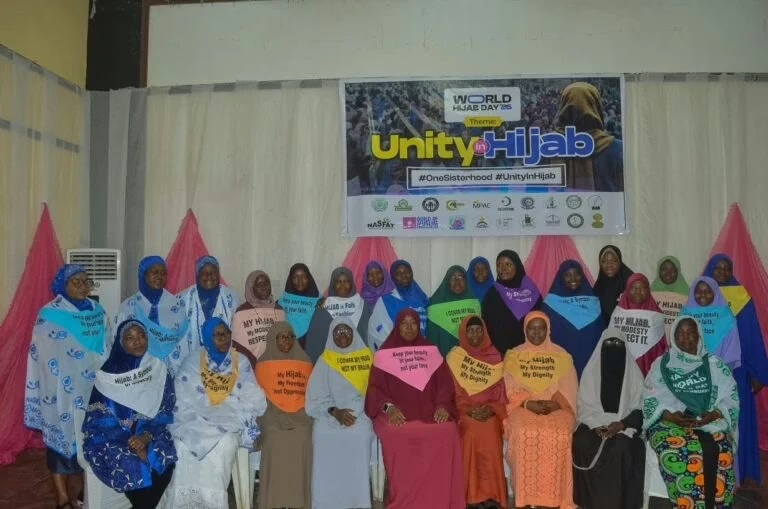
The call was made during a briefing held to mark World Hijab Day at the Lagos State Secretariat Community Central Mosque Hall in Ikeja. The global event was observed under the theme “Unity in Hijab,” while the local theme was tagged “One Sisterhood.”
Executive Director of the Hijab Rights Advocacy Initiative, Mutiat Orolu-Balogun, said Muslim women in Nigeria joined millions around the world to affirm the hijab as a symbol of faith, dignity and unity, rather than a tool for exclusion. She explained that World Hijab Day is aimed at promoting religious tolerance and understanding.
Orolu-Balogun noted that the hijab cuts across ethnicity, social class and ability, uniting Muslim women as one community. She, however, lamented that despite constitutional guarantees, hijab-wearing women continue to face harassment, denial of opportunities and restrictions in schools, workplaces and public institutions.
Speaking on the religious basis of the hijab, Maryam Abdur-Rasheed of the Pure Heart Foundation described it as a divine obligation rooted in the Qur’an, not a cultural or political symbol. She cited Section 38 of the 1999 Constitution, stressing that any restriction on the hijab amounts to a violation of the fundamental right to freedom of religion.
Kudrah Ogunmuyiwa of the Federation of Muslim Women’s Associations in Nigeria drew attention to the situation of Igbo Muslim women, describing them as facing double vulnerability due to both their faith and ethnicity. She condemned hate speech and threats against Igbo Muslims and called on security agencies and community leaders in the South-East to take firm action.
On inclusion, Hussainat Akintola of Al-Muminaat highlighted the challenges faced by Muslim women with disabilities. She called for disability-friendly mosques, inclusive policies and reasonable accommodations, noting that many women are excluded from public and religious spaces due to inaccessibility and insensitive treatment.
Addressing discrimination in schools, Rofiat Tijani of the Muslim Students’ Society of Nigeria, Lagos Area Unit, criticised what she described as subtle but persistent violations of Muslim students’ rights. She said practices such as forcing students to tuck in their hijabs, conceal them under berets or face suspension persist despite Supreme Court rulings affirming their rights.
Concerns were also raised about treatment at ports of entry and government offices. Akanbi Maryam of Akhwaat alleged that hijab-wearing women are often compelled to remove their hijabs for biometric capture, contrary to Nigerian regulations and international standards.
Similarly, Ummulkhayr Adeleke-Lawal of the Nasrul-Lahi-L-Fatih Society condemned reports from driver’s licence centres where Muslim women are allegedly denied biometric capturing unless they expose their ears. She noted that Federal Road Safety Corps guidelines and global biometric standards do not require visible ears, describing the practice as discriminatory.
Emphasising unity, Dr Halimah Ogunbekun of An-Nujabau said no Muslim woman should be marginalised because of ethnicity, disability or location. She stated that discrimination, not the hijab, is what divides society.
Presenting the coalition’s demands, Nimat Salako of the Lagos State Secretariat Community Central Mosque and Riskiah Adam-Adedimeji of The Criterion called on the Federal Government, state governments, law enforcement agencies, schools and regulatory bodies to issue clear directives, train personnel, sanction offenders and establish effective complaint mechanisms to protect hijab rights.
The coalition also urged the President, governors, lawmakers and citizens to uphold justice and constitutional values, expressing hope that the year would mark a turning point where unity and equal rights prevail over prejudice and discrimination.



Leave a Reply