

By Gloria Drealomalicha
Nigeria is bleeding.
Across villages and cities, mothers are crying themselves to sleep, fathers are selling properties to pay kidnappers, and children are growing up in a country where going to school has become a life-threatening gamble.
Yet, while fear spreads across the nation like wildfire, those in power appear more interested in celebration, politics and public relations.
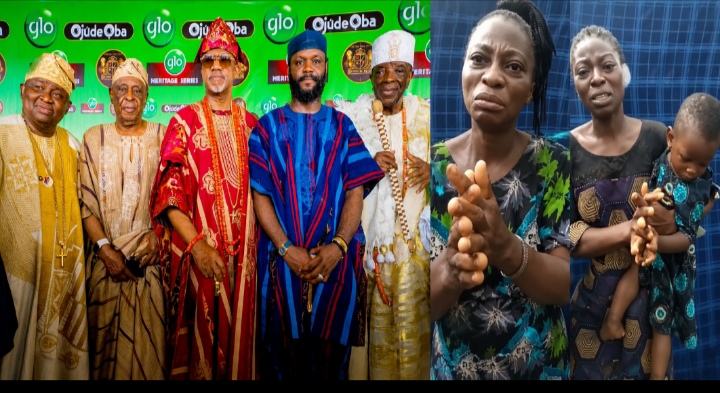
The now-viral images and videos from the glamorous Ojude Oba festival in Ogun State have ignited fresh anger among Nigerians already pushed to the edge by insecurity, hunger and economic suffering.
There stood members of the political elite like the Ogun state governor, Dapo Abiodun, the said soon-to-be-governor of Ogun state, Solomon Yayi, the minister of Art, culture and tourism, Hon. Hannatu Musa Musawa with her obvious flamboyant gele smiling, dancing, dressed in expensive flowing agbada surrounded by fanfare, luxury and praise singing.
Among the prominent faces spotted at the colourful event was Seyi Tinubu, son of President Bola Ahmed Tinubu, alongside powerful dignitaries and APC figures basking in the glamour of the moment.
But while champagne glasses clinked and cameras flashed, another video was circulating online a heartbreaking clip involving the principal connected to victims of a school kidnapping in Oyo State.
A woman’s pain. A nation’s shame.
That contrast has become the perfect symbol of today’s Nigeria.
A country where leaders celebrate while citizens mourn.
A country where politicians appear obsessed with 2027 campaigns while ordinary Nigerians bury their loved ones and negotiate with kidnappers for survival.
The anger erupting online is not merely about a cultural festival. Nigerians love Ojude Oba. Nigerians respect culture and tradition.
The outrage is about timing, priorities and shocking political insensitivity.
At what point did governance become so disconnected from human suffering?
At what point did leadership lose compassion?
Under President Bola Tinubu’s administration, insecurity has continued to spread like a dangerous stain across the country. From the North-West to the South-West, from highways to schools, Nigerians are living in fear.
Bandits operate boldly. Kidnappers negotiate ransoms openly. Terrorists attack communities with terrifying confidence.
Yet the federal government often appears emotionally absent.
The silence has become deafening.
Many Nigerians say they no longer feel protected by the state. Instead, citizens have been abandoned to fend for themselves in a country where survival now depends on luck, private security or divine intervention.
The situation becomes even more painful when one considers the economic hardship crushing millions of households.
Since the removal of fuel subsidy, transport fares have exploded. Food prices have become unbearable. Inflation has devastated families. Salaries have lost value almost overnight.
Parents cannot feed their children properly.
Graduates roam the streets without jobs.
Small businesses are collapsing daily.
Still, the political class continues to move from one celebration to another as if the country is not sitting on a keg of gunpowder.
What has further fuelled public anger is the perceived silence of First Lady Oluremi Tinubu over the suffering of kidnapped schoolchildren and traumatised families.
As a mother, a former senator and the nation’s First Lady, many Nigerians expected her to rise emotionally in moments like this to comfort grieving families, to publicly demand urgent action, and to stand visibly with victims of insecurity.
Instead, critics say her public posture has appeared cold and detached while the nation burns.
Many Nigerians have begun comparing her silence to the era of former First Lady Patience Jonathan during the Chibok girls’ abduction crisis.
Patience Jonathan was heavily criticised at the time, but Nigerians could see emotion. They could see visible concern. They could see a government forced to publicly acknowledge national pain.
Today, many citizens say the current presidency appears more concerned about optics, political alliances and image management than genuine empathy.
The disturbing perception growing among ordinary Nigerians is simple: the government has already shifted focus to 2027 while citizens struggle to survive 2026.
Everywhere, politicians are defecting, negotiating coalitions, lobbying for endorsements and calculating power equations.
But who is calculating the pain of the ordinary Nigerian?
Who is speaking for parents afraid to send their children to school?
Who is fighting for farmers chased away from their lands?
Who truly feels the fear of Nigerians trapped in a country where kidnapping has become an industry?
Leadership is not measured by agbada, convoys or political slogans.
Leadership is measured during moments of national tragedy.
And right now, many Nigerians feel abandoned.
The tragedy of modern Nigeria is no longer just insecurity or economic hardship.
It is the frightening emotional distance between the rulers and the ruled.
While citizens cry, the government dances.
While families beg for help, politicians prepare for elections.
While Nigeria bleeds, those in power smile for the cameras.
And unless something changes urgently, that anger building quietly across the country may become impossible to contain before 2027
Gloria Drealomalicha is the Editor of Starnews NG


Leave a Reply