
By George Omagbemi Sylvester
Death is not a single instant. It is a process—a cascade of biological shutdowns unfolding over seconds to hours.
Modern medicine, forensic science, and critical care have long studied this transition with precision.
At the center of that inquiry lies a deceptively simple question: which organ dies last in the human body? Answering it requires scientific clarity and a nuanced understanding of how life fades.
In mainstream conversation, answers vary. Some claim the heart stops last; others point to the skin, the brain, or the eyes. Yet clinical consensus shows that the brain, particularly the brainstem, typically ceases function last among vital organs at the moment of death.
Dr. Michael Nair‑Cook, emeritus neurologist and author of Foundations of Critical Care, explains: “From a clinical perspective, we define death by the irreversible loss of brain function, particularly the brainstem. Even if the heart continues to beat with mechanical support, without the brainstem’s control of respiration and reflexes, life as we define it has ended.”
This principle—brain death—anchors modern medical and legal definitions of death worldwide.
To understand why, we must grasp how organs fail. The human body’s systems vary in their tolerance to oxygen deprivation. When circulation stops, oxygen delivery plummets.
Without oxygen, cells fail at different rates: neurons perish within seconds, while skin and connective tissue endure minutes to hours.
Immediate cessation: When the heart stops, blood no longer circulates. Electrical activity may linger briefly, but this is residual energy, not life.
Within seconds: Brain neurons begin to fail. Consciousness vanishes as the cerebral cortex shuts down.
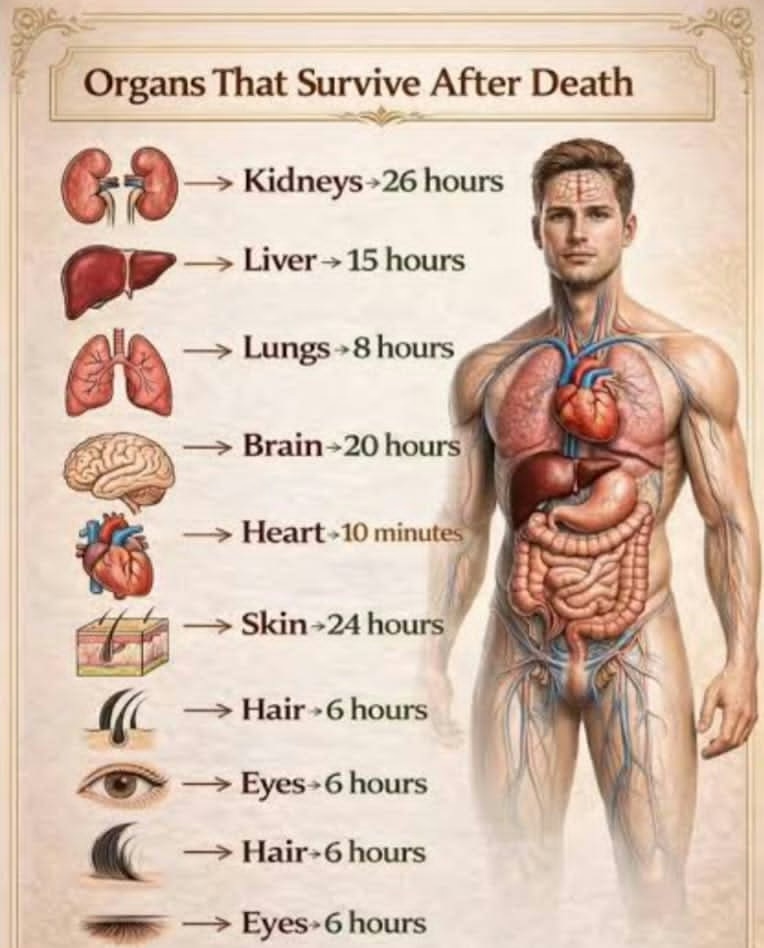
Within minutes: The brainstem, which controls breathing, heartbeat, and reflexes, succumbs after roughly 3–6 minutes without oxygen. At this stage, even mechanical ventilation or cardiac resuscitation cannot restore higher brain function.
Dr. Sandra Levine, professor of clinical neurology at Cornell University Medical College, notes: “In intensive care, we see hearts continuing to beat with mechanical support long after the brain has irreversibly ceased function.
That underscores that in death determination, the brain—not the heart—is the organ we watch most closely.”
With life support, organs like the heart, lungs, liver, and kidneys can remain active for hours or even days. For example:
The heart may continue beating artificially.
Lungs can be ventilated mechanically.
Liver and kidneys retain cellular activity sufficient for organ donation.
However, structural survival of tissues is distinct from the functional definition of life. The irreversible cessation of the brainstem defines death in clinical and legal terms.
Bioethicist Dr. Arthur Caplan explains: “Common understanding conflates death with bodily rust. Medically, we must distinguish the last flicker of a cell from the end of an integrated, functioning organism. The brain defines that boundary.”
This biological cascade occurs wherever life ends—hospitals, homes, or accident sites. Timelines vary with interventions like CPR or ventilators, yet the defining point remains consistent: irreversible brainstem failure.
Understanding which organ dies last is not mere curiosity. It informs emergency care, end-of-life decisions, and organ transplantation ethics. Cultural and religious perspectives influence how death is perceived, but advanced medical practice relies on neurological criteria.
As one leading intensivist puts it: “Death is a process, not a moment. When the brain—especially the brainstem—stops, the symphony of life concludes.”





Leave a Reply