
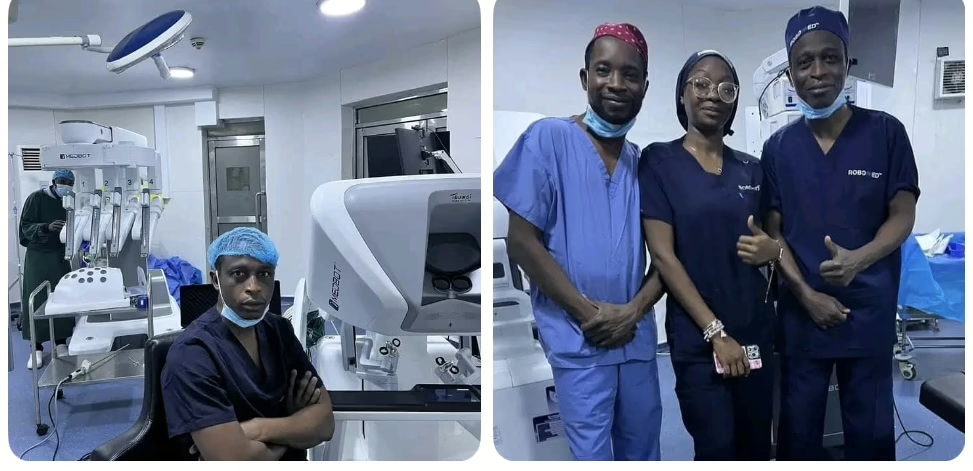
By Paul Joseph
Nigeria has made a significant mark in modern medicine with a pioneering robotic surgical achievement that heralds a new era in women’s healthcare.
Central to this historic accomplishment is Dr. Ahmed Abdullahi, a skilled and distinguished gynecologist from Adamawa, who has propelled Nigeria into the realm of robotic-assisted surgery.
On January 30, 2026, at the advanced surgical facilities of Nisa Premier Hospital in Abuja, a 22-year-old woman with uterine fibroids became the first patient in Nigeria to receive a robotic-assisted laparoscopic myomectomy.
This procedure, performed using the cutting-edge Microport Toumai MT-1000 surgical robot, represents a significant advancement in Nigeria’s medical landscape and offers hope to women facing fibroid-related issues.
The innovative surgery was a collaborative effort between Nisa Premier Hospital and RoboMed Global, a leader in medical technology, showcasing a successful partnership between global advancements and local medical expertise.
Dr. Ahmed Abdullahi, hailing from the Numan Local Government Area of Adamawa State and trained in the UK, led the operation, exemplifying excellence, patriotism, and professional skill. He was joined by Dr. David Ejenobo, a consultant gynecologist at Nisa Premier Hospital, whose teamwork contributed to the successful execution of the procedure.
Prior medical evaluations had confirmed the patient’s fibroid condition through ultrasound, leading her to opt for this innovative robotic approach, known for its minimally invasive nature and quicker recovery times.
The surgical results were impressive, with minimal blood loss and no need for transfusions. Unlike traditional surgeries that require large incisions, the robotic method utilized small, precise cuts, significantly reducing tissue damage.
In a demonstration of the remarkable impact of modern medical technology, the patient was released in record time, just hours after the procedure, experiencing only mild discomfort and showing a swift recovery post-surgery.
After the operation, Dr. Abdullahi emphasized the groundbreaking advantages of robotic-assisted surgery, pointing out that this technology provides surgeons with improved precision, better visualization, fewer surgical errors, and ultimately, quicker healing for patients. “This innovation enables us to carry out complex procedures with exceptional accuracy while reducing physical trauma to the patient,” he remarked.
Dr. Ejenobo shared similar views, stressing that the successful surgery highlights Nigeria’s increasing ability to offer world-class healthcare services domestically, thereby decreasing reliance on foreign medical tourism.
Dr. Obi Ekwenna, CEO of RoboMed Global, referred to the historic procedure as a pivotal moment for women’s healthcare throughout West Africa. He reiterated the company’s dedication to enhancing robotic surgical infrastructure and equipping local healthcare professionals through specialized training and technology transfer.
Health experts note that robotic surgery is particularly effective for conditions like fibroids, endometriosis, and certain tumors. In comparison to traditional open surgery, it consistently results in less pain, shorter hospital stays, minimal scarring, and quicker return to everyday life.
The successful robotic fibroid removal at Nisa Premier Hospital signifies more than just a technological achievement; it tells a transformative story of Nigerian medical capabilities reaching global standards. It is also a moment of pride for Adamawa State, as Dr. Ahmed Abdullahi has become a symbol of dedication and service-driven success.
From the resilient rivers of Numan to the precise robotics of Abuja’s operating rooms, Abdullahi’s accomplishment exemplifies the fusion of local excellence with global innovation.
His journey serves as an inspiring reminder that Nigeria’s brightest medical talents are not only competing internationally but are also bravely returning home to reshape the nation’s healthcare narrative.
As robotic surgery continues to gain momentum across Nigeria and West Africa, this landmark operation is likely to be remembered as the beginning of a new era where science, skill, and national pride come together to provide safer, smarter, and more compassionate healthcare solutions for future generations.






Leave a Reply