
By Gloria Drealomalicha
Politics, they say, is a game of strange alliances. But few political equations in Nigeria today are as intriguing or as potentially explosive as the one unfolding in Osun State.
On August 15, Osun voters will decide whether Governor Ademola Adeleke deserves another four years or whether the All Progressives Congress will finally reclaim the state it lost in 2022.
On the surface, this is a straightforward governorship contest between the incumbent and APC candidate Bola Oyebamiji.
But underneath lies a much bigger battle one involving President Bola Ahmed Tinubu, the Adeleke political dynasty, Afrobeats superstar Davido, Tinubu’s son Seyi, and the ever-present question of whether political friendships can overcome party loyalty.
The question therefore is no longer simply: Can Adeleke win Osun again?
The more intriguing question is: Can Adeleke’s increasingly visible alignment with Tinubu help him retain the Osun Government House even against the President’s own party?
That is where the election gets interesting.
Adeleke’s Tinubu card
Adeleke’s decision to publicly support President Tinubu’s re-election bid in 2027 is perhaps one of the most fascinating political developments ahead of the Osun poll.
Here is a governor seeking re-election under a platform outside the APC, while openly declaring support for the President of the Federal Republic of Nigeria, who happens to be the national leader of the APC the very party trying to remove him from office.
That is political gymnastics at its finest.
Adeleke appears to understand something many politicians sometimes forget: elections are not won by party labels alone.
In Osun, personalities, family networks, local structures, loyalty, performance and political relationships matter enormously.
The 2022 election already demonstrated the power of the Adeleke political machine. Adeleke defeated the then APC incumbent, Gboyega Oyetola, in a fiercely contested election. Contemporary analyses also identified the Adeleke family’s political clout and Davido’s visibility as part of the factors that helped the governor’s campaign.
Four years later, that family machine remains one of Adeleke’s biggest assets.
And this time, there is an additional layer: Tinubu.
Enter Davido -Adeleke’s celebrity trump card
If politics were only about party structures, Davido would probably have little to do with the calculation.
But Nigerian politics has never been that simple.
David Adeleke, popularly known as Davido, is not merely a global music star. He is Governor Adeleke’s nephew and has previously played a visible role in his uncle’s political campaigns.
Just days ago, Davido publicly backed Adeleke’s re-election bid, posting photographs of himself with the governor and declaring, “We got this. God got us.” He also appealed for peaceful campaigning and urged voters to exercise their franchise without violence.
That intervention should not be dismissed as mere celebrity noise.
Davido commands an enormous following, particularly among young Nigerians. His ability to generate conversations across social media, entertainment circles and youth communities gives the Adeleke campaign something political parties spend enormous sums trying to manufacture: attention.
The bigger advantage, however, is emotional.
Davido is not campaigning for a distant politician.
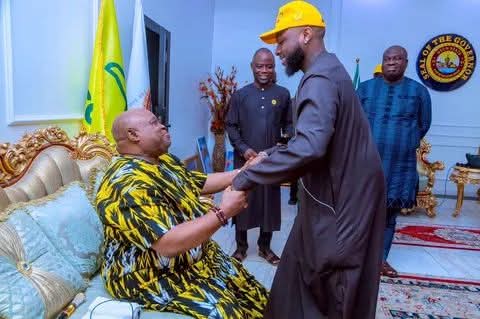
He is supporting his uncle.
That family connection gives his intervention an authenticity that a hired celebrity endorsement may never possess.
And if the Adeleke camp succeeds in converting Davido’s popularity into actual voter mobilisation, the APC could discover that defeating the Adeleke dynasty is considerably harder than defeating an ordinary incumbent.
But then there is Seyi Tinubu
And here comes another fascinating twist.
Davido has also maintained a longstanding friendship with Seyi Tinubu, the President’s son.
In May, Davido pushed back against criticism over his relationship with Seyi, insisting that their friendship does not prevent him from speaking about national issues and denying that he belongs to any political group called the “City Boys”.

That relationship creates an unusual political triangle.
Davido is related to Adeleke.
Davido is friends with Seyi Tinubu.
Adeleke is publicly backing Bola Tinubu for a second presidential term.
And Tinubu’s APC is simultaneously campaigning to remove Adeleke from office.
If Nigerian politics were a television series, this would be the point where the producers would probably ask for another season.
But beyond the drama, there is a serious political calculation.
The relationship between Davido and Seyi Tinubu could provide an informal bridge between two powerful families, even if neither relationship should automatically be interpreted as political endorsement.
Davido himself has made clear that friendship with Seyi does not determine his political opinions.
Still, relationships matter in politics.
They open doors.
They create conversations.
They make communication easier.
And sometimes, behind the scenes, relationships achieve what public political statements cannot.
Tinubu’s dilemma: party loyalty or political pragmatism?
This may be the most uncomfortable question of the entire election.
Tinubu’s political interest is clear: the APC wants Osun back.
The President’s camp has repeatedly presented Bola Oyebamiji as the APC’s candidate, and Oyebamiji himself has insisted that Tinubu’s support is behind his candidacy.
Yet Adeleke’s public support for Tinubu’s 2027 ambition complicates the political narrative.
Can Adeleke say, in effect, “I support your presidency, but your party should not take my governorship”?
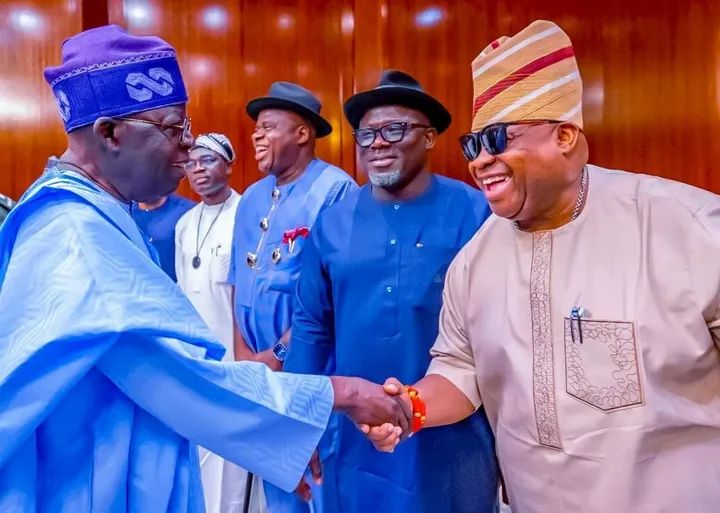
Absolutely.
That is politics.
Adeleke does not need to become an APC member to support Tinubu for president.
And Tinubu does not need to support Adeleke simply because the governor supports him.
But politically, the relationship creates an intriguing question for voters:
If Adeleke and Tinubu can work together for 2027, why should Osun voters necessarily see them as mortal political enemies in 2026?
The APC will obviously argue that party loyalty comes first.
Adeleke’s camp, however, can turn the same relationship into a different message: that the governor is capable of working with the Federal Government regardless of party affiliation.
That could be politically useful in a state where voters may care less about ideological purity and more about who they believe can deliver.
Then comes Oyebamiji’s Tinubu problem
For Bola Oyebamiji, the challenge is not merely defeating Adeleke.
He must also convince voters that he is the man best positioned to carry the APC’s message while avoiding being consumed by the larger Tinubu-versus-Adeleke narrative.
This becomes particularly important because political statements have long memories.
Any previous remark or perceived confrontation involving Tinubu can become campaign ammunition, especially when a candidate is now seeking to present himself as the preferred standard-bearer of the President’s political family.
That is the danger.
Politics has a peculiar habit of resurrecting yesterday’s words at the precise moment they become inconvenient.
If Oyebamiji previously made remarks that could be interpreted as hostile or dismissive towards Tinubu, opponents could weaponise those statements to question the depth of his loyalty.
The APC candidate may have moved on.
The electorate may have moved on.
But social media has not.
And political opponents certainly have not.
The irony would be deliciously brutal: a candidate fighting under the banner of a President whose political support he needs, while opponents remind voters of comments that could portray him as someone who once stood on the other side of the political argument.
That does not automatically mean such remarks will cost Oyebamiji the election.
But they can create an unnecessary vulnerability.
And in a close election, unnecessary vulnerabilities are dangerous.
Adeleke’s biggest strength may also be his biggest weakness
There is another side to this story.
Adeleke’s relationship with Tinubu could help him, but it could also confuse his supporters.
Some voters who oppose Tinubu and the APC may ask a simple question:
How can you campaign against Tinubu’s party in Osun while supporting Tinubu for president?
That is a legitimate political question.
Adeleke therefore has to walk a very narrow road.
He must convince voters that supporting Tinubu’s presidential ambition is not the same thing as surrendering Osun to the APC.
He must also persuade his supporters that his relationship with the President is an advantage, not a contradiction.
If he gets that message right, the alliance could become a weapon.
If he gets it wrong, it could become an embarrassment.
And what if Davido turns the election into a referendum on the Adeleke family?
The APC appears determined to attack the Adeleke family’s political style, including Davido’s involvement.
Some APC figures have already attempted to turn Davido’s relationship with his uncle into political ammunition, mocking Adeleke’s dancing and suggesting that the governor’s political career could soon be over. Davido has responded publicly to some of those attacks.
But there is a danger in attacking Davido too aggressively.
The APC could inadvertently give him more publicity.
And Davido knows how to turn publicity into political attention.
Every attack generates a response.
Every response generates social media engagement.
Every engagement keeps the Adeleke name in public conversation.
That is a powerful campaign cycle.
The APC may therefore have to decide whether attacking Davido is actually worth the political cost.
The ghost of 2022
The APC cannot afford to forget what happened in 2022.
Adeleke did not simply defeat Oyetola; he defeated an incumbent APC administration in a state the party considered one of its strongholds.
The margin was not enormous, which makes the lesson even more important.
The election was competitive.
And when elections are competitive, small advantages become decisive.
The Adeleke family has name recognition.
Davido brings celebrity influence.
Adeleke has incumbency.
Tinubu has national political power.
The APC has party structures.
Oyebamiji has the President’s backing.
And Osun voters have the final say.
That is why predicting the result with absolute certainty would be political arrogance.
The bigger Tinubu question
For President Tinubu, Osun is bigger than Adeleke.
The state has deep political and ancestral significance for him, while an APC victory would strengthen the argument that the ruling party remains capable of reclaiming lost territory in the South-West. Analysts have already described the contest as a test of Tinubu’s political influence and a potential pointer to the 2027 presidential race.
An APC victory would give Tinubu bragging rights.
Adeleke’s defeat would weaken one of the most prominent opposition political families in the state.
But an Adeleke victory would raise an uncomfortable question for the APC:
If Tinubu’s own party cannot defeat a governor who openly supports his re-election, what does that say about the strength of the APC in Osun?
That is the real nightmare scenario.
It would mean that Tinubu’s presidential popularity or political influence does not automatically translate into a governorship victory for the APC.
And opposition politicians across the South-West would immediately take note.
So, can Adeleke’s Tinubu gamble return him to office?
Perhaps.
But not because Tinubu can magically hand him victory.
Elections are won at polling units, not family gatherings.
Adeleke’s support for Tinubu may give him a useful political shield, particularly if he successfully sells himself as a governor who can work with Abuja rather than fight it.
Davido gives him celebrity reach and emotional connection with a younger demographic.
The Adeleke name gives him a formidable political family structure.
His incumbency gives him access to the machinery and visibility that come with occupying Government House.
But the APC has its own weapons.
Tinubu’s influence.
Oyebamiji’s campaign structure.
The APC’s grassroots network.
And a determined desire to turn Osun into an early political victory ahead of 2027.
So the August 15 election is not simply Adeleke versus Oyebamiji.
It is Adeleke’s family machine versus APC’s political machine.
It is Davido’s popularity versus Tinubu’s political structure.
It is a governor seeking another term versus a President seeking to strengthen his party ahead of 2027.
And somewhere in the middle sits Seyi Tinubu, whose friendship with Davido adds yet another layer to an already extraordinary political story.
The most fascinating possibility, however, is this:
What if Adeleke manages to defeat the APC while simultaneously supporting Tinubu for President?
That would be more than a governorship victory.
It would be a political paradox.
It would tell Abuja that Osun voters can separate a presidential preference from a governorship choice.
And it would leave the APC facing the uncomfortable reality that even with Tinubu’s name, structure and influence behind it, Osun may still refuse to surrender.
That is why this election deserves to be watched beyond the dancing, the celebrity banter and the campaign theatrics.
Because when the music stops, when Davido leaves the stage and when the political slogans fade, one question will remain:
Who truly owns the Osun voter — the Adeleke dynasty, the Tinubu machine, or neither?
On August 15, Osun will answer.
Gloria Drealomalicha is the editor for Starnews NG


Leave a Reply