
By Gloria Drealomalicha
Politics, as they say, is a game of numbers. But in Nigeria, anybody who has spent enough time around power knows that numbers are only one part of the equation.
There is money. There are structures. There are security agencies. There are godfathers. There is party machinery.
And, perhaps most importantly, there is Abuja.
That is why the recent comments by former Rivers State Governor Nyesom Wike and former Ekiti State Governor Ayo Fayose should not simply be dismissed as the usual political banter.
They have touched a very sensitive nerve in Nigerian democracy: how much power does the Federal Government really have over what happens at the state level?
Fayose’s argument was particularly blunt. His suggestion was that if the Federal Government had genuinely wanted to take control of the Osun governorship election, it could have done so.
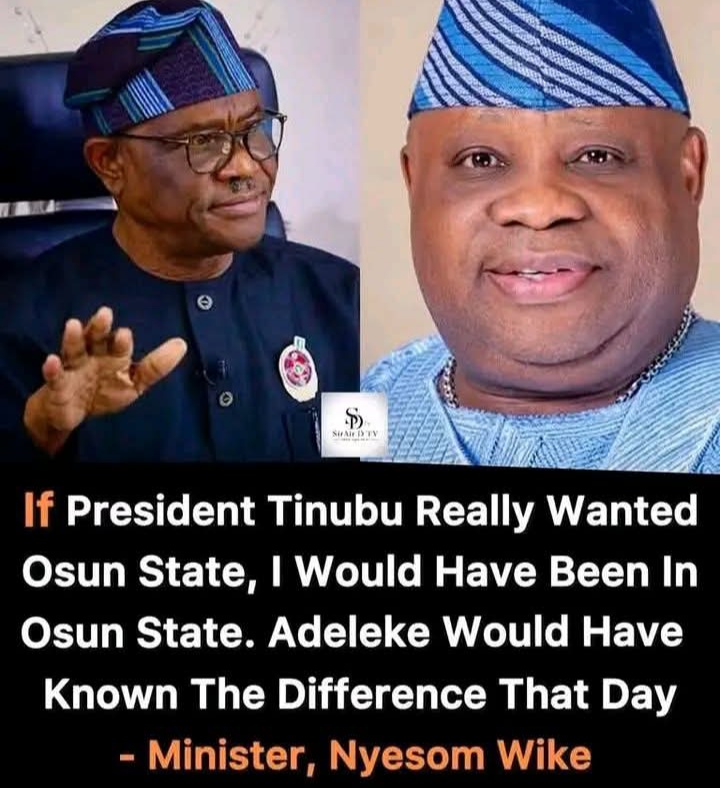
Wike, in his own characteristic manner, took the argument further, saying that if President Bola Tinubu had personally wanted the election for himself, he would have been in Osun and the outcome could have been different.
Really?
If two experienced politicians can speak so casually about the ability of federal power to influence a state election, Nigerians have every right to stop and ask uncomfortable questions.
Is the ballot box really stronger than political power?
Or have Nigerians simply become accustomed to a system in which elections are fought at polling units but political battles are sometimes decided in drawing rooms far away from them?
The Wike question
Wike is no ordinary politician.
He has survived presidential contests, governed Rivers State for eight years, fought political battles with his former political allies and emerged as one of the most influential power brokers in the country.
Today, as President Tinubu’s Minister of the Federal Capital Territory, his political influence has arguably become even more formidable.
To his admirers, Wike is a political heavyweight who understands how power works.
To his critics, however, he increasingly looks like something more dangerous: a political enforcer for the Tinubu administration almost a political hitman sent into difficult political territories to do the dirty work others may prefer not to do publicly.
That is a brutal accusation.
But Nigerian politics has always been brutal.
And Wike himself has never been the type to whisper when he can speak loudly.
His critics will therefore ask: when Wike attacks opponents, challenges political structures or throws his weight behind a particular political arrangement, where does Wike the individual politician end and Wike the powerful Federal Government insider begin?
That question becomes even more interesting when Rivers State enters the conversation.
Then came Rivers
The Rivers political crisis between Wike and his successor, Siminalayi Fubara, was not a minor disagreement between two politicians.
It became a full-blown battle for control of one of Nigeria’s most politically strategic states.
The crisis paralysed the state legislature, produced bitter political divisions and eventually dragged the Presidency directly into the matter.
On 18 March 2025, Tinubu declared a state of emergency in Rivers State and suspended Fubara, his deputy and members of the State House of Assembly. He appointed Vice Admiral Ibokette Ibas as administrator.
That was an extraordinary intervention.
And here is where the political mathematics becomes fascinating.
Tinubu insisted that the emergency declaration was necessary to prevent anarchy and restore constitutional order. His administration pointed to the political impasse, court decisions, the crisis in the Assembly and alleged threats to critical oil infrastructure.
But critics saw something else.
They saw a President intervening in a bitter political struggle involving a former governor who had become one of his administration’s most powerful political allies.
Even more controversial was the perception that Wike escaped the same political consequences that befell Fubara.
The Rivers government itself questioned why Fubara was suspended while Wike, whom it described as a principal actor in the crisis, remained a Federal Government minister.
That is the kind of question that refuses to die.
Because once Nigerians begin to believe that federal power can determine which politician survives a political war, every subsequent election becomes vulnerable to suspicion.
Was Fubara ever going to return?
At the height of the Rivers crisis, there were fears and political speculations that Fubara might never return to Government House.
And who could blame those who wondered?
A sitting governor had been suspended by presidential proclamation.
A Federal Government-appointed administrator had taken control of the state.
The political machinery around the governor appeared badly weakened.
For critics of the Presidency, it looked like a frightening demonstration of what federal power could do to a state government.
But history eventually took a different turn.
Tinubu ended the emergency rule in September 2025 and confirmed that Fubara, his deputy and the state lawmakers would resume their constitutional duties from 18 September.
So, no, Fubara did return.
But the political lesson from the episode remains.
For six months, Nigerians watched Abuja take extraordinary control of the affairs of an elected state government.
That experience cannot simply be erased because normal government eventually returned.
And that is where Osun becomes interesting
The Osun election has therefore become bigger than Osun.
It has become another test of whether Nigerians believe that the power of the voter is greater than the power of the political establishment.
Fayose and Wike may have been trying to make different political points. But their comments have unintentionally reopened an old wound.
The fear that elections can be influenced not only by voters but by those who control political structures, security institutions, money and federal authority.
This is where Nigerians must be careful.
There is a difference between saying that federal power can influence an election and saying that the Federal Government rigged an election.
The first is a political reality worth debating.
The second is a serious allegation that requires evidence.
But politicians themselves repeatedly talking about the enormous power of Abuja is enough to make Nigerians uncomfortable.
Because democracy should not work on the basis of whether the President personally wants a candidate to win.
It should not depend on whether a powerful minister chooses to deploy his political machinery.
It should not depend on whether a governor has a stronger godfather.
And it certainly should not depend on whether a political heavyweight decides to enter the battlefield.
The real danger
Perhaps the most disturbing part of the Wike-Fayose comments is not what they said.
It is what their comments reveal about how Nigerian politicians themselves perceive power.
If politicians believe that the Federal Government possesses the capacity to simply overwhelm a state election whenever it chooses, then the Nigerian voter has a serious problem.
Because democracy becomes little more than theatre when the people begin to believe that the real election is happening somewhere else.
Wike may reject the description of him as Tinubu’s political hitman.
The Presidency would certainly reject the suggestion that it controls elections.
And Fayose may insist that he was merely making a political observation.
Fair enough.
But Nigerians are entitled to ask:
Why should the presence or absence of one powerful politician matter so much to the outcome of an election?
Why should a presidential endorsement terrify opponents?
Why should a governor fear a minister?
Why should political godfathers command more attention than ordinary voters?
And why should Abuja be the place where every political battle eventually goes to seek its final blessing?
That is the uncomfortable question.
The real test of Nigerian democracy is not whether Tinubu can influence an election.
It is whether Tinubu, Wike, Fayose, governors, ministers and every other political heavyweight can be denied by millions of ordinary Nigerians who simply decide to vote differently.
That is what democracy is supposed to mean.
And if the politicians are right that power can determine everything, then Nigeria has a much bigger problem than the outcome of one governorship election.
But if the voters are truly sovereign, then perhaps Osun has delivered a more important message:
Political godfathers may control the machinery. Abuja may control enormous power. But at the end of the day, the ballot box must still belong to the people.
Anything less is not democracy.
It is merely politics wearing democracy’s clothes.


Leave a Reply