
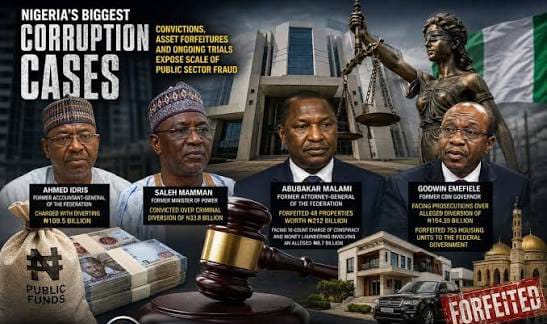

By Paul Joseph
Each time another high-profile corruption suspect walks out of court on bail while trial dates are fixed months into the future, many Nigerians are left asking the same question: Is the country’s anti-corruption war truly delivering justice, or is the judicial process moving too slowly to inspire public confidence? Is the bail money so interesting that the judges or lawyers are neglecting the right thing to do? Although bail is a constitutional right and not a conviction or acquittal, the combination of lengthy court proceedings, bail money, repeated adjournments and prolonged legal battles has fuelled a growing perception that justice favours the wealthy and politically connected.
Nigeria’s anti-corruption campaign continues to face one of its greatest challenges not because high-profile arrests are not being made, but because many corruption prosecutions take years to conclude, leaving citizens increasingly doubtful that justice is being served.
In recent months, several prominent public figures accused of financial crimes have been granted bail pending trial. Among them is former Managing Director of the Warri Refining and Petrochemical Company Limited (WRPC), Jimoh Yisawu, who was granted ₦500 million bail after pleading not guilty to charges involving the alleged laundering of $789,950.
Similarly, the National President of Miyetti Allah Kautal Hore, Bello Bodejo, was granted ₦2 billion bail over allegations involving $2.63 million in suspected money laundering.
Other notable defendants include former Code of Conduct Tribunal Chairman Danladi Umar, former Attorney-General of the Federation Abubakar Malami, former Kogi State Governor Yahaya Bello, Bauchi State Finance Commissioner Yakubu Adamu, and former Minister of Science Uche Nnaji, all of whom have been admitted to bail while facing corruption or money laundering-related charges.
It is important to note that bail is neither a conviction, a punishment nor an acquittal. Under Nigeria’s Constitution, every accused person is presumed innocent until proven guilty and is entitled to seek bail where the law permits. Bail exists to ensure that defendants appear before the court while safeguarding their constitutional right to liberty pending the determination of their cases.
The real concern, however, is not the granting of bail but the slow pace at which many high-profile corruption cases move through the courts.
For years, Nigerians have watched major corruption cases become entangled in repeated adjournments, preliminary objections, interlocutory appeals, jurisdictional disputes and other procedural delays. Some cases remain unresolved for years, while public attention gradually fades and confidence in the justice system weakens.
This prolonged process has created a perception that influential defendants, backed by experienced legal teams and substantial financial resources, can comfortably navigate the judicial process while ordinary citizens face a far different experience.
The consequence is a growing trust deficit. Many Nigerians wonder why allegations involving billions of naira in public funds rarely result in swift trials, timely judgments or successful recovery of stolen assets.
The judiciary has consistently maintained that its responsibility is to uphold the Constitution and ensure fair trials. Judges must determine cases based solely on the evidence before them, not on media reports, public pressure or political considerations. Protecting the constitutional rights of accused persons, including the right to bail, remains a fundamental pillar of the rule of law.
However, protecting constitutional rights should not come at the expense of timely justice.
A stronger justice system requires more than arrests and sensational headlines. It demands efficient investigations, diligent prosecution, improved case management, modern judicial processes and firm action against unnecessary delays that prolong corruption trials.
Justice delayed does not only affect the accused; it also affects victims, taxpayers and the nation’s confidence in public institutions. Every unresolved corruption case sends a message that accountability can be postponed indefinitely.
The solution is not to deny defendants bail indiscriminately. Rather, Nigeria needs a judicial system that guarantees speedy trials, transparent proceedings and timely judgments while fully respecting constitutional rights.
When corruption cases are concluded promptly and fairly, innocent defendants can clear their names without undue delay, while those found guilty can be punished in accordance with the law and public assets recovered.
Ultimately, Nigerians are not calling for the abandonment of due process. They are demanding a justice system that delivers both fairness and efficiency one in which no individual, regardless of wealth, political influence or social status, can evade accountability through endless legal delays.
Only when justice is not only done but also seen to be done within a reasonable time will public confidence in Nigeria’s anti-corruption institutions and the nation’s judicial system begin to recover.






Leave a Reply