
By Paul Joseph
Nigeria’s political and security leadership is standing at a deeply painful crossroads, as waves of school abductions, mass public outrage, and emotional nationwide protests push the country into one of its most emotionally charged security crises in recent years.
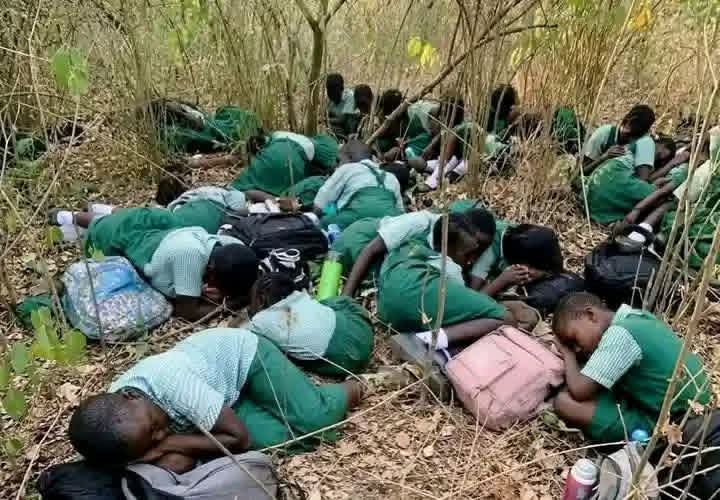
At the heart of the unfolding crisis are the tears of frightened children, grieving parents, and desperate teachers symbols of a nation struggling to protect its most vulnerable, and a haunting reminder of what many describe as a deep moral and spiritual wound inflicted on society when innocence is violated.
The latest wave of anguish was triggered by the abduction of teachers and schoolchildren in Oyo State, an incident that has ignited nationwide protests by members of the Nigeria Union of Teachers (NUT) and intensified urgent calls for stronger protection of educational institutions.
Across several states, teachers have taken to the streets in grief and anger, demanding the immediate rescue of abducted colleagues and pupils, stronger school security frameworks, and urgent reforms to prevent learning environments from becoming hunting grounds for armed groups.
The protests reflect a growing sense of fear and exhaustion among citizens, as repeated attacks on schools continue to shake public confidence in the ability of the state to guarantee safety.
Public anxiety has been further amplified by the intervention of prominent religious leader, Pastor Enoch Adeboye, General Overseer of the Redeemed Christian Church of God (RCCG), whose remarks on national security have added weight to the ongoing national conversation.
In a widely circulated video, Adeboye called for tougher action against terrorist networks and their sponsors, suggesting that security chiefs should be given strict deadlines to deliver measurable results or be held accountable.
His comments have resonated across religious, political, and civil society spaces, reflecting a shared concern that insecurity has reached a critical point demanding urgent and decisive response.
For many Nigerians, his message echoes a growing frustration not only with the persistence of violence, but with the emotional, moral, and what some describe as the “spiritual consequences” of sustained attacks on innocent children and families.
Security analysts warn that school abductions have moved beyond isolated tragedies to become a defining symbol of Nigeria’s insecurity crisis.
What were once considered rare incidents have now become recurring national emergencies, forcing school closures in some areas and leaving thousands of parents in constant fear each time children leave for school.
Teachers, who once stood as pillars of learning and community stability, now find themselves on the frontlines of danger—a development that experts say threatens the very foundation of Nigeria’s education system.
Education stakeholders fear that continued attacks could deepen learning disruptions, increase dropout rates, and reverse years of progress in expanding access to basic education.
Political observers describe the current moment as one of the most emotionally charged tests of leadership in Nigeria’s recent democratic history, with growing concerns that the continued suffering of children could deepen national despair and further erode trust in governance.
As public frustration grows, pressure is mounting from opposition voices, professional bodies, religious leaders, civil society organisations, and ordinary citizens demanding stronger and more visible results in the fight against insecurity.
While government officials insist that security agencies are intensifying operations against criminal networks through intelligence-driven interventions and military action, many Nigerians say the impact is yet to be felt in daily life.
“The real issue is not only defeating armed groups, but restoring hope to communities that no longer feel safe,” one political analyst noted.
Beyond the human tragedy, experts warn that the ripple effects of insecurity are spreading into Nigeria’s economic and social fabric.
Rural farming communities face repeated disruptions, threatening food production and increasing the risk of shortages and rising prices. Transport routes in some regions remain vulnerable, raising operational costs for businesses and limiting economic activity.
Foreign investors and development partners continue to monitor Nigeria’s security environment closely, with stability seen as a key factor in long-term investment decisions.
Despite rising anger and grief, analysts caution that the current wave of public criticism reflects a demand for better governance rather than a rejection of democratic institutions.
Across the country, there is a shared longing for safety, stability, and reassurance—a desire to see children return to classrooms without fear and communities restored to peace.
For now, the urgent priority remains the safe return of abducted teachers and pupils, whose fate continues to dominate national attention and emotional discourse.
As pressure intensifies from every corner of society from classrooms to pulpits, from protest grounds to policy circles Nigeria finds itself at a defining moment.
The challenge ahead is no longer only about security operations, but about healing a wounded nation, restoring trust, and ensuring that the tears of today’s children do not become the defining memory of a generation or the silent burden that shapes the conscience of a country for years to come.






Leave a Reply