
By Oyeniyi Iwakun
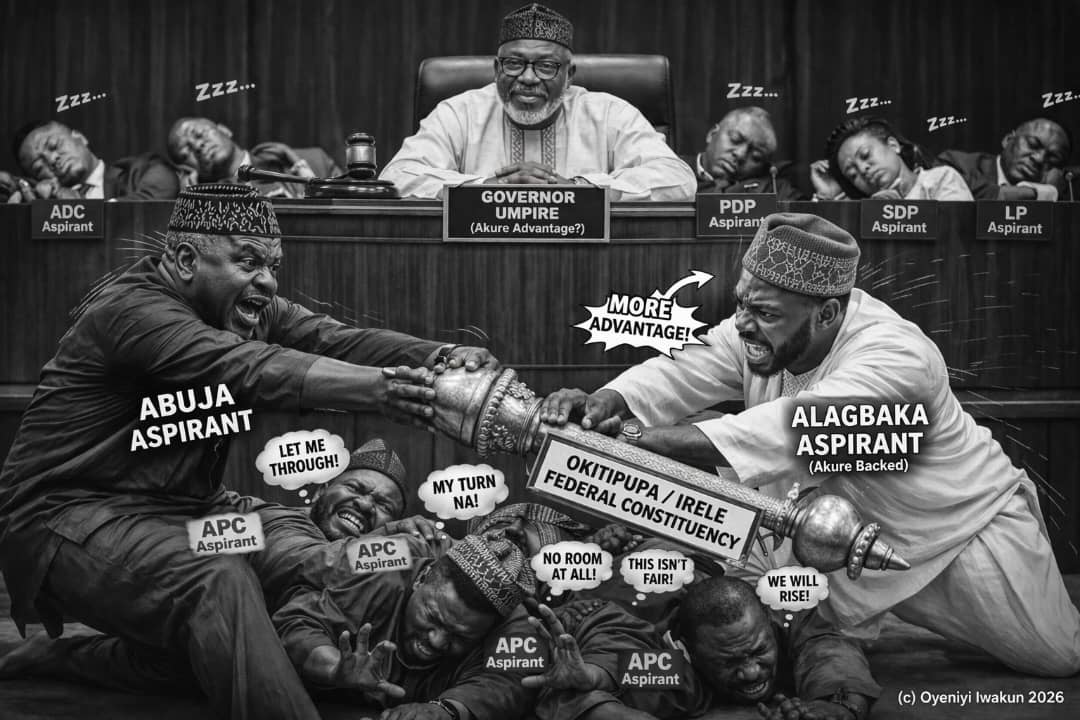
As preparations for the 2027 General Elections gradually gather momentum, political interests are beginning to crystallize across constituencies. Of particular interest to me is the Okitipupa/Irele Federal Constituency, a political space historically defined by a delicate balance of zoning sensitivity, rotational representation and merit considerations.
The Ikale political environment has repeatedly demonstrated an unusual trait: voters are often willing to defy party directives and downplay partisan loyalty in order to elect a candidate perceived as broadly acceptable. In this constituency, influence, political machinery, or elite endorsements do not always guarantee electoral victory.
Let me state clearly that the views expressed here are personal reflections, not the official position of any political party, group, or community. Neither do I claim exhaustive knowledge of all political activities within Ikaleland.
For now, within the APC, two aspirants appear to dominate the emerging calculations; one perceived to be Abuja backed and the other state backed. Interestingly, one of these contenders is also believed to possess an additional strategic advantage which will be discussed in subsequent reflections.
Among grassroots observers, one aspirant currently enjoys visible street level popularity and legitimacy, while the other appears to rely more on party structures and elite networks, including influence from Abuja and key leadership caucuses. Yet, as is typical of the APC’s internal politics, the situation remains fluid and unpredictable.
Ultimately, the governor’s influence may prove decisive. Ikale constituency occupies a strategic position bordering Ilaje and Ese-Odo, making it politically significant within the broader Ondo South calculus. While such interest from the state leadership may be understandable, party hierarchy and elite bargaining could still tilt the process in unexpected directions. Where this produces a questionable outcome, it could present an opening for the opposition.
Meanwhile, several aspirants continue to focus heavily on local endorsements within wards and LGAs, often mobilizing supporters whose influence rarely extends beyond communities such as Lafe, Gbeleju Loda, or at most Omotosho, whereas the decisive negotiations may eventually occur in Akure and Abuja. The persistence of this pattern raises questions about political strategy, although it also sustains local political structures that must continually be engaged.
Notably, the two leading contenders appear to be adopting a dual-track strategy combining grassroots engagement with elite political networking. Others may eventually recognize the necessity of this balance.
In reality, the APC ticket will most likely emerge from elite alignment and strategic endorsement, with the formal primary serving largely as a ceremonial confirmation. Regardless of how the process unfolds, internal dissent is almost inevitable. The intensity of such rebellion, however, will depend largely on whether the eventual candidate aligns with zoning expectations and the broader sentiment of the majority, a concept that itself deserves deeper interrogation.
For now, however, the opposition across Ondo South, particularly in Okitipupa/Irele Federal Constituency appears unusually quiet, despite the opportunities that internal APC tensions may present. The electorate may not always voice its dissatisfaction loudly, but history shows it can express it decisively at the ballot.
This may well be the moment for opposition actors to awaken and reposition.
As the Ikale saying goes: “Otenibo… Otepawapo?”
Oyeniyi Iwakun is a former Publicity Secretary of SDP in Ondo State





Leave a Reply