
By George Omagbemi
On October 1, 1960, Nigeria stepped onto the world stage as an independent nation.
The Union Jack came down. The green-white-green flag went up.
There was optimism.
Nigeria had enormous agricultural resources, a growing educated class, a strategic position in Africa and a population that many believed could propel the new country into continental leadership.
Sixty-six years later, Nigeria remains Africa’s most populous country and one of the continent’s most consequential states.
But the journey has been anything but straight.
Nigeria has experienced parliamentary democracy, military coups, counter-coups, civil war, prolonged dictatorship, an annulled presidential election, economic crises, structural adjustment, democratic restoration, uninterrupted civilian government since 1999, terrorism, unprecedented population growth and repeated attempts at economic reform.
The country’s history is therefore not a simple story of good leaders and bad leaders.
It is a story of institutions, personalities, ethnic and regional competition, military intervention, oil wealth, corruption, economic policy, insecurity, democratic struggles and the resilience of ordinary Nigerians.
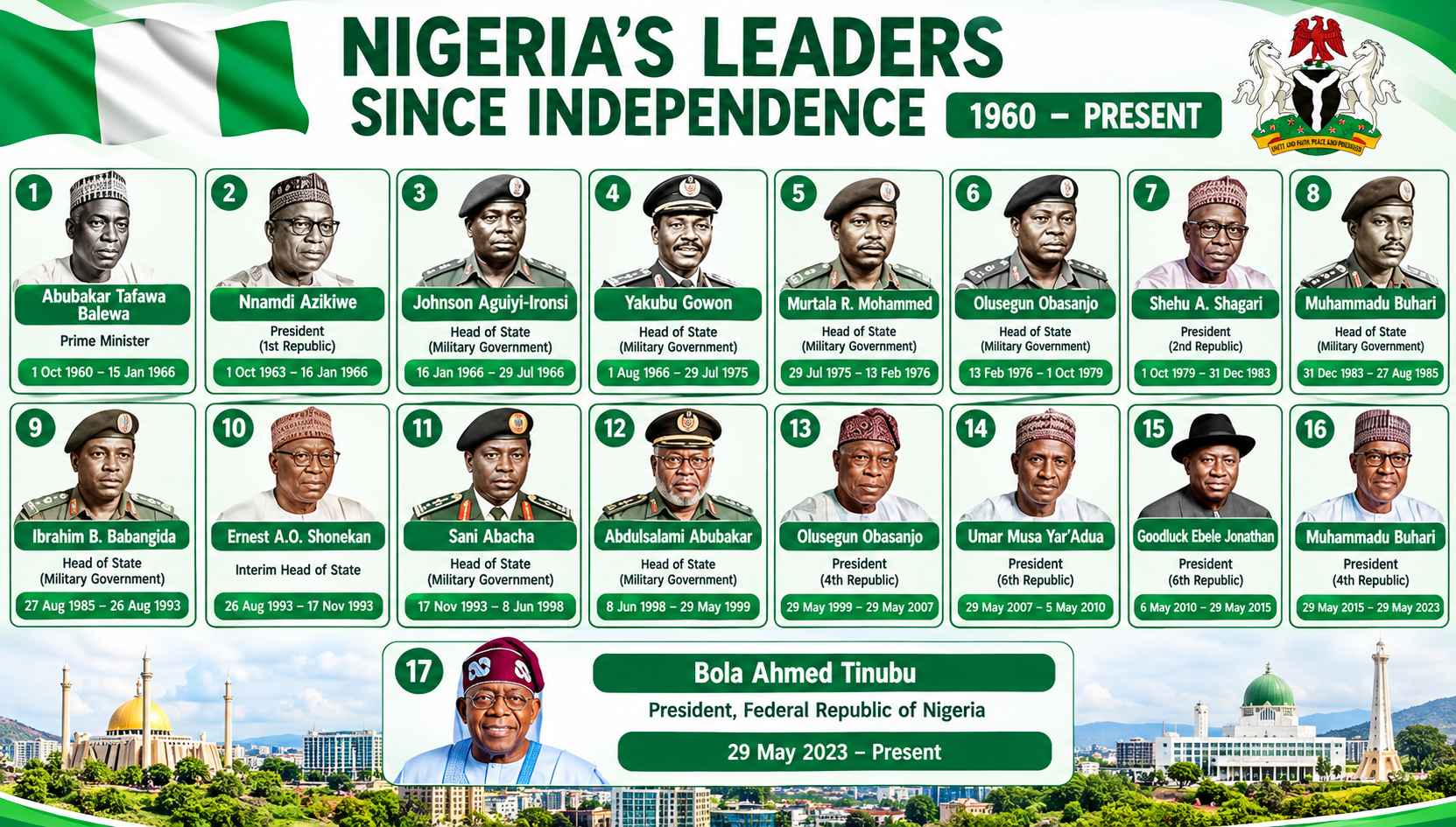
The official record of Nigeria’s heads of government confirms the succession from Prime Minister Abubakar Tafawa Balewa and President Nnamdi Azikiwe through the military era and the Fourth Republic.
This is the record.
THE FIRST REPUBLIC
- SIR ABUBAKAR TAFAWA BALEWA
Prime Minister — 1960–1966
Nigeria’s first Prime Minister was Sir Abubakar Tafawa Balewa, who led the federal government from independence until the military coup of January 1966.
Balewa inherited a country whose political system was based on parliamentary government.
The regional structure was powerful. The Northern, Western and Eastern regions possessed considerable political influence, while ethnic and regional identities remained deeply intertwined with political competition.
The Good
Balewa helped establish Nigeria’s first independent federal government.
His administration maintained parliamentary institutions and positioned Nigeria as an important voice in African affairs.
Nigeria’s early foreign policy under Balewa supported African independence and opposed colonial domination and apartheid.
The Bad
The First Republic struggled with intense regional rivalry.
Political competition increasingly became a struggle for control of the federal centre.
The controversial Western Region crisis, electoral disputes and allegations of political manipulation weakened public confidence.
The 1964 federal election and 1965 Western Region election became particularly contentious.
The Ugly
On January 15, 1966, Nigeria’s first military coup took place.
Balewa was abducted and killed.
The First Republic collapsed.
The country’s experiment with parliamentary democracy had lasted only five years.
The Independent National Electoral Commission’s historical account notes that the political crisis surrounding the 1964 and 1965 elections preceded the January 1966 military intervention.
- DR NNAMDI AZIKIWE
President — 1963–1966
When Nigeria became a republic in 1963, Dr Nnamdi Azikiwe became the country’s first President.
But this needs to be understood correctly.
Nigeria did not operate the executive presidential system Nigerians know today.
The Prime Minister remained the head of government, while the President was largely ceremonial.
The Good
Azikiwe was one of the towering figures of Nigerian nationalism.
He represented the country’s independence struggle and became one of its most internationally recognised statesmen.
The Bad
His presidency existed within an increasingly unstable political system.
Regional competition and political crisis continued to weaken the First Republic.
The Ugly
The January 1966 coup ended the First Republic.
Azikiwe’s presidency disappeared with it.
Nigeria entered military rule.
THE COUP ERA BEGINS
3. MAJOR-GENERAL JOHNSON AGUIYI-IRONSI
Head of State — January–July 1966
Aguiyi-Ironsi became Nigeria’s first military Head of State following the January coup.
His administration attempted to restore order and prevent further political disintegration.
The Good
Ironsi tried to create a stronger national administrative structure.
His government also sought to suppress political violence and restore stability.
The Bad
His Unification Decree No. 34 replaced the federal structure with a more centralised system.
The policy generated strong opposition, particularly among those who viewed it as an attempt to destroy Nigeria’s federal arrangement.
The Ugly
Ironsi was overthrown and killed during the counter-coup of July 1966.
The crisis deepened.
Violence against civilians, particularly in Northern Nigeria, followed.
Nigeria was moving rapidly towards civil war.
- GENERAL YAKUBU GOWON
Head of State — 1966–1975
Gowon assumed power following the July 1966 counter-coup.
His government inherited a country already approaching catastrophe.
In 1967, the Eastern Region declared independence as Biafra.
The Nigerian Civil War began.
The Good
Gowon’s government preserved Nigeria’s territorial unity.
After the war ended in 1970, the government introduced the policy of Reconstruction, Rehabilitation and Reconciliation — the Three Rs.
His government also created additional states and expanded federal infrastructure.
The rapid expansion of oil production generated enormous revenues.
Nigeria became increasingly wealthy on paper.
The Bad
The oil boom encouraged government dependence on petroleum.
The agricultural economy, once central to Nigeria’s exports, declined in relative importance.
The enormous flow of oil revenue also created new opportunities for corruption and patronage.
The Ugly
The Civil War remains one of the most devastating events in Nigeria’s history.
Millions died during the conflict, with starvation and disease contributing heavily to the death toll.
The war also left deep psychological, political and economic wounds that continue to influence Nigerian politics.
The 1966 coups, counter-coups and the 1967–1970 Civil War fundamentally reshaped Nigeria’s political system and remain influential in understanding the country today.
Gowon was overthrown in 1975 while attending an OAU summit abroad.
- GENERAL MURTALA RAMAT MUHAMMED
Head of State — 1975–1976
Murtala Muhammed came to power in the 1975 coup.
His government lasted only about seven months.
But his impact was enormous.
The Good
Murtala launched a sweeping purge of the public service.
He accelerated plans for Abuja to become Nigeria’s new federal capital.
His foreign policy was strongly supportive of African liberation movements.
Nigeria’s diplomatic influence increased considerably.
The Bad
The purge was extensive.
Thousands of public officials were removed, generating controversy over due process and institutional continuity.
The Ugly
On February 13, 1976, Murtala was assassinated during a failed coup attempt.
His death shocked Nigeria.
His deputy, General Olusegun Obasanjo, took over.
- GENERAL OLUSEGUN OBASANJO
Military Head of State — 1976–1979
Obasanjo inherited power after Murtala’s assassination.
His most important historical contribution was arguably the transition back to civilian rule.
The Good
His government completed the transition programme and handed power to an elected civilian administration on October 1, 1979.
That transfer was significant because the military voluntarily returned to the barracks.
The Bad
The government remained military and therefore lacked electoral legitimacy.
The Historic Achievement
Obasanjo handed power to Shehu Shagari.
The Second Republic began.
THE SECOND REPUBLIC
7. SHEHU SHAGARI
President — 1979–1983
Shagari became Nigeria’s first executive President under the 1979 presidential constitution.
The Good
His administration promoted agriculture through the Green Revolution programme.
It pursued industrial development, housing and infrastructure.
Major projects associated with the era included the Ajaokuta steel development.
The Bad
Nigeria’s economy remained heavily dependent on oil.
When oil revenues declined, the weaknesses of government finances became increasingly visible.
Spending expanded while revenues fell.
The Ugly
The 1983 election was highly controversial.
Allegations of electoral malpractice and political violence intensified.
On December 31, 1983, the military returned to power.
The Second Republic collapsed.
THE SECOND MILITARY ERA
8. MAJOR-GENERAL MUHAMMADU BUHARI
Head of State — 1983–1985
Buhari seized power in the December 1983 coup.
The Good
His administration launched the War Against Indiscipline.
It attempted to enforce public discipline, reduce waste and combat corruption.
Fiscal controls were strengthened.
The Bad
The methods were authoritarian.
Political opponents were detained.
Military decrees restricted civil liberties.
The judiciary and press operated under significant constraints.
The Ugly
The regime became associated with harsh punishments and authoritarian governance.
After less than two years, Buhari was removed by General Ibrahim Babangida.
- GENERAL IBRAHIM BABANGIDA
Head of State — 1985–1993
Babangida remains one of the most consequential and controversial figures in Nigerian political history.
The Good
His government introduced the Structural Adjustment Programme.
It attempted to liberalise the economy, encourage private-sector activity and reduce excessive government control.
His administration also undertook extensive political reforms and created a transition programme.
The National Electoral Commission conducted local, state and parliamentary elections and ultimately organised the June 12, 1993 presidential election.
The Bad
Structural adjustment produced severe economic and social consequences.
The naira was devalued.
Inflation and unemployment increased.
The cost of living became a major source of public anger.
The Ugly
Then came June 12, 1993.
The presidential election was annulled.
The result remains one of the most consequential democratic controversies in Nigeria’s history.
Moshood Kashimawo Olawale Abiola was widely regarded as the winner, but the election result was never allowed to produce a civilian presidency.
Babangida eventually stepped aside.
The country descended into another political crisis.
- CHIEF ERNEST SHONEKAN
Interim Head of State — August–November 1993
Shonekan headed the Interim National Government established after Babangida’s departure.
The Good
The arrangement represented an attempt to create a bridge towards civilian government.
The Bad
The government lacked the legitimacy of a government elected by Nigerians.
It also inherited the enormous political crisis created by the annulment of June 12.
The Ugly
On November 17, 1993, General Sani Abacha removed Shonekan.
Military rule returned in its most authoritarian form.
- GENERAL SANI ABACHA
Head of State — 1993–1998
Abacha’s government became one of the darkest chapters of Nigeria’s post-independence history.
The Good
His government invested in infrastructure and accumulated substantial foreign reserves during periods of high oil prices.
Nigeria remained influential in regional diplomacy.
The Bad
Political parties and opposition groups were restricted.
Journalists and activists faced detention.
Civil liberties were severely curtailed.
The Ugly
The regime was accused of widespread corruption and human-rights abuses.
The execution of Ken Saro-Wiwa and eight other Ogoni activists in 1995 provoked international condemnation.
The June 12 democratic crisis remained unresolved.
After Abacha’s death, billions of dollars associated with his family and associates were subsequently recovered from foreign jurisdictions by successive Nigerian governments.
Abacha died suddenly on June 8, 1998.
- GENERAL ABDULSALAMI ABUBAKAR
Head of State — 1998–1999
Abdulsalami Abubakar inherited Nigeria after Abacha’s death.
The Good
He moved rapidly towards democratic elections.
Political prisoners were released.
Political activity was reopened.
A new constitution was prepared.
Elections were conducted.
On May 29, 1999, military rule ended.
The Historic Achievement
Nigeria entered its Fourth Republic.
Since then, civilian government has remained uninterrupted.
That is one of the most significant political developments in Nigeria’s post-independence history.
THE FOURTH REPUBLIC
13. OLUSEGUN OBASANJO
President — 1999–2007
Obasanjo returned to power as an elected civilian president twenty years after leaving office as military Head of State.
The Good
His administration pursued major economic reforms.
Nigeria secured substantial debt relief from the Paris Club.
The World Bank has documented how fiscal reforms contributed to Nigeria’s eligibility for major debt relief.
The banking sector was consolidated.
Telecommunications expanded dramatically.
Nigeria’s international diplomatic influence increased.
Obasanjo also played major roles in African peace and regional diplomacy.
The Bad
The administration faced repeated corruption allegations.
The privatisation programme generated controversy.
Relations between the presidency and political opponents were frequently confrontational.
The Ugly
The attempt to amend the Constitution to permit Obasanjo a third term became one of the most controversial political episodes of the Fourth Republic.
The attempt failed in the National Assembly.
The 2003 and 2007 elections were also heavily criticised.
Obasanjo left office in 2007.
- UMARU MUSA YAR’ADUA
President — 2007–2010
Yar’Adua inherited the presidency after the controversial 2007 election.
The Good
He openly embraced the rule of law.
His administration established electoral reform as a major national issue.
The Niger Delta Amnesty Programme helped reduce militant activity and contributed to restoring stability in the oil-producing region.
The Bad
The government struggled with infrastructure, electricity and corruption.
The Ugly
Yar’Adua’s illness and prolonged absence from Nigeria generated a constitutional crisis.
The secrecy surrounding his medical condition created uncertainty over who was exercising presidential authority.
The National Assembly eventually invoked the Doctrine of Necessity, allowing Vice-President Goodluck Jonathan to assume presidential powers.
Yar’Adua died on May 5, 2010.
- GOODLUCK EBELE JONATHAN
President — 2010–2015
Jonathan assumed the presidency following Yar’Adua’s death and later won the 2011 election.
The Good
His administration invested in infrastructure, agriculture and power.
Electoral reforms were pursued.
But Jonathan’s most important political legacy came in 2015.
After losing the presidential election to Muhammadu Buhari, Jonathan conceded defeat.
It was the first time an incumbent Nigerian president had lost a presidential election and peacefully handed power to the opposition through the ballot box.
INEC’s official record confirms the 2015 presidential election and its result.
The Bad
The administration was criticised over corruption and public-sector accountability.
The Boko Haram insurgency became increasingly severe.
The Ugly
The abduction of the Chibok schoolgirls in April 2014 became a defining symbol of Nigeria’s security crisis.
The government’s initial response attracted widespread criticism.
The administration eventually left office peacefully in 2015.
- MUHAMMADU BUHARI
President — 2015–2023
Buhari returned to power in 2015, this time through democratic elections.
The Good
Anti-corruption became a central theme.
His government invested heavily in roads, railways and other infrastructure.
The Abuja-Kaduna railway was completed.
The administration also launched and expanded social investment programmes and agricultural financing initiatives.
The government’s own end-of-term factsheet records numerous infrastructure, economic and international initiatives during the eight-year period.
The Bad
Nigeria entered recession in 2016.
Unemployment and inflation became major concerns.
The government struggled to contain Boko Haram, banditry, kidnapping and other forms of insecurity.
The Ugly
The #EndSARS protests of 2020 exposed deep public anger over police brutality and governance.
The Lekki incident became one of the most controversial episodes of the administration.
The government also faced criticism over borrowing, economic management, security and the pace of development.
Buhari left office peacefully in May 2023.
- BOLA AHMED TINUBU
President — 2023–Present
Tinubu became President on May 29, 2023.
He inherited a country facing severe fiscal pressure, foreign-exchange distortions, insecurity, declining purchasing power and heavy dependence on oil revenue.
His administration chose immediate and painful economic reforms.
THE GOOD
The government removed the petrol subsidy.
It also reformed the foreign-exchange regime.
The administration has pursued tax reform, revenue mobilisation, infrastructure development, industrial investment, CNG transportation and other structural measures.
The International Monetary Fund said in June 2026 that reforms undertaken during Tinubu’s first three years had produced improved macroeconomic outcomes and greater resilience. It also reported stronger international reserves and projected continued economic growth.
The administration argues that the reforms are intended to create a more sustainable economy.
THE BAD
The immediate consequences have been severe for many households.
Fuel prices increased dramatically after subsidy removal.
The naira lost significant value.
Food and transportation costs rose sharply.
Poverty and food insecurity remain major concerns.
The IMF reported in June 2026 that conditions remained difficult for many Nigerians, estimating poverty at 63 percent under the national poverty line and 27 million people facing food insecurity in the autumn of 2025.
THE UGLY
Tinubu’s administration continues to face serious challenges involving insecurity, poverty, unemployment, inflation, public debt, purchasing power and public confidence.
The central political argument over his administration is therefore not simply whether reforms are necessary.
It is whether the benefits of those reforms will reach ordinary Nigerians quickly enough and widely enough to justify the hardship they have imposed.
That remains a matter for evidence and ultimately for Nigerians to judge.
66 YEARS OF LEADERSHIP: WHAT HAVE WE LEARNED?
The Nigerian experience demonstrates that leadership cannot be separated from institutions.
Nigeria has had brilliant leaders.
Nigeria has had controversial leaders.
Nigeria has had military rulers who built infrastructure.
Nigeria has had elected presidents who introduced major reforms.
Nigeria has had governments accused of corruption that nevertheless delivered important projects.
Nigeria has had governments with good intentions whose policies produced painful consequences.
The record is complicated.
THE OIL CURSE
Oil transformed Nigeria.
It also distorted Nigeria.
Before oil dominated the economy, agriculture was the backbone of Nigeria’s regional economies.
Cocoa from the West.
Groundnuts from the North.
Palm produce from the East.
The discovery and expansion of oil transformed government revenue and political incentives.
The federal government became increasingly dependent on petroleum.
The result was a powerful central government controlling enormous financial resources.
That helped finance development.
But it also created fierce competition for political power.
Control of the federal government became synonymous with control of national resources.
The consequences can still be seen today.
THE MILITARY’S LONG SHADOW
Military rule lasted roughly three decades, with interruptions.
During those years, the military centralised authority.
It created states.
It altered Nigeria’s federal structure.
It controlled oil revenues.
It suspended constitutional government.
It restricted political activity.
It imprisoned opponents.
It sometimes delivered infrastructure rapidly.
But it also weakened democratic institutions.
The legacy remains visible.
Nigeria’s struggle to build strong institutions cannot be separated from the period when military decrees replaced constitutional politics.
THE JUNE 12 WOUND
Few political events have had the emotional impact of the annulment of the June 12, 1993 presidential election.
The election became a symbol of the Nigerian citizen’s demand for democratic choice.
Abiola’s detention and eventual death deepened the crisis.
The transition that eventually produced democracy in 1999 came after the deaths of Abacha and Abiola.
The historical circumstances surrounding that transition have been extensively examined, but June 12 remains one of the defining wounds of Nigeria’s political history.
THE DEMOCRATIC YEARS: PROGRESS AND DISAPPOINTMENT
Since 1999, Nigeria has achieved something previous generations could not sustain:
continuous civilian government.
That should not be dismissed.
Nigeria has conducted elections in 1999, 2003, 2007, 2011, 2015, 2019 and 2023, according to INEC’s institutional history.
But elections alone do not constitute good governance.
Citizens still demand:
reliable electricity;
affordable food;
functional healthcare;
quality education;
security;
jobs;
affordable transportation;
productive industries;
accountable government;
credible elections;
independent institutions;
responsible borrowing;
and justice.
These demands have survived administration after administration.
THE QUESTION OF BETRAYAL
Was Nigeria betrayed by its leaders?
That question cannot be answered honestly with one name.
There have been documented cases of corruption, abuse of power, electoral controversy, human-rights violations, policy failures and institutional manipulation across different administrations.
There have also been documented achievements.
The more difficult question is this:
Why have successive governments been unable to permanently solve problems that have been identified for decades?
Why is electricity still a national conversation?
Why does Nigeria still depend overwhelmingly on crude oil despite decades of diversification programmes?
Why do citizens still struggle with insecurity?
Why does corruption remain resilient despite repeated anti-corruption campaigns?
Why do governments repeatedly borrow for development while citizens continue to debate whether borrowed funds are producing sufficient value?
Why do campaign promises routinely exceed post-election delivery?
Why do institutions remain weaker than the political influence of individuals?
These questions transcend political parties.
They transcend ethnic groups.
They transcend religion.
They transcend individual presidents.
THE LEADERS ARE GONE. THE SYSTEM REMAINS.
Balewa is gone.
Azikiwe is gone.
Ironsi is gone.
Gowon is no longer in office.
Murtala is gone.
Obasanjo has left office twice.
Shagari is gone.
Buhari has completed his civilian presidency.
Babangida is no longer in power.
Abacha is dead.
Abdulsalami handed over power more than two decades ago.
Yar’Adua died in office.
Jonathan left office in 2015.
Tinubu remains in office.
But the fundamental Nigerian questions remain.
The country has changed governments more often than it has changed the underlying political culture.
That may be the most important lesson of the past 66 years.
THE GOOD, THE BAD AND THE UGLY
The good is that Nigeria survived.
It survived coups.
It survived a civil war.
It survived military dictatorship.
It survived economic crises.
It survived the annulment of June 12.
It survived terrorism.
It survived multiple constitutional crises.
It survived repeated predictions of national collapse.
And it has maintained civilian government continuously since 1999.
The bad is that too many Nigerians remain excluded from the prosperity that the country’s resources should make possible.
The ugly is that corruption, insecurity, poverty, weak institutions and political impunity have repeatedly consumed opportunities that could have transformed millions of lives.
WHAT NIGERIA’S LEADERS LEFT BEHIND
Every administration left something behind.
Balewa left the memory of Nigeria’s first independent government.
Azikiwe left a powerful nationalist legacy.
Ironsi left the controversy of centralisation.
Gowon left the legacy of civil war, reconstruction and the oil boom.
Murtala left a reputation for radical reform and a shortened life.
Obasanjo left two very different legacies — military rule and later democratic reform.
Shagari left the memory of the Second Republic and the consequences of an oil-dependent economy.
Buhari’s first regime left the War Against Indiscipline.
Babangida left structural adjustment and the unresolved wound of June 12.
Shonekan left the brief and controversial experiment of interim government.
Abacha left the darkest record of dictatorship and corruption allegations, alongside infrastructure and accumulated reserves.
Abdulsalami left Nigeria’s return to democracy.
Obasanjo’s second era left debt relief and economic reforms, but also serious political controversies.
Yar’Adua left the Niger Delta Amnesty Programme and the rule-of-law agenda, alongside the constitutional crisis surrounding his illness.
Jonathan left a record of infrastructure and governance controversies, but also the historic 2015 peaceful transfer of power.
Buhari left major infrastructure projects, anti-corruption initiatives and social programmes, alongside major economic and security controversies.
Tinubu is still writing his chapter.
His final historical assessment will depend not on speeches alone, but on what the reforms ultimately produce for Nigerians.
THE FINAL VERDICT BELONGS TO HISTORY
Nigeria should not turn its history into a shrine for politicians.
Nor should history become a weapon for political hatred.
The record must be examined.
Achievements must be acknowledged.
Failures must be documented.
Victims must not be forgotten.
Corruption allegations must be investigated.
Public money must be accounted for.
Human-rights abuses must be remembered.
Democratic victories must be protected.
And political promises must be measured against actual results.
Because Nigeria’s greatest problem may never have been a shortage of leaders.
Nigeria has had leaders.
What Nigeria has repeatedly struggled to build is a system strong enough to ensure that good leadership becomes institutional, bad leadership is constrained, public money is protected, and national development continues regardless of who occupies the presidential seat.
That is the unfinished business of the Nigerian Republic.
Sixty-six years after independence, the central question is no longer simply:
Who has ruled Nigeria?
The more important question is:
What did each government leave behind — and what did it take away from the Nigerian people?
History will continue to answer that question.
And the evidence, not political loyalty, should determine the answer.
Nigeria’s story is still being written.

Leave a Reply