
By Paul Joseph
Tens of thousands of people have taken to the streets across Spain to demand lower rents and stronger protections for tenants after the government suffered a parliamentary defeat over emergency housing measures.
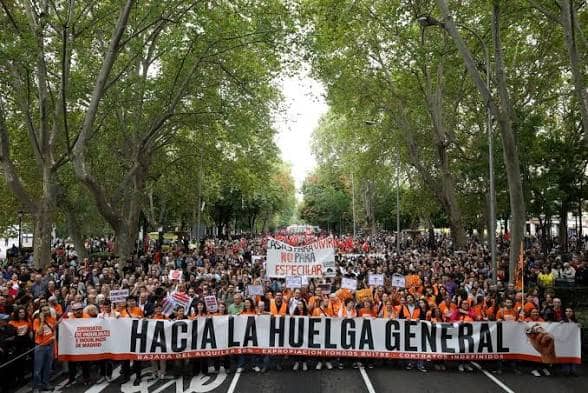
About 50 demonstrations were planned in cities including Madrid, Barcelona and Valencia on Saturday, with protesters accusing authorities of failing to adequately address rising housing costs and evictions.
In Valencia, tensions escalated between protesters and police near the Palau de les Arts Reina Sofía, where a real estate summit was taking place.
Spanish media reported that some demonstrators removed barriers and threw objects at police, who responded with rubber bullets.
Public broadcaster RTVE reported that nine police officers were injured and five people arrested during the confrontation.
The protests follow widespread public anger over the eviction in September of 87-year-old Maricarmen Abascal, who was unable to afford a sharp increase in her rent.
Her eviction triggered demonstrations across the country, with protesters demanding rent reductions, an end to evictions and restrictions on investment funds buying residential properties.
Although the company that owned Abascal’s apartment, Urbagestión, later negotiated her return to the property at a lower rent, demonstrations have continued.
Housing measures rejected
Prime Minister Pedro Sánchez’s minority coalition government suffered a setback in Congress on Friday after lawmakers rejected two emergency housing decrees.
The first decree, which was defeated by 178 votes to 172, proposed suspending evictions of vulnerable tenants until 2030, extending certain rental leases by two years, increasing taxes on tourist apartments and restricting residential property purchases by investment funds.
A second decree, which included automatic renewal of rental contracts, was rejected by 184 votes to 166.
The governing Socialist Party and its junior coalition partner, the Sumar alliance, do not hold a parliamentary majority and rely on support from smaller parties to pass legislation.
The conservative People’s Party and Vox had already opposed the measures, while Together for Catalonia (JxCat) also indicated its opposition before the vote.
Huge turnout in Madrid
Madrid has emerged as the centre of the demonstrations, with tens of thousands of protesters filling major streets.
Estimates of the crowd size differed significantly. Madrid’s Tenants’ Union claimed about 500,000 people attended, while government officials put the figure at around 70,000.
Some protesters have also maintained an encampment at Puerta del Sol, one of the capital’s main public squares.
One demonstrator, David, told RTVE: “We’re not here for pleasure or comfort. We’re here out of conviction.”
Another protester, 26-year-old librarian Marcos Sainz, said the cost of renting in Madrid had become increasingly difficult.
He said he previously shared a two-bedroom apartment with friends for €900 a month, but that a one-bedroom apartment can now cost about €1,000.
Housing shortage drives rising costs
The protests come amid a severe shortage of housing in Spain.
The Bank of Spain estimates that the country has a housing shortfall of about 700,000 homes, based on the difference between demand and new construction.
Data from Spain’s national statistics institute, INE, showed house prices increased by 12.2% in the year to the second quarter of 2026.
Meanwhile, rental costs rose by 8.5% in 2025, according to property firm Idealista. Madrid recorded a 9.7% increase.
Barcelona and Madrid remained among Spain’s most expensive cities for renters, with average rents reported at €23.80 and €22.70 per square metre respectively.
The defeat of the housing measures has also fuelled speculation about the political future of Sánchez’s government and whether an early general election could be called, although the next election was not due until next summer.






Leave a Reply