
By George Omagbemi Sylvester
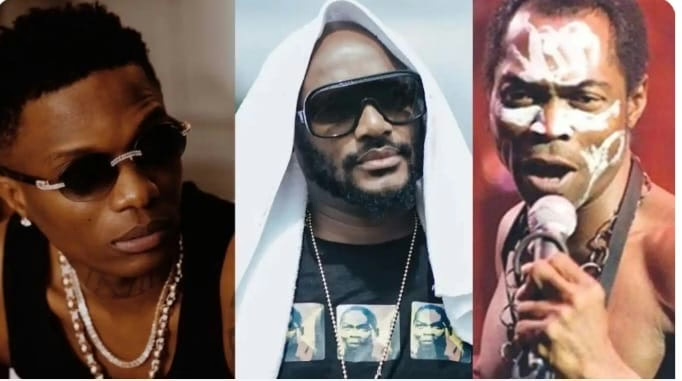
A fresh debate over musical legacy and generational impact has erupted in Nigeria’s entertainment industry after veteran singer Innocent Ujah Idibia, popularly known as 2Baba, described comparisons between Afrobeats superstar Ayodeji Balogun, known globally as Wizkid, and the late Afrobeat icon Fela Aníkúlápó-Kuti as “ridiculous” and “disrespectful.”
The controversy stems from recent exchanges between Wizkid and Seun Kuti, Fela’s son and a prominent Afrobeat musician, which triggered widespread online arguments among fans and industry figures. According to multiple Nigerian media reports, the dispute escalated after Wizkid reportedly claimed he was “bigger” than Fela while responding to criticisms from Seun Kuti and members of his fanbase.
2Baba, one of Africa’s most respected contemporary musicians, weighed in during a recorded segment of the Mic On podcast hosted by journalist Seun Okinbaloye. In the widely circulated clip, the “African Queen” crooner dismissed the entire comparison as misguided and unfair to both artists.
“Comparing Fela with Wizkid is ridiculous. Apart from the fact that it is disrespectful to Fela, at the same time it is also unfair to Wizkid,” 2Baba said, noting that both men belong to entirely different musical eras with distinct missions and contexts.
His remarks quickly went viral across social media and were widely reported by Nigerian news outlets, further amplifying an already heated debate about legacy, influence and the meaning of greatness in African music.
The argument did not begin with 2Baba. It had been building for weeks, largely fueled by exchanges between Seun Kuti and Wizkid’s fans, popularly known as Wizkid FC. Seun had earlier criticized the practice of labeling contemporary artists as the “new Fela,” insisting that such comparisons misunderstand his father’s historical role.
“My father was not just a musician, he was a movement,” Seun said in one of the widely circulated videos, urging fans to allow each artist to exist in their own space without forced parallels.
The debate gained fresh momentum after Fela Aníkúlápó-Kuti was posthumously honored with the Grammy Lifetime Achievement Award at the 68th Grammy Awards, making him the first African artist to receive the prestigious Special Merit recognition.
The award reignited global conversations about his legacy and influence on modern African music.
To understand the emotional weight behind 2Baba’s statement, one must consider who the individuals involved are and why their names carry such symbolic power.
Fela Aníkúlápó-Kuti, who died in 1997, is widely regarded as the founder of Afrobeat; a genre that fused jazz, funk, highlife and traditional Yoruba rhythms into a politically charged musical form. His songs were not merely entertainment; they were sharp critiques of military dictatorships, corruption and Western imperialism.
He was repeatedly arrested, harassed by security forces, and became a symbol of artistic resistance across Africa and the diaspora.
Wizkid, by contrast, represents the global explosion of Afrobeats, the contemporary pop-leaning genre that has dominated international charts over the past decade. With Grammy wins, sold-out world tours and collaborations with major Western artists, he has helped bring African pop music into the global mainstream.
2Baba, born in 1975, occupies a crucial middle ground. Rising to prominence in the late 1990s and early 2000s, he became one of the pioneers of modern Nigerian pop, especially after the success of his hit song “African Queen.” His career spans the transition from the era of Fela’s political Afrobeat to the globalized Afrobeats movement led by artists like Wizkid and Burna Boy.
It is precisely this generational vantage point that gives weight to his intervention in the debate.
According to multiple reports, 2Baba stressed that placing Fela and Wizkid side by side ignores the vast differences in their historical contexts, artistic objectives and cultural impact.
Fela, he implied, was not simply a musician competing for chart positions but a political figure whose art functioned as a revolutionary platform.
Music scholars have long drawn similar distinctions. Ethnomusicologist Veit Erlmann once described Fela’s Afrobeat as “a musical revolution wrapped in rhythm,” noting that its purpose extended beyond entertainment into the realm of social agitation.
Likewise, cultural historian Tejumola Olaniyan wrote in his seminal study Arrest the Music! that Fela’s performances were “political rallies disguised as concerts,” where music served as a tool of resistance.
From that perspective, comparing Fela’s legacy to a contemporary pop star (even one as successful as Wizkid) risks flattening history into a simplistic contest of popularity.
At the same time, 2Baba was careful not to diminish Wizkid’s achievements. By describing the comparison as “unfair” to the younger artist, he underscored that Wizkid’s influence should be evaluated within the realities of the modern music industry, not against the revolutionary politics of the 1970s and 1980s.
Industry observers note that the two artists operate in entirely different ecosystems. Fela performed in an era of military rule, censorship, and physical repression, where music could provoke state violence. Wizkid, on the other hand, operates in a digital, globalized marketplace where streaming numbers, endorsements and international collaborations define success.
This distinction echoes the words of Nigerian cultural critic Benson Idonije, Fela’s former manager, who once observed that “Fela’s music was not meant to be comfortable; it was meant to disturb.” By contrast, modern Afrobeats has largely thrived as a commercial, dance-oriented genre designed for global consumption.
The controversy also reflects a broader cultural tension between generations. Many younger fans measure greatness through streaming records, chart positions and international awards, while older audiences often judge influence through social impact and political courage.
In this context, 2Baba’s intervention appears less like a defense of one artist over another and more like a plea for historical perspective.
The names central to the controversy are clear. Innocent “2Baba” Idibia is the veteran singer who made the statement. Ayodeji “Wizkid” Balogun is the contemporary Afrobeats superstar whose comments triggered the debate. Seun Kuti, son of Fela Aníkúlápó-Kuti, is the musician who initially challenged the comparisons. And at the center of the storm stands the late Fela himself, whose legacy continues to shape African music decades after his death.
What happened was a public disagreement over musical legacy. Where it happened was largely on social media platforms and in interviews, particularly the Mic On podcast where 2Baba made his remarks. When it happened was in early February 2026, following the Grammy Lifetime Achievement Award given to Fela. Why it happened stems from fan-driven comparisons and statements attributed to Wizkid claiming greater stature. And how it unfolded was through online exchanges, celebrity reactions and media coverage across Nigeria’s entertainment press.
In the end, 2Baba’s message was simple but resonant: legends should not be forced into artificial rivalries across generations.
As Nigerian music continues its global ascent, the debate serves as a reminder that success can be measured in many ways as we as through charts, through cultural influence or through the courage to challenge power. For Fela, that courage defined a lifetime. For Wizkid, global dominance defines a generation. And for 2Baba, the space between those two worlds may be where the true story of modern African music lies.





Leave a Reply